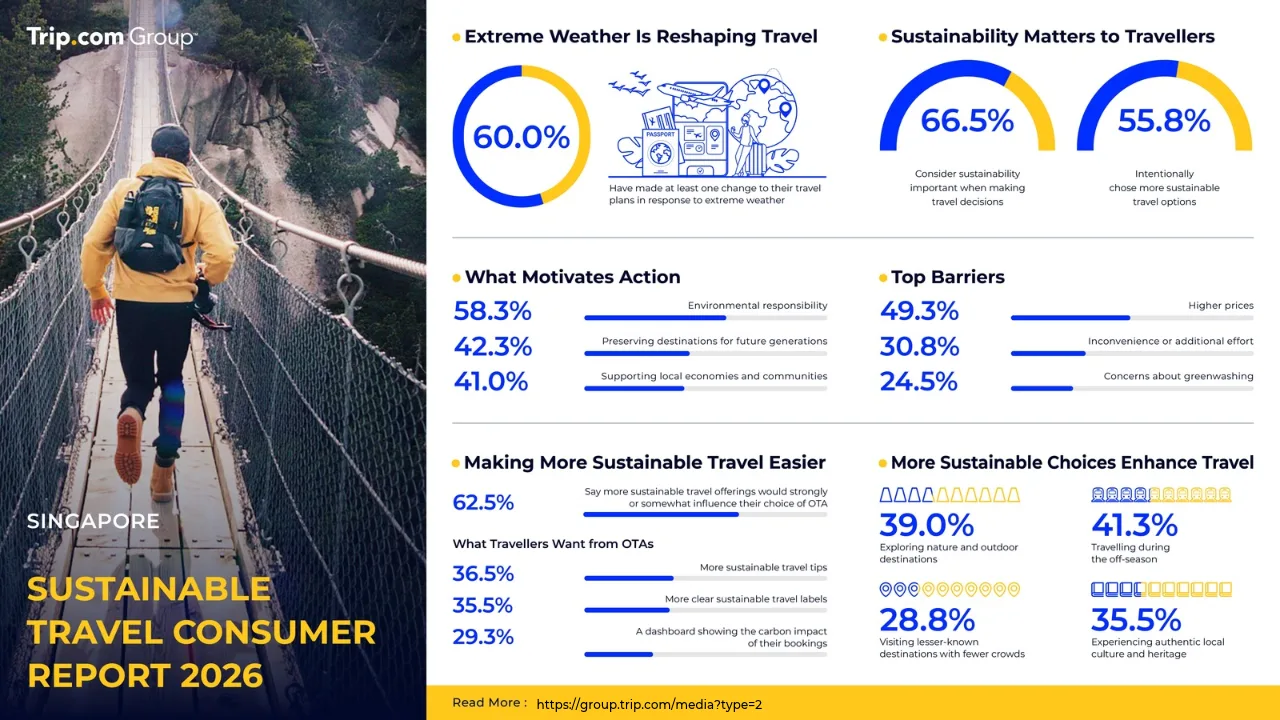
Trip.com Group‘s 2026 Sustainable Travel Consumer Report, released in Singapore on 28 October 2026, found that 49.3% of Singapore travellers name higher prices as the biggest thing stopping them from picking the more sustainable option.
That price figure sits under a much sunnier headline number. According to Trip.com Group’s 2026 Sustainable Travel Consumer Report, 55.8% of Singapore travellers now intentionally choose more sustainable travel options, and 66.5% say sustainability matters when they make travel decisions. Alongside the report, the company is introducing My Travel Impact, a dashboard in the Trip.com app that collects a user’s greener hotel, flight and rail choices in one place. For anyone travelling on a budget, the real question is whether a dashboard does anything about the price tag.
Who Got Asked
The full report is based on a survey of 8,777 respondents across 29 markets in four regions: Asia Pacific; Europe, the Middle East and Africa; Latin America; and North America. Singapore is one of those markets, and the release breaks out a set of Singapore-specific findings from the wider data, which the report labels “global” when it covers the whole surveyed sample.
Set the two side by side and Singapore comes across as the more wallet-watching crowd. Globally, 75.4% say sustainability is important and 56.8% intentionally choose greener options, so the share of people here who act on it is roughly in line with everyone else. The share who say it matters trails the global figure by almost nine points. The bigger gap is price: 37.1% of all respondents call it their top barrier.
Weather Is Rerouting Trips
The urgency comes from the forecast as much as from the conscience. Trip.com Group says 60% of travellers have made at least one change to their travel plans because of extreme weather. The global breakdown in the report shows 29.9% delayed or rescheduled a trip, 23.6% shifted the season or timing of travel, and 21.9% switched destinations altogether.
That’s no longer an abstract climate statistic. It’s the reason your next holiday might move, and it explains why sustainability is creeping into booking decisions in the first place.
What Moves Singapore, What Stops It
Singapore travellers know why they’d go green. Environmental responsibility tops the list of motivations at 58.3%, followed by preserving destinations for future generations (42.3%) and supporting local economies and communities (41%), according to the release.
The barriers are just as clear. After price comes inconvenience or additional effort (30.8%), then concerns about greenwashing (24.5%), which means companies making environmental claims that don’t hold up. That last number deserves attention, because close to one in four Singapore travellers doesn’t fully trust the labels in front of them. Any tool that wants to close this gap has to earn that trust before it can change anyone’s booking.
How the Dashboard Works
Trip.com says My Travel Impact gives an overview of the more sustainable choices a traveller has made through Trip.com, split across three parts of a trip. The fine print in the report matters here, so it’s worth going through each one.
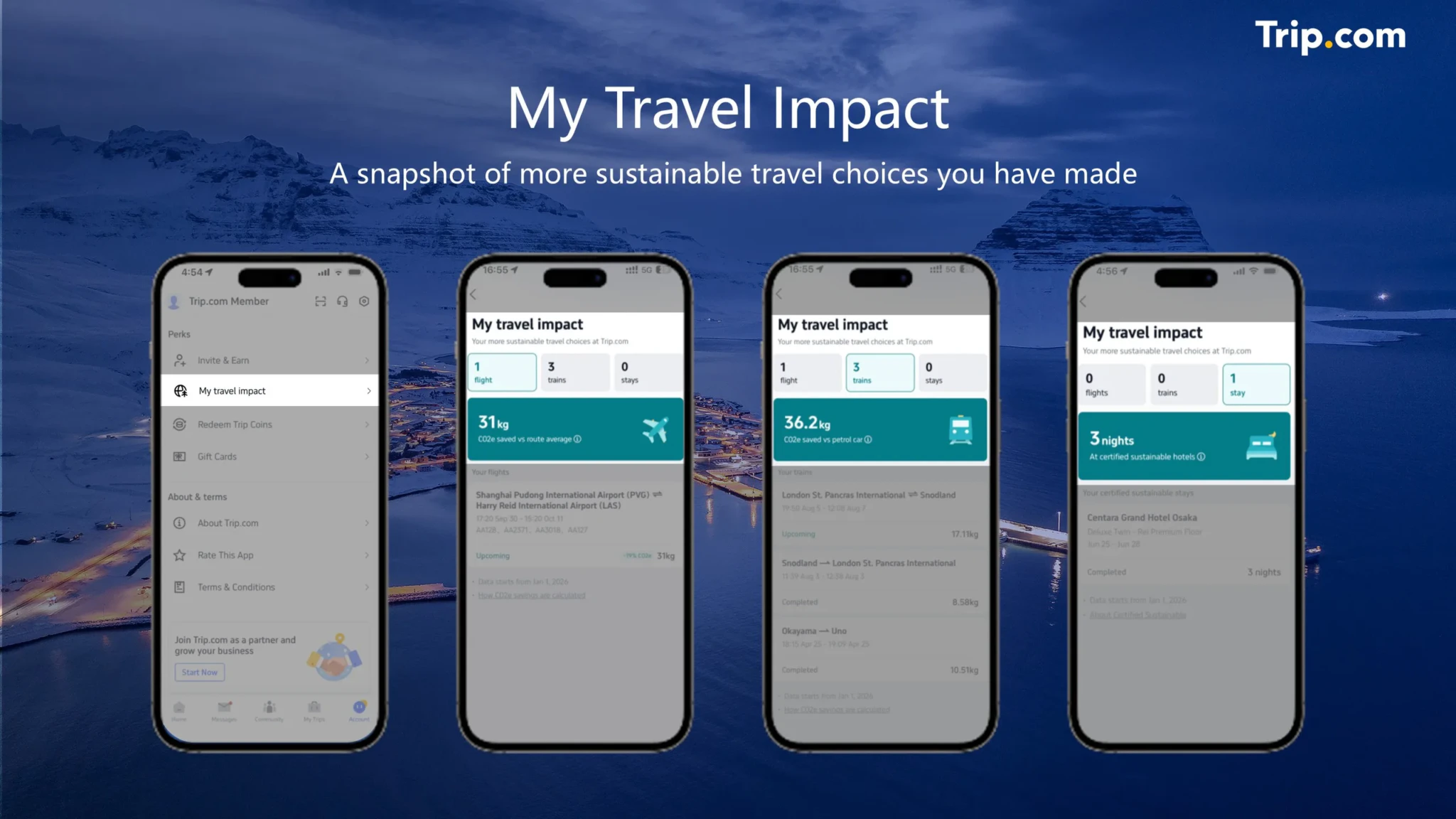
Hotels: The dashboard counts nights stayed at properties carrying Trip.com’s Certified Sustainable label. The report says only hotels and other accommodation that hold a certification accredited by the Global Sustainable Tourism Council (GSTC) are eligible, which is a meaningful answer to the greenwashing worry. A third-party standard carries more weight than a hotel describing itself as “eco-friendly”.
Flights: It shows estimated emissions avoided by choosing lower-emission flight options, where comparable data exists. The figures use the Travel Impact Model, which the report says was developed by Google in collaboration with the Travalyst coalition.
Rail: It estimates savings from choosing rail over a gasoline car, where comparable data exists. According to the report, this uses UK Government conversion factors from DEFRA (the Department for Environment, Food and Rural Affairs) and applies to selected European rail services. In practice, a Singapore traveller is most likely to see rail figures on a Europe trip.
Does It Fix the Price Gap?
In short, no, and the survey explains why. When Singapore travellers were asked what they want most from online travel agencies (OTAs), sustainable travel tips came first at 36.5%, clearer sustainable labels second at 35.5%, and a carbon dashboard third at 29.3%. My Travel Impact answers the third request directly and supports the second through the GSTC-backed hotel label. What it can’t do is change what a greener room or flight costs.
The dashboard is a record of choices already made through Trip.com, and its transport numbers are estimates rather than measured reductions. That makes it useful for the trust problem and for seeing your own habits. It does nothing for the 49.3% who simply find the greener option too expensive.
The report admits as much. Globally, 59.2% say they’d pay some premium for a more sustainable trip, but 50.6% cap it at 10%. Its own conclusion is blunt: if greener choices are consistently pricier, less convenient or lower quality, intentions may struggle to translate into action. Younger travellers are the most open, with 69.3% of Gen Z and 62.6% of Millennials willing to pay a premium, and Gen Z leading on action at 69.5%. Even so, a modest premium has a ceiling. The dashboard helps people trust the green option, but only a lower price will get most of them to book it.
Greener Doesn’t Mean Pricier
The more encouraging finding is how Singapore travellers want to travel. When asked which more sustainable choices would improve their trip, Singapore travellers pointed to travelling during the off-season (41.3%), exploring nature and outdoor destinations (39%), and authentic local culture and heritage (35.5%), followed by lesser-known destinations with fewer crowds (28.8%).
Two of these are worth picking out. Off-season travel ranks far higher here than in the global sample, where it lands at 29.6%. That suggests Singapore travellers are already thinking about when they go and not only what they book. Lesser-known destinations matter for the same reason: both are choices about timing and place rather than a premium product. The report makes the point itself: sustainability doesn’t have to mean giving something up or paying more.
If you’re curious where your own bookings land, the My Travel Impact dashboard sits in the Trip.com app, and the full 2026 Sustainable Travel Consumer Report is worth a scroll for the generational breakdowns alone. The bigger takeaway from the numbers is that a greener trip often comes down to shifting your dates or choosing a quieter town, so the cheapest sustainable choice might already be on your calendar!
Cover Photo by Damir Korotaj on Unsplash; visuals courtesy of Trip.com Group.
Read us first on Google: add DANAMIC as a preferred source and our stories show up more in your Top Stories and AI results.