Djordjo Cetkovic, the Serbian chef running the kitchen at Pano Kato Grill, Pizza & Deli in Tanglin Mall, answered six written questions from DANAMIC by email on 3 November 2026. His answers cover what changes when you move a career’s worth of cooking to Singapore, and they end with a dish any home cook here can make with ingredients from the neighbourhood supermarket.
Cetkovic (also written Dordjo Cetkovic, or Đorđo Ćetković in Serbian) is a Singapore permanent resident (PR), Ambassador for Asia for the Culinary Federation of Serbia, and the author of The Grand Heritage Cookbook. His career runs through professional kitchens in Europe and Asia. The question at the heart of his answers is one that anyone who has changed jobs, countries or even teams will recognise: what do you have to learn all over again?
Singapore Weather Rewrites the Recipe
Most chefs arriving from Europe expect new ingredients and new diners. What catches them out is the air. Cetkovic puts it plainly: “Dough develops differently, fresh herbs lose their freshness quickly, and dairy needs careful handling.”
His answer to that is a change in rhythm. According to Cetkovic, the kitchen works in smaller batches and runs texture checks through the day rather than trusting that something prepped in the morning will behave the same way by dinner. That is a shift in mindset for anyone trained somewhere cooler, where a tray of dough or a bunch of herbs can sit a little longer without drama.
Home cooks in Singapore will know a milder version of this. Coriander that looked perky at the wet market can droop within a day, and the bread dough recipe that worked fine in an overseas YouTube video tends to race ahead in a non-air-conditioned HDB kitchen. Cetkovic’s fix (cook less at a time, check more often) holds up just as well at home as it does in a restaurant.
Show, Taste, Then Explain
The second thing he had to relearn was how to lead a mixed team, where cooks come from different countries and food cultures and do not share the same reference points. His approach, as he describes it, runs in a set order: show the finished result, taste it together, and then explain the reason behind it.
“Good leadership begins with making the standard understandable,” Cetkovic says.
That line is worth sitting with, because it puts the burden on the person giving the instruction rather than the person receiving it. A head chef who shouts “Not like that!” across the pass has told a cook that something is wrong without telling them what right looks like. Cetkovic’s version asks the leader to do the harder work first, and anyone who has ever had a vague manager will appreciate how rare that is.
Teaching Words Nobody Grew Up With
Then there are the dish names. A Greek and Serbian menu carries words that most cooks in Singapore did not grow up hearing, and a name means nothing if the person at the station cannot picture the plate.
Cetkovic says he teaches the Greek and Serbian names through the method itself. That means demonstration, tasting, written quantities and reference photographs, so the word becomes attached to something a cook has seen, eaten and measured. It is a sensible system for an unfamiliar vocabulary: the name sticks because the cook has a memory of the dish to hang it on, not because they memorised a list.
The Moussaka Test
Moussaka, the Greek baked dish of layered aubergine, spiced meat sauce and a creamy topping, is where Cetkovic makes his clearest point about turning experience into instructions that survive a busy service.
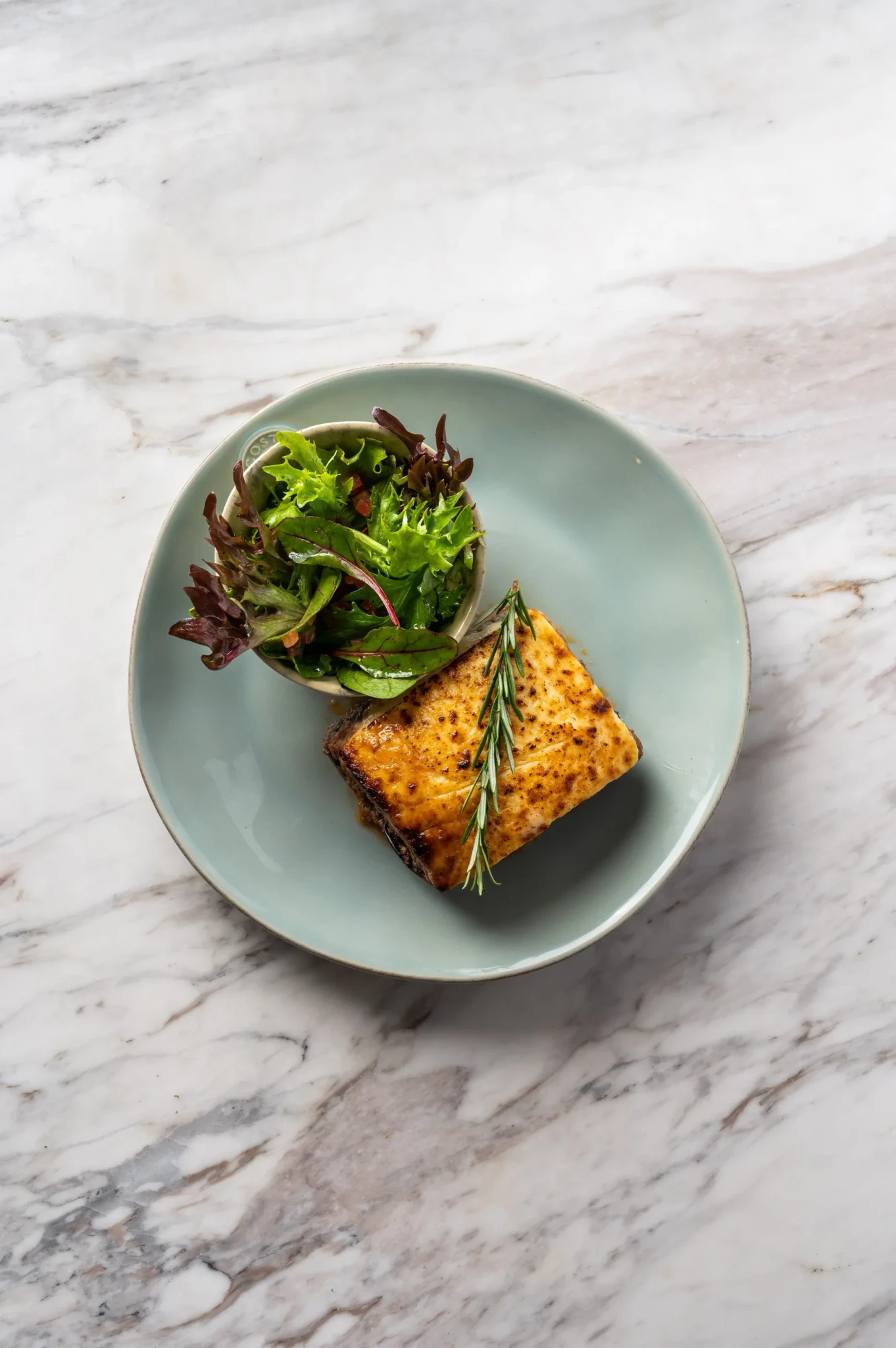
“If I only say, ‘Make a good moussaka,’ I have left too much inside my own head,” Cetkovic says.
That sentence is the most useful thing in the whole interview, and it applies well beyond kitchens. Every experienced cook knows what “good” means to them: the thickness of each layer, how set the top should be, when it is ready to slice. None of that travels unless someone writes it down, weighs it and photographs it. Cetkovic’s point is that knowledge stuck in the head chef’s memory disappears the moment the head chef has a day off, and that a station needs the knowledge put into it directly.
For young professionals in any field, it is a handy test. If your instructions only work when you are standing next to the person following them, you have not finished writing them!
Serbian Hospitality in a Greek Kitchen
Cetkovic’s Greek cooking comes partly from his time cooking in Greece, including on the island of Thasos in the northern Aegean. He brings a Serbian sense of hospitality to it, and his answers draw lines between the two food cultures that make the menu feel less like two separate cuisines and more like close cousins.
Serbian sarma (cabbage leaves rolled around a filling) sits alongside Greek dolmades (stuffed vine leaves), the same idea of a wrapped, slow-cooked parcel worked out by neighbouring kitchens. Serbian ražnjići, grilled meat skewers, have an obvious match in Greek skewers, and Singaporeans already raised on satay will find nothing strange about meat on a stick over fire. Then there is Yia Yia’s Moussaka (yiayia is Greek for grandmother), a name that tells you exactly the kind of homely, generous cooking it is aiming for.
What makes these pairings useful in a Singapore kitchen is that they give a cook a bridge. A team member who has never heard of sarma can understand it faster once it is placed next to a dish they have already learned, and that links neatly back to his method of teaching names through food rather than vocabulary drills.
Inside the 299-Page Cookbook
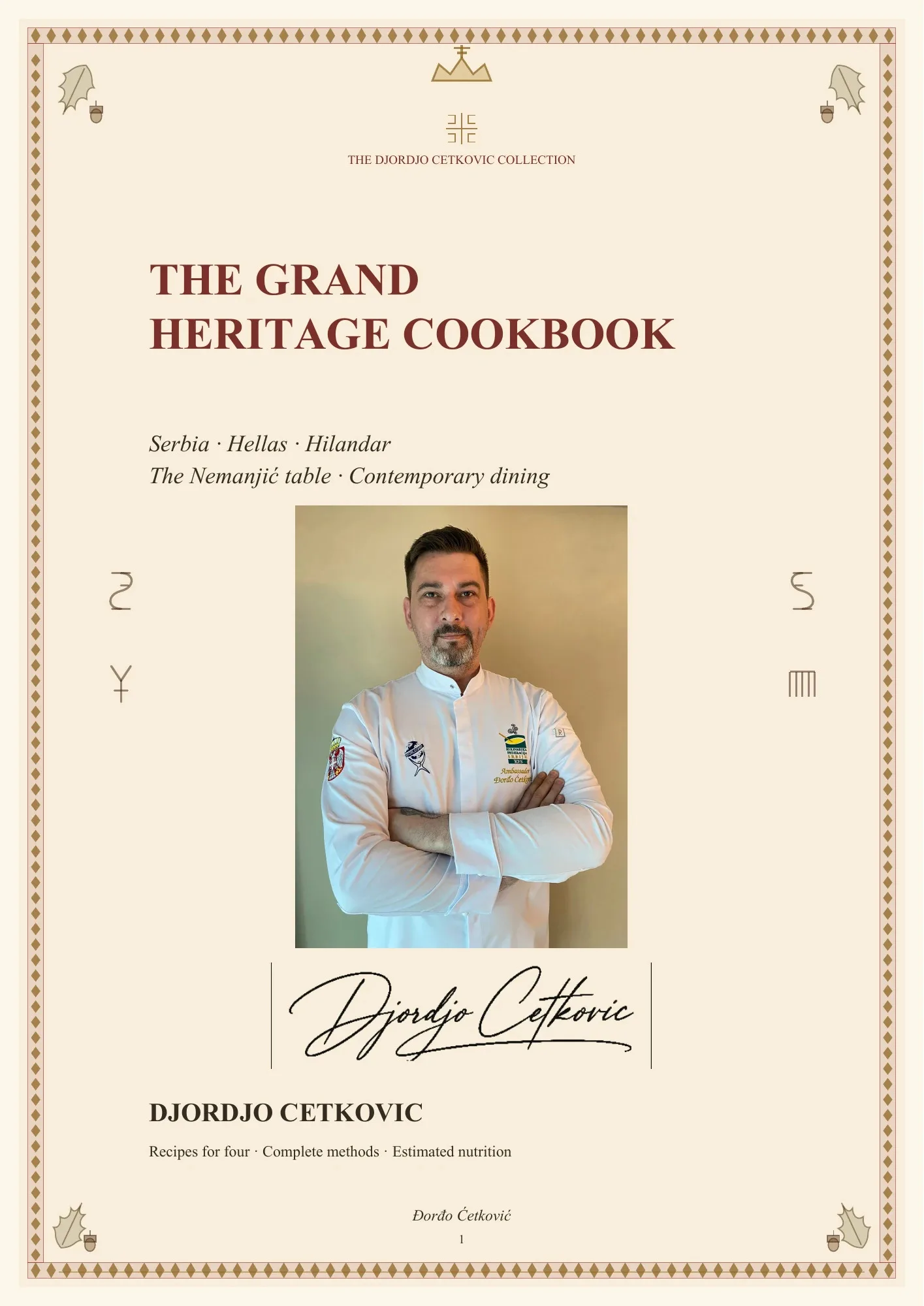
Away from the restaurant, Cetkovic has put his heritage on paper in The Grand Heritage Cookbook, which, by his own account, runs to 299 pages and 145 recipes across five sections (these are Cetkovic’s figures; the book is read online on his site):
- Serbian Heritage: 40 recipes
- Hellenic Heritage: 40 recipes
- Hilandar-inspired Lenten table: 25 recipes
- Historical reconstructions around the table of Stefan Nemanja: 15 recipes
- Contemporary creations: 25 recipes
A little context helps here. Hilandar is a Serbian Orthodox monastery on Mount Athos in Greece, and the Lenten section draws on the fasting tradition, when Orthodox Christians cook without meat. Stefan Nemanja was a medieval Serbian ruler, and the 15 dishes built around his table are interpretations, Cetkovic’s reconstructions of what such a meal could have been rather than recipes copied from a surviving source. That is an honest way to frame historical cooking, and it makes the section more interesting, since readers can see a chef reasoning his way back through the centuries.
For anyone curious, the most approachable entry points are the two heritage sections, which hold 80 recipes between them and cover the everyday Serbian and Greek cooking that informs his restaurant work. The Lenten chapter is the one to bookmark if you eat mostly plant-based, because meat-free cooking is the entire point of it. The cookbook is available for online reading through the complete cookbook page on Cetkovic’s site.
The Peppers You Can Make Tonight
Here is the part for home cooks. Cetkovic’s pick for Singapore readers is posne punjene paprike, Lenten stuffed peppers filled with mushrooms and rice. Posne means fasting-friendly, and punjene paprike simply means stuffed peppers.
According to Cetkovic, the dish comes together from what a local supermarket stocks: peppers, mushrooms and rice. The recipe sits within the Lenten tradition his cookbook explores, so it is a gentle first taste of that chapter too.
He sums up the spirit of it in one line: “Sometimes a pepper, a patient cook and a table to share are enough.”
Why His Answers Stick
Strip away the moussaka and the medieval kings, and Cetkovic’s answers describe something most people living in Singapore have done in their own way. You arrive with skills that worked somewhere else, discover the weather, the team and the language all behave differently, and then rebuild your habits so they work here. His version involves smaller batches, tasting with the team and writing down what used to live in his head, and it is refreshingly practical advice from someone who clearly thinks about how knowledge moves from one person to the next.
Start with the peppers, since they need nothing more than a supermarket run and some patience, then browse The Grand Heritage Cookbook on Djordjo Cetkovic’s official site to find your next dish. A Serbian chef has handed Singapore home cooks a fasting-season classic built from mushrooms, rice and peppers, and that is a generous place for anyone to begin!
Photos and Visuals courtesy of Djordjo Cetkovic / personal archive; cookbook cover: The Grand Heritage Cookbook / Djordjo Cetkovic.
Read us first on Google: add DANAMIC as a preferred source and our stories show up more in your Top Stories and AI results.