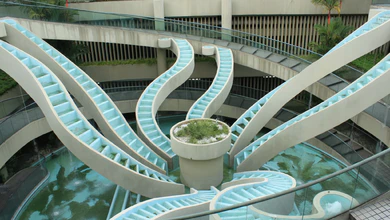
National Gallery Singapore has a free listening corner on Level 2 of its City Hall Wing, right outside Singapore Stories: Pathways and Detours to Art, and it’s very easy to walk past. The Soundscapes of Art listening space plays four original pieces by local Chinese music company The TENG Company, each written about an artwork on view a few steps away. A second version of the same music plays in the Gallery’s Calm Room on Level B1. Both are piloted for eight months from October 2026, so this is a limited window for anyone who wants a breather in the middle of a busy museum day.
This is the first time the Gallery and TENG have worked together, and it’s the Gallery’s first music commission as part of its arts and wellbeing programming. The museum has form in this area. In December 2025, the Jameel Arts & Health Lab, working with the World Health Organisation (WHO), named it Asia’s first Healing Arts Centre of Excellence.
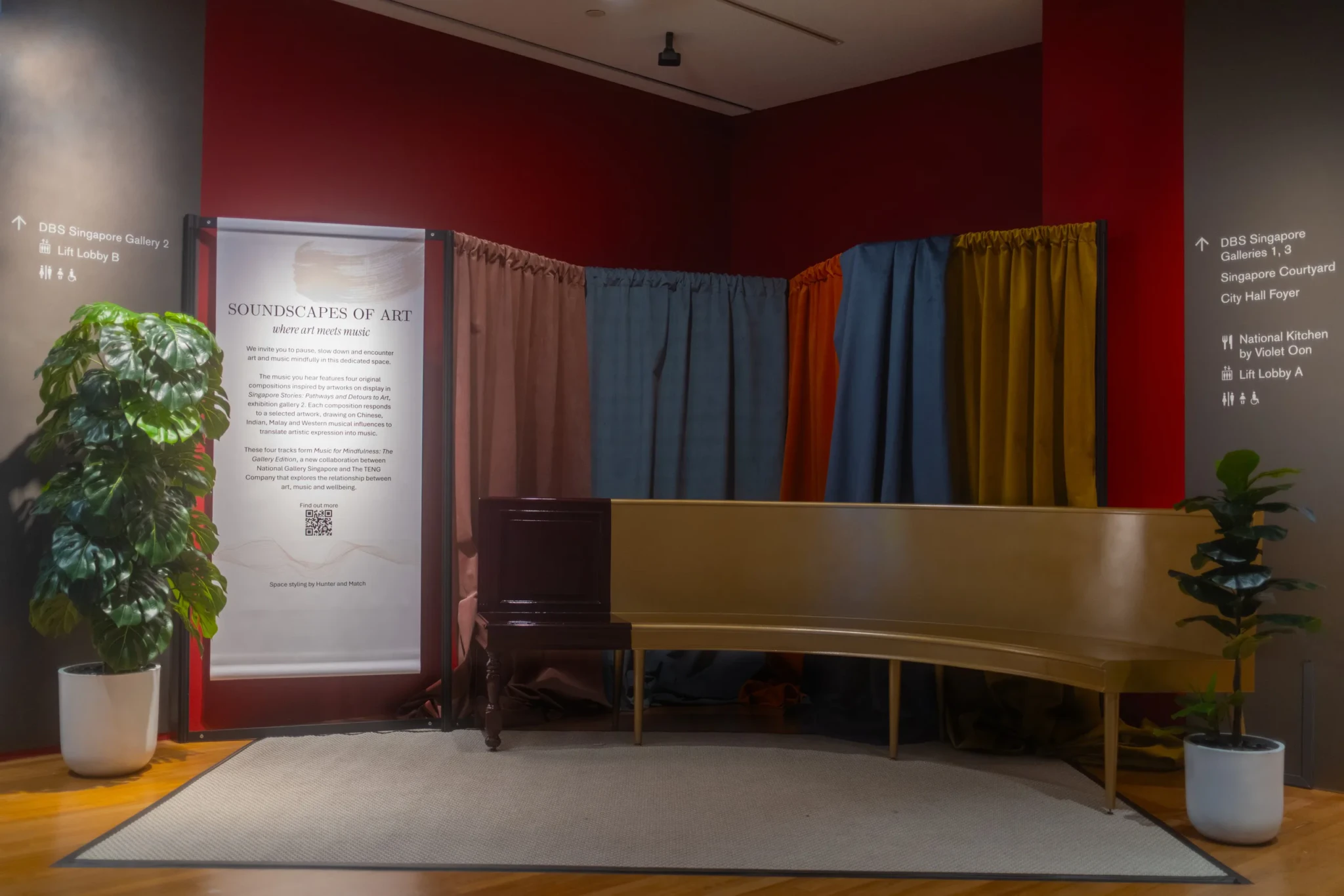
Four Artworks, Eight Instruments
TENG wrote one track for each of four works in Singapore Stories: Tan Ping Chiang’s Music (1979), Khoo Sui Hoe’s Sunbathing on Quilts (1977), Abdul Ghani Hamid’s The Face in Meditation (1975), and Jaafar Latiff’s Vision 1/86 (1986). An art therapist helped pick works that inspire positive emotions, and a music therapist gave input as the compositions took shape.
The guzheng, pipa, erhu, and sheng play alongside the bansuri, accordion, cello, and keyboard, so Chinese, Malay, and Indian influences share every track. Alicia Teng, Deputy Director of Community & Access at National Gallery Singapore, told us in written answers that this blend was what stood out when the final tracks arrived. “What struck me was how Singaporean it sounded with the different multicultural instruments blending and how each track captured the essence of each of the four artworks,” she said.
Her favourite track to relax to is the one based on Sunbathing on Quilts, and if you only have time for one, that’s where to start before stepping into the exhibition to see Khoo Sui Hoe’s canvas in person. For a wider route through the show, our pick of eight must-see artworks in Singapore Stories makes a good warm-up.
How a Painting Becomes Music
We asked Dr Samuel Wong, Creative Director and Co-founder of TENG, to talk us through one artwork, and he chose Jaafar Latiff’s Vision 1/86. His first impression, he said, “wasn’t a sound, so much as movement held in stillness, with layers of colour that seem to drift and settle, like something slowly breathing.”
He’s firm that the team never copies a painting note for note. “We never try to translate a painting literally; that would be illustration, and music does something different,” he explained. The canvas’s layers became the method instead, with “quiet phrases that overlap and dissolve into one another, the way the colours do on the canvas.” Warmer tones pointed the team to the softer pipa and sheng, with the cello holding the depth beneath.
His test for whether it worked is a lovely one: “Could someone sit before the painting, close their eyes, and still feel they were inside it?” That’s a challenge anyone can try at the listening space, and it costs nothing to find out!
Two Versions, Two Jobs
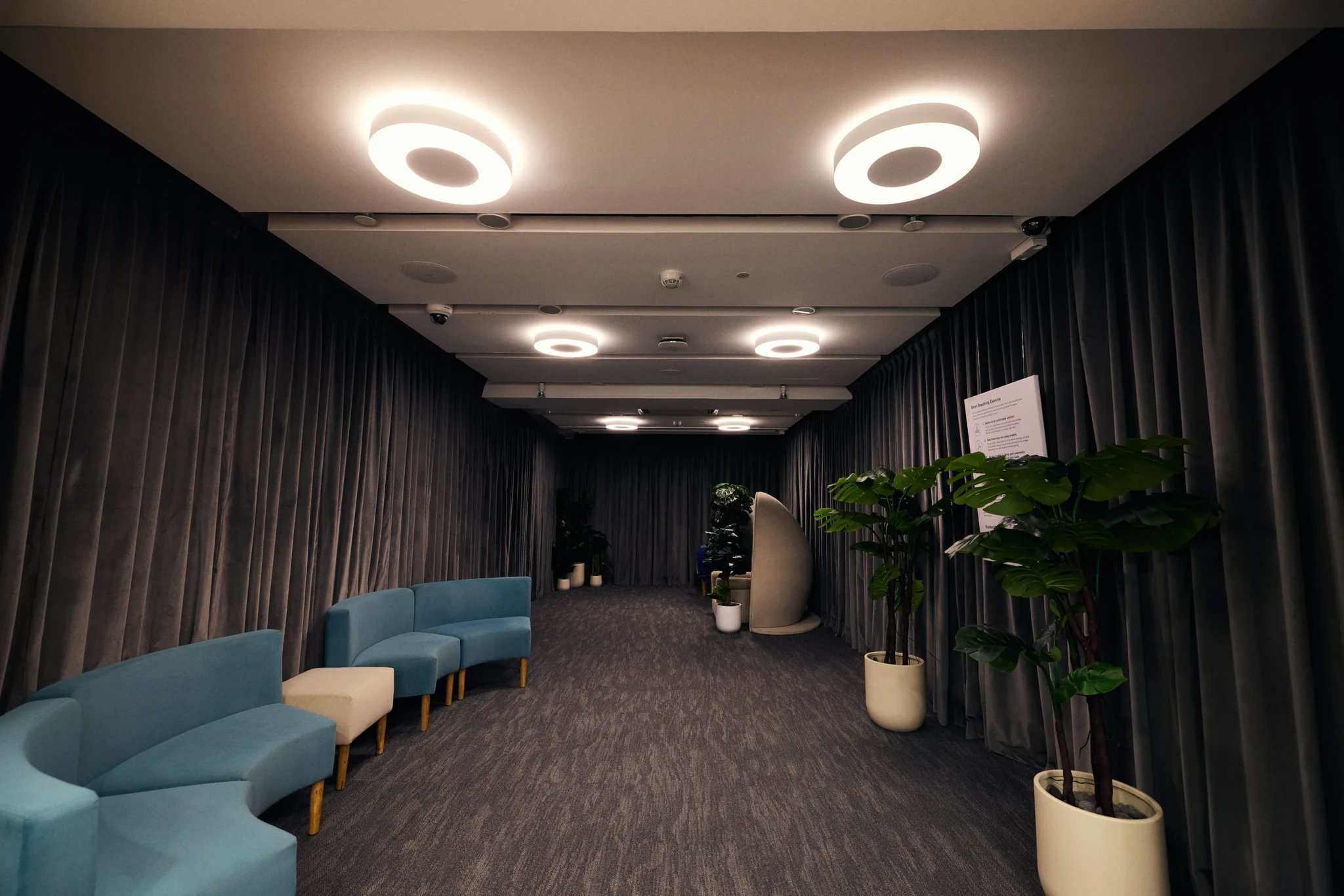
Each composition comes in two versions. The listening space plays the pure music, while the Calm Room version adds a monaural beat, which Wong describes as “a very subtle, slow pulse created within the sound itself,” tuned to a low frequency associated with deep relaxation. “You don’t so much hear it as feel it,” he said.
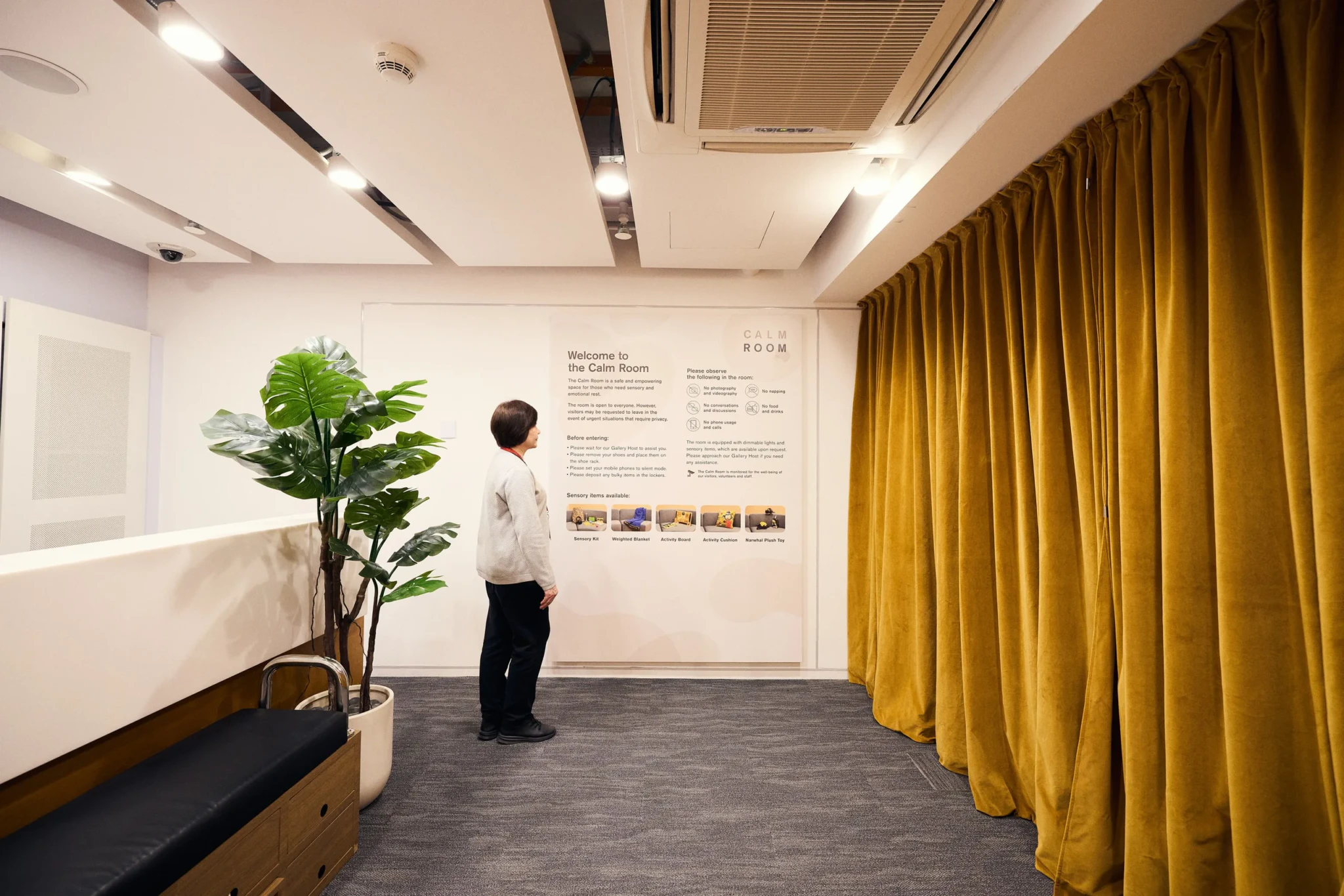
Unlike the better-known binaural kind, monaural beats don’t need headphones and can fill a quiet room on their own. “The effect depends on a still, enclosed space where someone stays long enough to feel it,” Wong explained, which is why the open, busier listening space plays the music without that layer.
The Gallery describes the Calm Room as a sensory-friendly space for visitors who feel overstimulated or overwhelmed, somewhere to calm down, regulate stress, and renew focus. Treat it as a refuge rather than a sightseeing stop, and check the Gallery’s Calm Room page before you head down to B1.
The “Wong Wong Wong” Moment
When the Gallery first piloted the compositions in the Calm Room, one visitor told staff that the “wong wong wong sound” had helped her. “We believe she was referring to the monaural beats, and it was interesting to see a visitor pick up on something that was designed to sit quite subtly within the compositions,” Alicia Teng said. A pulse built to go almost unnoticed turned out to be the part one listener remembered most.
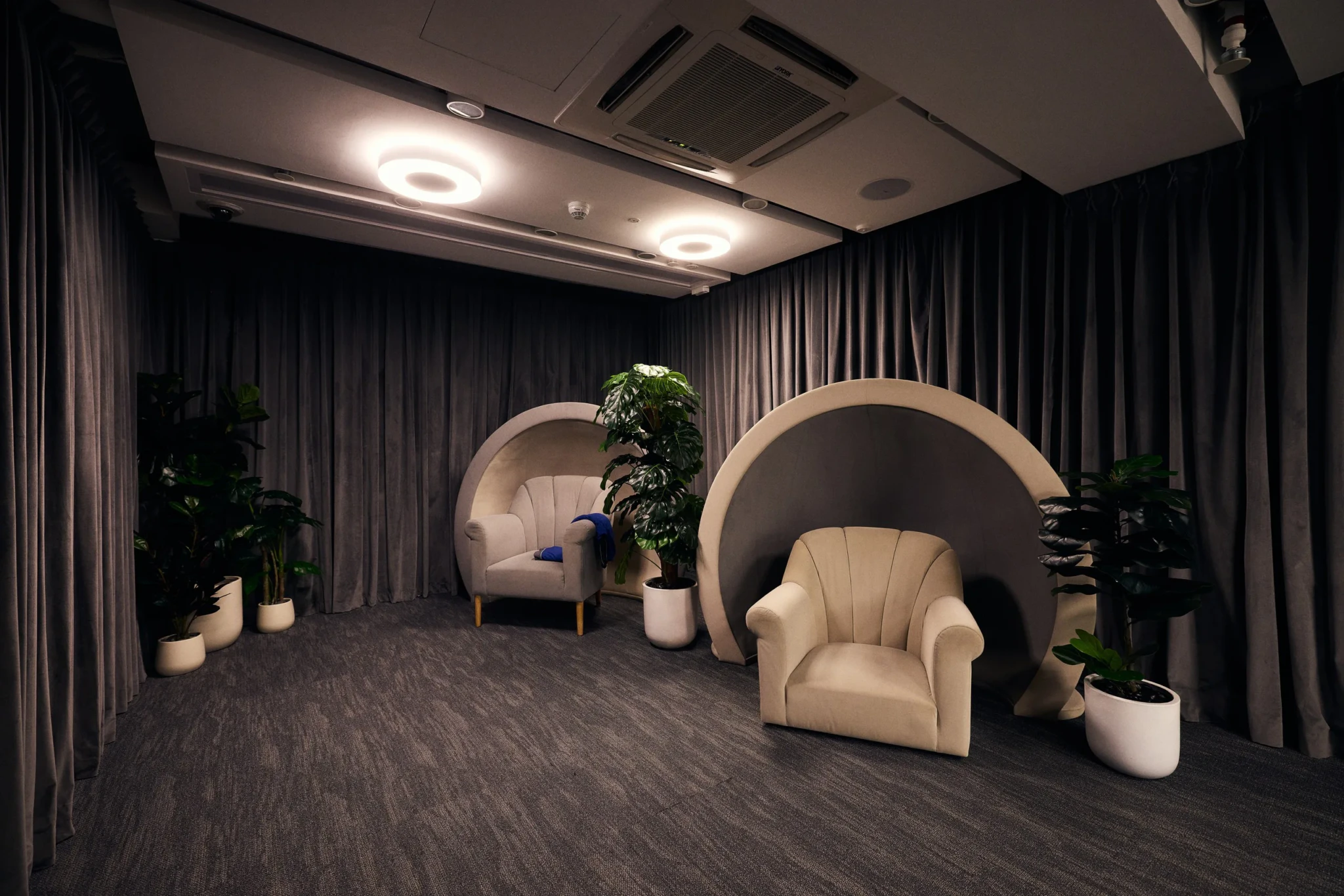
Upstairs, she describes visitors “pausing at the space to immerse in the music and to appreciate the artwork projections,” and calls the response so far encouraging.
What the Research Says
The project draws on the Gallery’s Calm Room Research Project, a 12-week study from May to July 2026 led by researcher Dr Rachel Chen, whose work covers disability studies (particularly neurodiversity) and the design of interactive environments. Her team analysed 203 hours of observation and 330 completed visitor surveys.
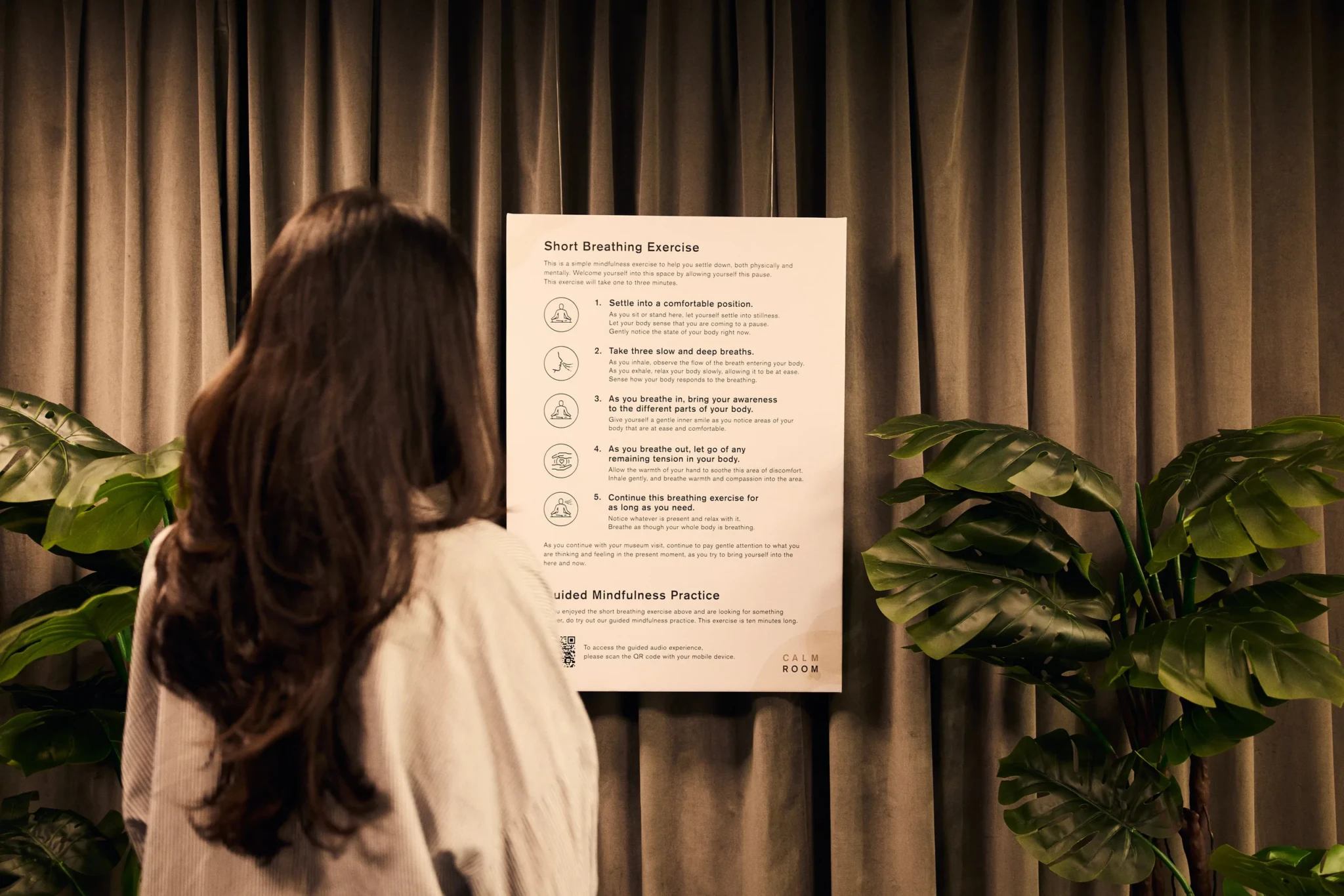
Of those respondents, 97% said they might or would use the Calm Room again, and around 25% named background music among its most helpful features. For anyone who finds museums overwhelming, that’s a good sign the room does its job.
The monaural layer comes from TENG’s 2024 research with the Singapore Institute of Technology (SIT), in which participants heard TENG’s music with monaural beats added. According to TENG, they showed better emotional regulation, lower stress, and improved inhibition toward negative stimuli.
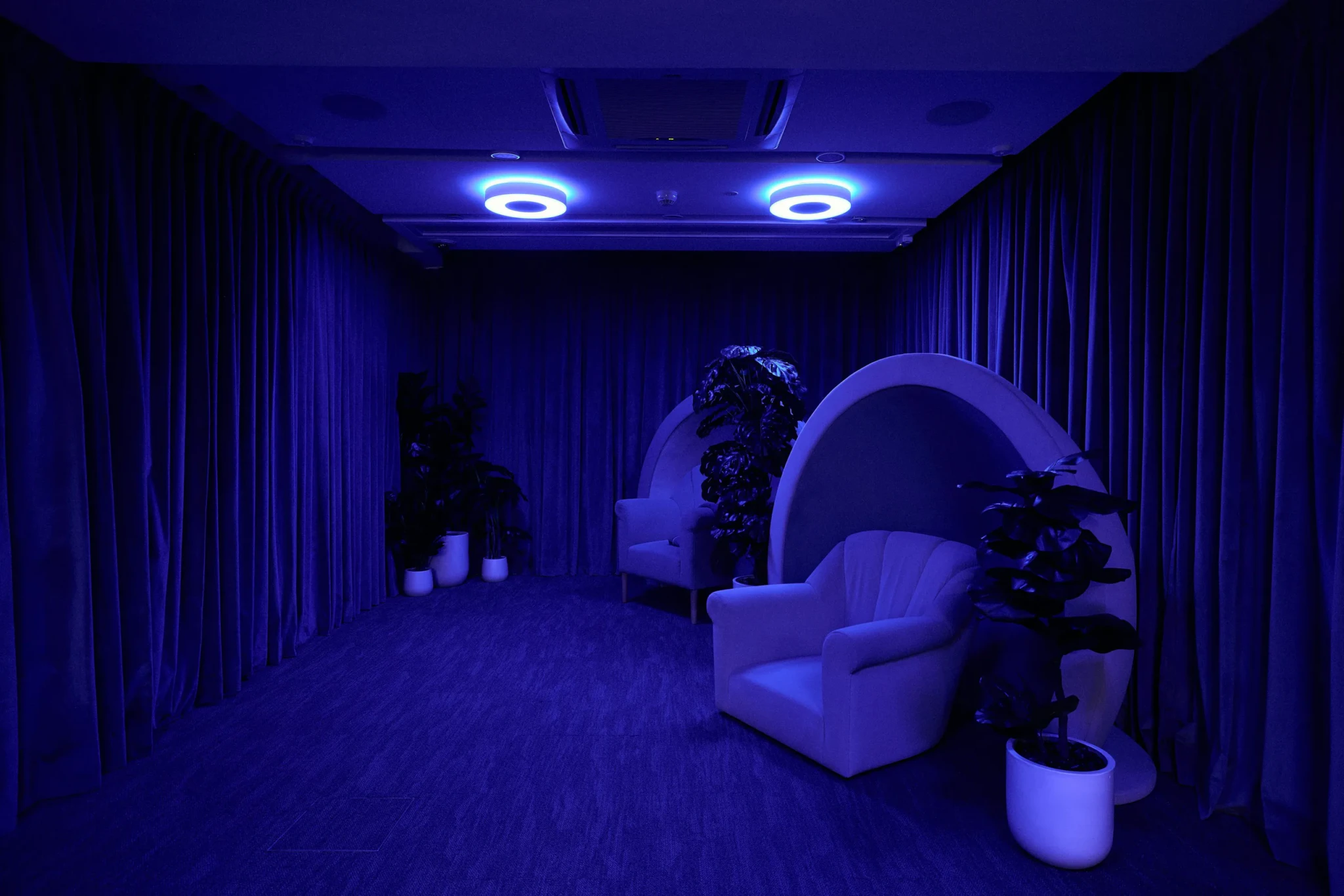
The Gallery’s own wording is careful: monaural beats have been “scientifically studied for their potential to support mindfulness.” That’s the right frame for it, a calming experience worth trying rather than a treatment.
Which Space Should You Try?
If you’re already visiting Singapore Stories, the listening space is the easy choice, because it’s free, it sits right outside the galleries, and the projections let you match each track to its artwork before you see the real thing.
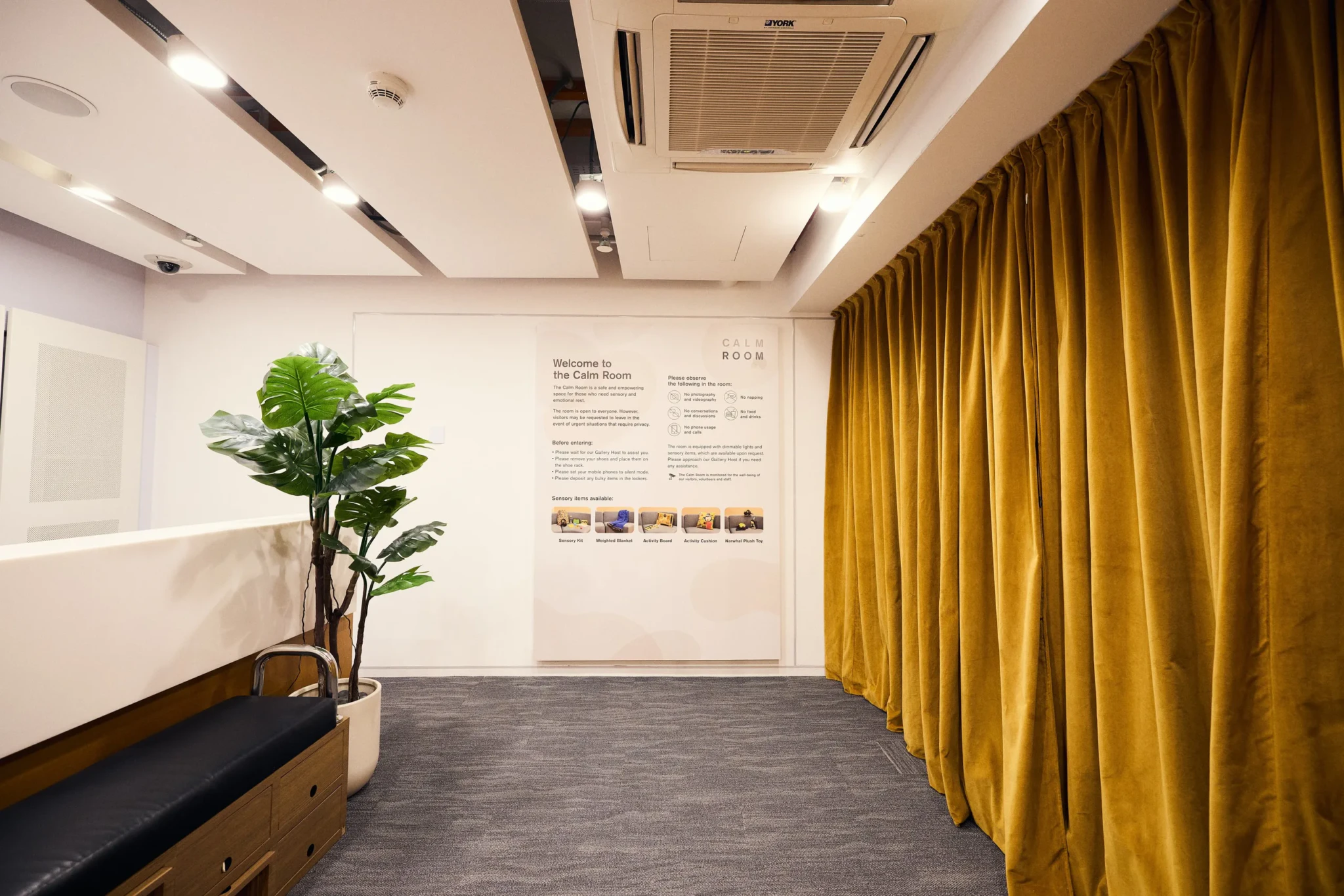
Save the Calm Room for when you need a break from sensory overload. If you’re mostly curious about the music, the listening space gives you all four compositions without the extra layer.
🗓️ Date: Ongoing (eight-month pilot from October 2026)
⏰ Time: 10am to 7pm (as listed by the Gallery for both spaces)
📍 Location: National Gallery Singapore. Soundscapes of Art listening space: City Hall Wing, Level 2, outside DBS Singapore Galleries 1 and 2. Calm Room: City Hall Wing, Level B1
💰 Entry: Free at the Soundscapes of Art listening space
🎧 Two versions: Pure music at Soundscapes of Art; monaural beat versions in the Calm Room
🖼️ See the originals: Singapore Stories: Pathways and Detours to Art, DBS Singapore Gallery 2
Four artworks, eight instruments, and two rooms add up to one of the gentlest experiences in the Civic District, and it’s here only for the eight-month pilot. Read up on National Gallery Singapore’s Calm Room, then find a seat at the listening space, close your eyes, and see whether Dr Wong’s test holds up for you!
Photos and Visuals courtesy of National Gallery Singapore.
Read us first on Google: add DANAMIC as a preferred source and our stories show up more in your Top Stories and AI results.