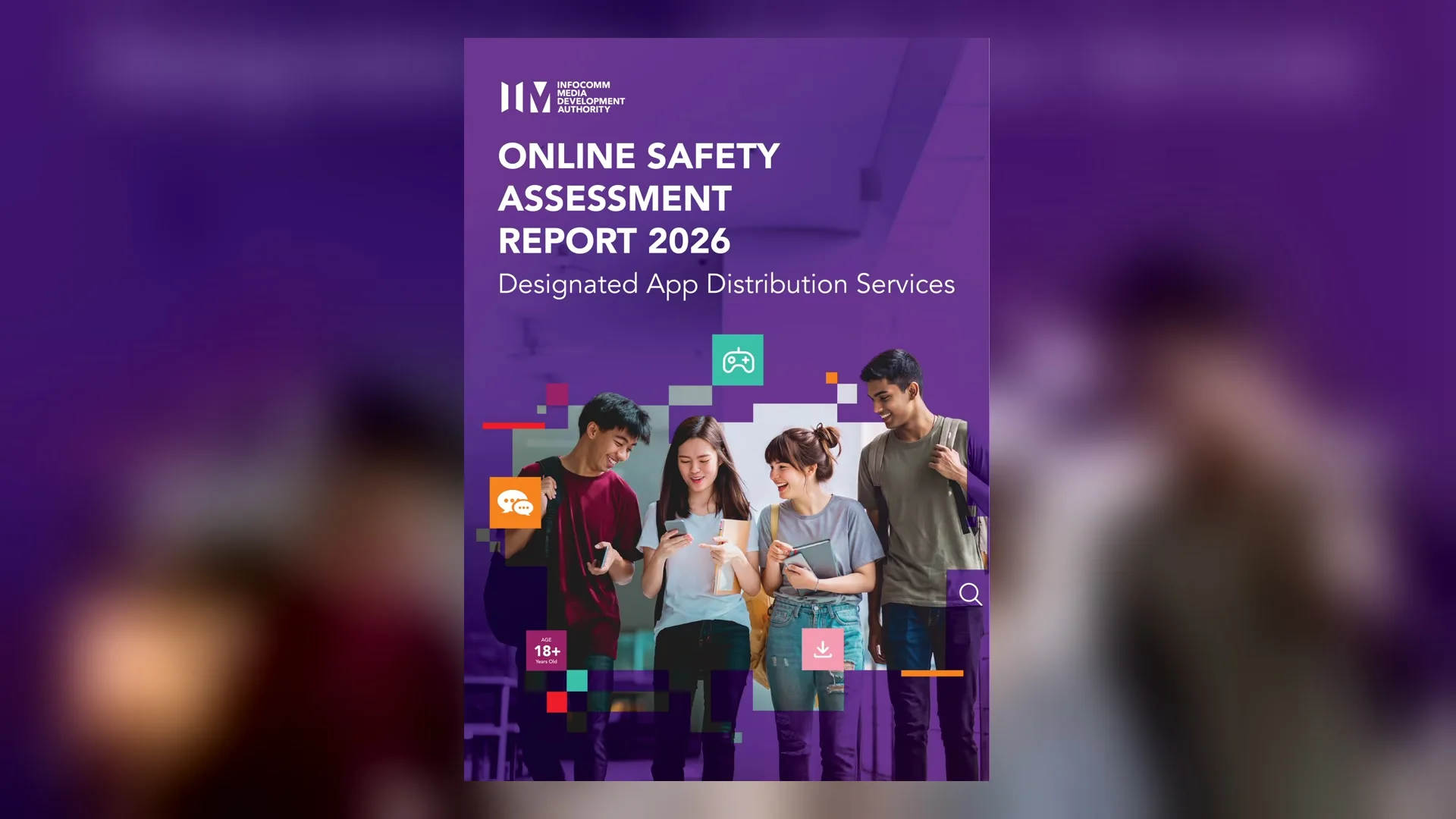
Singapore’s Infocomm Media Development Authority (IMDA) published its first report card on the five big app stores on Saturday, 24 October 2026. The verdict is a pass with plenty of red ink in the margins: IMDA found 65 apps containing or facilitating harmful content that violated the stores’ own policies; the stores removed or re-rated them after IMDA flagged them.
The app store is how almost everything reaches your phone, whether that’s a game for your younger cousin or the tablet you hand your kid at dinner. This report is the first official look at how well those stores keep harmful content and underage users out, and it names names.
Who Got Graded, and How
The Online Safety Assessment Report covers the Apple App Store, Google Play Store, Huawei AppGallery, Microsoft Store and Samsung Galaxy Store. These are the five services designated under Singapore’s Code of Practice for Online Safety for App Distribution Services, which took effect in March 2025. Microsoft’s entry spans five storefronts, including the Xbox console storefront and the PC Games Store, so your gaming rig is in scope as well.
The report looks at 1 April to 31 December 2025. IMDA combined each store’s annual safety report with its own mystery shopper testing (posing as ordinary users), direct testing and operational data. It then judged whether each safety measure existed, covered enough ground and worked in practice. According to IMDA, Singapore is one of the first countries in the world to regulate app stores for online safety.
The headline finding is that all five stores have baseline safety measures in place, with no systemic breaches of the Code. That sounds reassuring, and on age checks it mostly holds up. The trouble starts when you look at what gets through the door.
65 Apps Violated Store Policies
IMDA’s mystery shoppers tested over 7,000 apps across the five stores. They found 65 apps containing or facilitating harmful content that violated the stores’ own policies. They also found 24 apps with 18+ content that carried a lower age rating, spread across the Apple App Store, Google Play Store and Huawei AppGallery.
The most common problems were sexual content, violent content, and content facilitating vice and organised crime. Every one of those apps was removed or re-rated, but only after IMDA reported them.
Sixty-five out of 7,000 works out to under 1%, and IMDA’s factsheet points out the number is small next to the sheer size of these stores. Fair enough, but these are the apps a regulator caught on a sample run. The mis-rated ones bother us more. An age rating is the label a parent glances at for two seconds before tapping “Get”, so a wrong one undermines the whole point of having ratings.
The 18+ Gate Had Gaps
The good news first: IMDA found that age assurance, the checks stores use to work out how old you are, was present and well implemented on all five stores. Its testing found these checks generally couldn’t be easily dodged. The exception was Huawei AppGallery, where a small percentage of users could get around the check under specific circumstances on certain versions. IMDA put this down to technical limitations, and Huawei has committed to working with the regulator to monitor and fix it. The report notes that no age check is completely foolproof.
Once a store knows a user is under 18, children were largely blocked from downloading 18+ apps by default. IMDA’s testing did turn up limited instances on Huawei AppGallery and Microsoft Store where those restrictions were missing, or where loopholes let children switch them off. Most of these have since been fixed.
That switch-off loophole is the detail parents should sit up for. A restriction a 12-year-old can toggle off in settings is a suggestion, not a safeguard.
Report an App, Hear Nothing
Every store offers ways to report a dodgy app, through in-store flagging, web forms, hotlines or chat. But IMDA found the stores were inconsistent about telling users what happened next, and some didn’t tell them at all. Google Play Store and Samsung Galaxy Store failed to notify users who had downloaded an app within six months of its removal. In practice, you could still have a banned app on your phone and never know it was pulled.
All five stores reported zero or near-zero user reports about harmful content. IMDA wants Google, Huawei and Samsung to provide better data showing their reporting systems work in the next annual report. Our read is that near-zero reports point to people not reporting, rather than to no problems existing. If nobody hears back after flagging something, why would they bother next time?
What You Can Do Today
Set your kid up with their own account and the correct birthdate. Default restrictions only kick in once a store knows the user is a child, so letting them borrow your adult account switches off the protection entirely. Treat the age rating as a starting point and check what the app does yourself, especially for anything with chat or “mature” themes. If something feels off, report it.
The full report, along with each store’s own safety report, is published on IMDA’s online safety page. It’s worth ten minutes of your time if you’re the family’s unofficial IT department.
Social Media Is Next
Alongside the report, the Ministry of Digital Development and Information (MDDI) shared results from public engagements with over 2,000 parents and youth held from June to August 2026. These included focus groups, school dialogues, a survey on the CrowdTaskSG platform, and sessions run by TOUCH Community Services, Fei Yue Community Services, YouthTechSG and Singapore Children’s Society.
More than 80% of parents and nearly 70% of youth backed a tiered approach to social media, which means age-appropriate access with safeguards rather than an outright ban. Their worries differed. Screen addiction and overuse topped the list for youth at 71%, while inappropriate content led for parents at 84%. The most popular default safeguards were disabling autoplay (76%), disabling direct messaging (75%) and a daily screen-time limit (75%). The Government says it intends to introduce legislation next year.
The lessons start early, too. IMDA piloted an online safety curriculum with over 100 Kindergarten 2 children at E-Bridge pre-school, and it plans to roll it out to close to 3,000 K1 and K2 children across 30 E-Bridge centres from December 2026. Skool4Kidz delivered the curriculum to 800 K2 children across 35 centres in September 2026. All of this builds on the Screen Smart from the Start movement, which Prime Minister Lawrence Wong launched at the National Family Festival on 31 May 2026.
Take It to Heartbeat@Bedok
The report landed on the opening day of IMDA’s Digital for Life (DfL) Festival, which President Tharman Shanmugaratnam, Patron of the DfL movement, attended with host Mrs Josephine Teo, Minister for Digital Development and Information. The festival runs across two weekends with close to 130 partners, and entry is free.
If you only hit a few booths, make it these three. Ottodot’s Digital Detectives game has parents and kids team up to spot online red flags, which is the exact skill this report shows you can’t fully outsource to an app store. Singtel’s booth has tips for a child’s first smartphone, so it suits anyone whose kid is about to get one. Meta x EYEYAH!’s Digital Dialogue IRL helps you think through your boundaries on social media and tune the safety settings that control what you see. Younger visitors can try Edufrienz 99’s stories about being kind online, or create digital art at Make The Change’s booth.
🗓️ Date: Saturday, 31 October and Sunday, 1 November 2026 (the VivoCity weekend, 24 and 25 October, has ended)
📍 Location: Heartbeat@Bedok
🎟️ Admission: Free
🤝 Partners: Close to 130
👨👩👧 Picks: Ottodot’s Digital Detectives, Singtel’s first smartphone tips, Meta x EYEYAH!’s Digital Dialogue IRL
Your app store is doing more than it was a year ago, but this audit shows it can’t catch everything, and a little know-how on your end closes the gaps it leaves. The VivoCity weekend is over, but the festival’s second weekend is at Heartbeat@Bedok on 31 October and 1 November, with booth details on the Digital for Life Festival page. The bite-sized parenting guides for first screens, first phones and first social media accounts are on the Digital for Life portal whenever you need them!
Photos by Danish Lukawski of The DANAMIC Team; additional visuals courtesy of IMDA.
Read us first on Google: add DANAMIC as a preferred source and our stories show up more in your Top Stories and AI results.