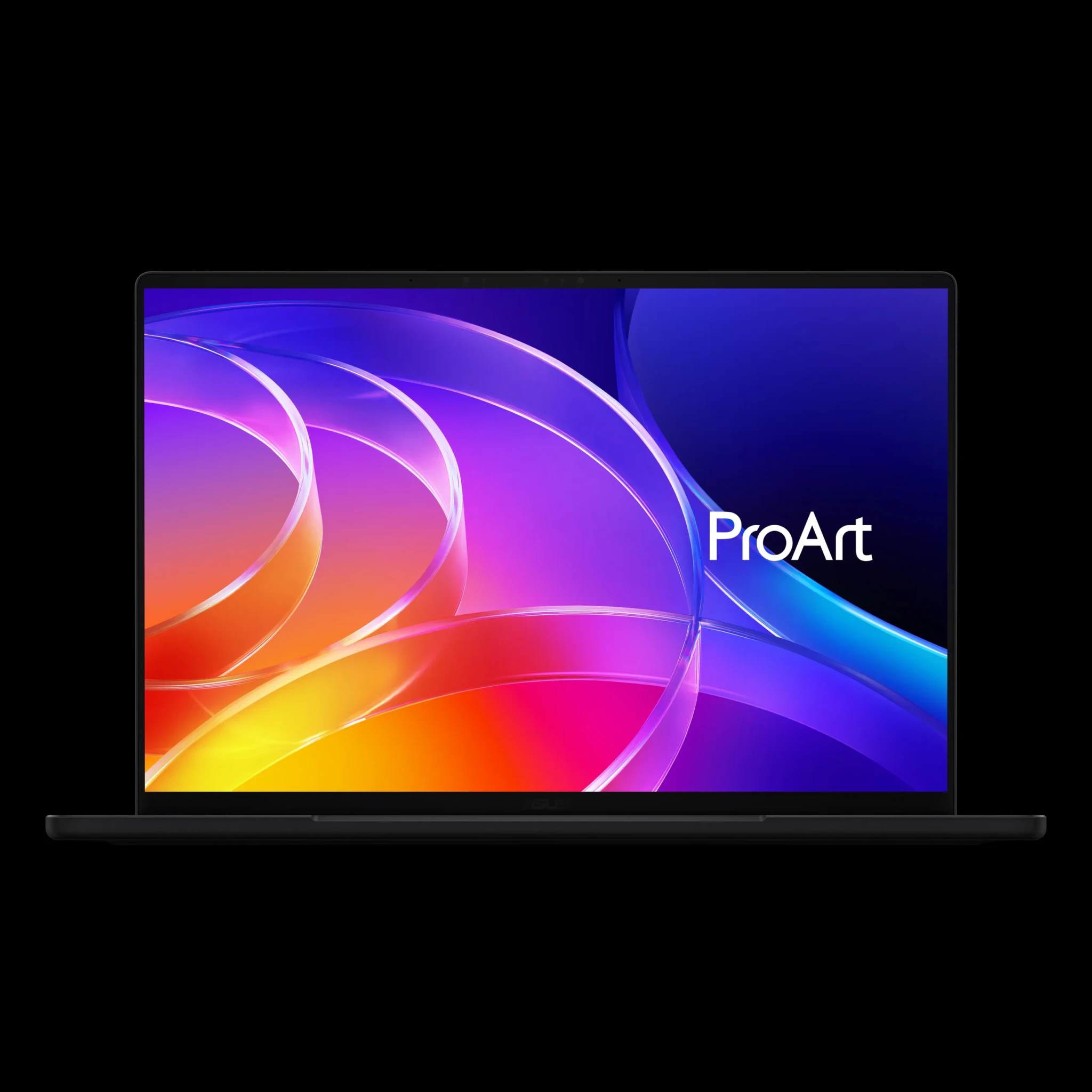
Anyone who has used a cloud image generator knows the feeling of being one more regeneration away from the perfect frame when the credit counter hits zero. From 30 October 2026, the ASUS ProArt P16 goes on sale in Singapore from S$6,599, built to run artificial intelligence (AI) models on the laptop itself so you stop paying for every attempt.
That idea comes with a hefty upfront bill, and that trade-off is the whole story. ASUS says the P16 is the first laptop in its creator-focused ProArt line to use NVIDIA’s new RTX Spark chip. Whether it makes sense for you depends on how much you spend on paid AI tools today.
The Chip Behind It
NVIDIA’s chief executive, Jensen Huang, unveiled RTX Spark (also known as N1X) at Computex in Taipei on 1 June 2026. He said NVIDIA and Microsoft would “reinvent the PC” for creativity, gaming and AI agents, with Windows laptops from ASUS, Dell, HP, Lenovo, Microsoft and MSI. So ASUS has company on this chip. Microsoft’s Surface Laptop Ultra, for one, was announced with RTX Spark on 7 October.
Here’s what’s inside the P16. RTX Spark combines a 6,144-core NVIDIA Blackwell graphics processor (GPU), a 20-core NVIDIA Grace central processor (CPU) and up to 128GB of unified memory. That last part is the big deal. On most laptops, an AI model has to fit into the graphics card’s own memory, which is far smaller. Here the CPU and GPU share one large pool, so much larger models can run without hitting a wall.
IDC analyst Tom Mainelli told CNBC that Huang wants to “own every bit of the AI stack”. For buyers, that ambition means NVIDIA now makes the whole chip, not only the graphics card bolted beside someone else’s processor. The shake-up is coming from NVIDIA itself.
What “Token-Free” Means for You
Cloud AI services charge by tokens or credits, the units they use to measure each prompt and each generated image or clip. Every retry costs a little more. ASUS’s argument is that a local machine turns that unpredictable spending into a fixed cost you pay once, so you can iterate as much as you like.
The tool most likely to change your daily routine is MuseTree, which comes preloaded. It runs the FLUX and WAN image models locally for what ASUS calls “token-free” generation, so you can generate as many variations as you like without watching a meter tick. ASUS has also partnered with ComfyUI, the open-source tool many creators use to chain AI image and video steps together, and says it provides validated workflows that run on ProArt laptops.
The rest of the software bundle plays a supporting role. StoryCube sorts and tags your media library. Hermes, an open-source AI agent from Nous Research, can carry out multi-step tasks across your apps and files. Zenni Claw is an ASUS-exclusive assistant for everyday AI and productivity. ASUS also says the P16 can handle language models of up to 120 billion parameters (a rough measure of a model’s size and capability). Because your prompts and project files stay on the machine, client work can stay off someone else’s server too.
Does the Maths Work?
Cloud AI plans charge a monthly fee, so a laptop that costs thousands of dollars is no reason to cancel a subscription you already use.
ASUS’s own estimate is that frequent use of cloud AI agents could cost more than an RTX Spark ProArt PC within five to 10 months. That’s the company’s figure, and it only holds for heavy users. The P16 starts to pay off when it replaces several things at once: a stack of subscriptions, monthly video-generation credit top-ups and paid cloud computing. If you mostly use one chatbot plan, this laptop is a want rather than a saving.
For comparison with ASUS’s own range, the previous ProArt P16 used an x86 processor (the chip design most Windows software is built for) with up to 64GB of memory. The new model doubles that ceiling, and that’s what lets it run the bigger models.
Skip the Middle Option
There are three configurations, and they don’t differ only in memory. According to ASUS’s spec sheet, the 48GB (S$6,599) and 128GB (S$11,099) models get a 700-nit screen that peaks at 1,600 nits in high dynamic range (HDR), plus an anti-reflection coating. The 64GB model (S$7,499) drops to 500 nits and a 1,100-nit HDR peak, and its spec sheet doesn’t list the anti-reflection coating.
That makes the middle option hard to recommend. You pay S$900 more than the entry model for extra memory and get a dimmer, more reflective screen in return. Our advice: start with the 48GB if you mainly work on images. Go for the 128GB only if you need the largest models or heavy video generation.
Otherwise, all three P16 models share the same 16-inch 4K OLED touchscreen with a 120Hz refresh rate and stylus support. ASUS lists the laptop at 12.9mm thin and 1.77kg, which it says is 14% thinner and 9% lighter than the previous generation, with a 99.9Wh battery. For ports, you get three USB4 ports running at up to 40Gbps, HDMI 2.1 and an SD Express 7.0 card reader, so photographers can skip the dongle.
The Arm Catch
Here’s the catch most launch coverage will skip. RTX Spark uses an Arm processor, the same kind of chip design found in phones, running Windows 11. Many big creative apps now run natively on Arm, including Photoshop, and DaVinci Resolve is reported to as well. However, individual plug-ins, older drivers for capture cards, printers and VPNs, and games that use kernel-level anti-cheat software can run slowly or not at all. Older Windows software can run through translation (emulation), but drivers can’t be translated that way.
So before spending S$6,599, list every plug-in and device your workflow depends on and check that each one supports Windows on Arm. If you also want this to be your gaming laptop, check your competitive multiplayer games especially carefully.
Where to Buy
💻 Available: From 30 October 2026, according to ASUS
📍 Where: ASUS Online Store and authorised retailers islandwide
💰 Recommended retail prices: S$6,599 (48GB), S$7,499 (64GB), S$11,099 (128GB)
🎁 Bundles: Adobe Creative Cloud and Google AI Pro offers on eligible models; confirm which models qualify, and for how long, when you buy
🗓️ Also coming: ProArt P14 with 24GB memory at S$4,999, at a later date
🎬 Review units: ProArt P16 128GB (H7607BA-SE049W) and 64GB (H7607BA-SE409W) available by RSVP, first-come, first-served
⚠️ Embargo: 20:00 SGT (12:00 GMT), Friday, 16 October 2026
At this price, the ProArt P16 isn’t an impulse buy. Its real value is the glimpse it gives of where creative tools are heading: AI you own outright, running on your own desk instead of on a meter. If your credit receipts already look like a phone bill, compare the three configurations on the ASUS Online Store from 30 October, and check that your plug-ins support Windows on Arm before you check out!
Read us first on Google: add DANAMIC as a preferred source and our stories show up more in your Top Stories and AI results.