Most of us inherit a rice cooker or a seat in the family group chat, but Shi Dunyu inherited a cave complex. Born inside China’s Mogao Caves in 1952, according to the exhibition notes, she brings her paintings of its murals to Singapore in Daughter of Dunhuang, which opens at Gallery II, The Arts House at the Old Parliament Singapore on Saturday, 17 October 2026.
The exhibition has 30 paintings and runs for 16 days across two venues. Its scenes range from a seated Buddha surrounded by demons in Cave No. 254 to many-armed Yuan Dynasty deities. If the Asian Civilisations Museum (ACM) has already made you curious about Dunhuang, this is the more personal follow-up: one family’s work on the same walls, carried on for more than seventy years.
Raised Among the Murals
According to the exhibition notes, Shi’s parents were Shi Weixiang (1924 to 2000) and Ouyang Lin (1924 to 2016). Both were pioneering Dunhuang scholars and artists who devoted their lives to studying, documenting and preserving the caves, home to the Mogao murals that UNESCO (the United Nations Educational, Scientific and Cultural Organization) lists as World Heritage.
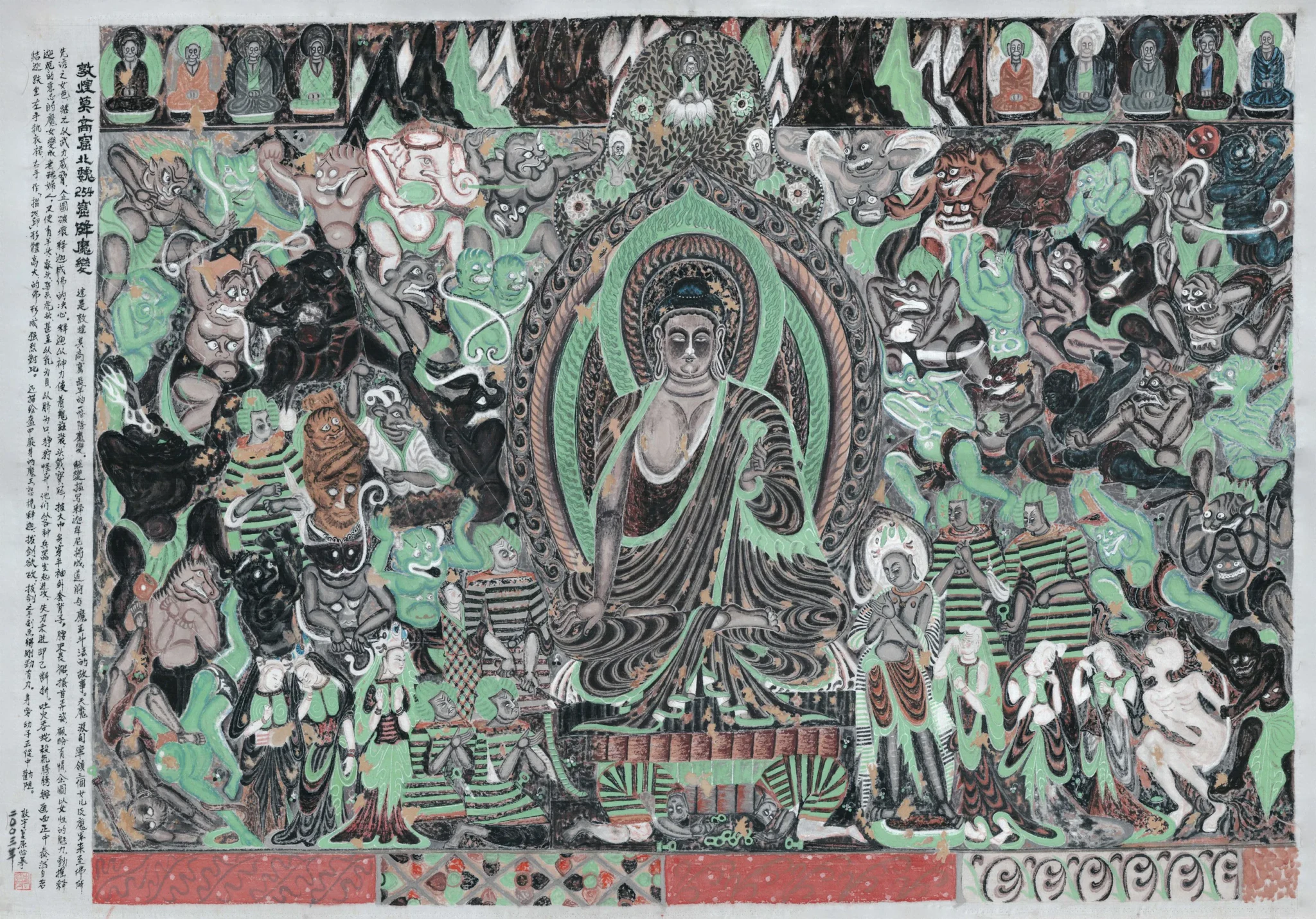
Imagine a childhood where your parents’ workplace is a set of caves covered in Buddhist murals, and the family business is keeping those murals alive. According to the organisers, Shi grew up knowing the murals intimately and with a strong sense of responsibility for protecting them. That inheritance gives the show its title.
The detail worth hunting for is that only 29 of the 30 works are hers. The 30th is Mañjuśrī Bodhisattva, a work painted by her parents in 1954, Mid-Tang Dynasty, Cave No. 112.
The gallery pairs it with Shi’s own Western Pure Land (Early Tang Dynasty, Cave No. 372), which she painted in 1993. The organisers argue that her parents’ technical discipline shows up clearly in her colour and detail. Seeing a mother, father and daughter working from the same caves decades apart is the most moving idea in the exhibition. It’s reason enough to go even if Buddhist art isn’t usually your thing!
Filling In What Time Erased
Shi works from surviving murals, historical photographs, drawings and archival records. From these she reconstructs imagery that has been damaged, faded or lost.
It helps to know what you’re looking at before you walk in. These are contemporary paintings by a living artist, made at various points between 1990 and 2026. Think of them as informed reconstructions of how the murals may once have looked, and leave the ancient originals in Dunhuang where they belong. Hand-copying murals has a long history at Dunhuang itself. A version with restored colour can also make a crowded composition much easier to read than the faded wall it came from.
Size is part of the draw. The catalogue lists most pieces as Chinese ink and colour on fabric or rice paper. The largest, Drum Dancer, measures 118 by 165 cm.
3 Works Worth Planning Around
The centrepiece to seek out is The Mañjuśrī Sutra: Music and Dance (Mid-Tang Dynasty, Cave No. 159), painted in 1993. Its musicians are absorbed in performance. Shi’s father wrote a rare handwritten inscription on it praising her drapery lines and the musicians’ expressions. A father’s approval, inked onto his daughter’s painting, is the kind of detail no museum label can supply!
The Three Noble Ladies (Late Tang Dynasty, Cave No. 9), from 2003, is the pick for people-watchers. Its female patrons wear elaborate hairstyles, beaded jewellery and flowing robes. Some pray or carry offerings, while one turns to talk to the woman beside her. Women helped fund and shape Dunhuang’s art, so seeing them revisited by a woman artist brings the story full circle.
The third choice is the quietest surprise in the catalogue. White-Robed Guanyin (Yuan Dynasty, Cave No. 3) is listed as begun in 1950, two years before Shi was born, with colours added in 2026. That means one painting spans her entire lifetime and then some. Drum Dancer (Yulin Cave No. 25) took a similar path: it was started in 1956 and coloured in 2016.
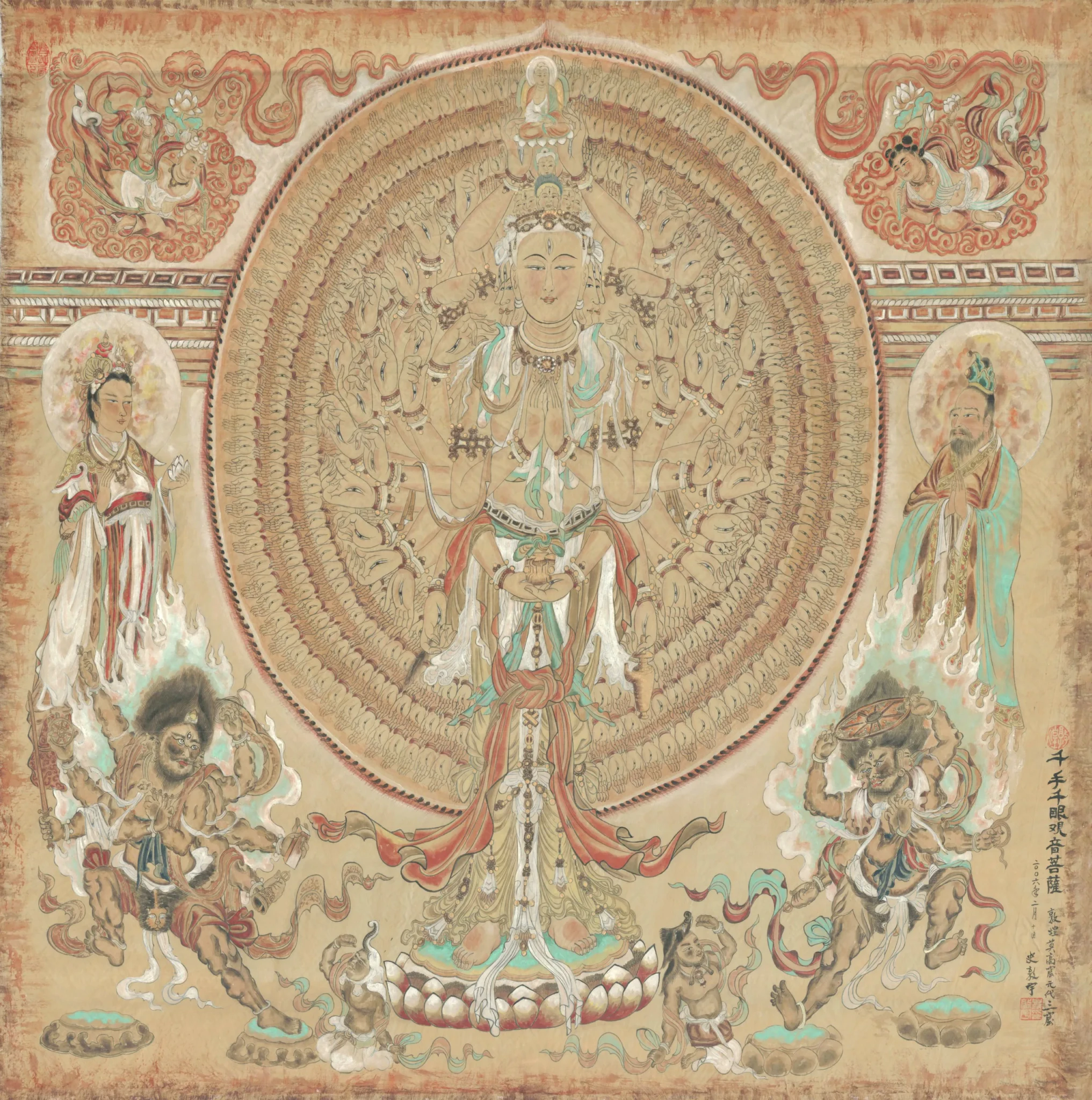
Cave No. 3 is well represented overall, with three Guanyin paintings drawn from it. The most striking of the three is the 2006 Thousand-Armed and Thousand-Eyed Guanyin, a dense swirl of arms and eyes that rewards a slow look.
From Northern Wei to Yuan
The range of dynasties is the other reason to set aside an hour. Cave No. 254 supplies three Northern Wei Dynasty stories: The Subjugation of Māra, The Jātaka Tale of King Śibi: Cutting His Flesh to Ransom a Dove and Prince Sattva Sacrificing Himself to Feed a Hungry Tigress. These are dramatic tales of sacrifice painted at full narrative stretch.
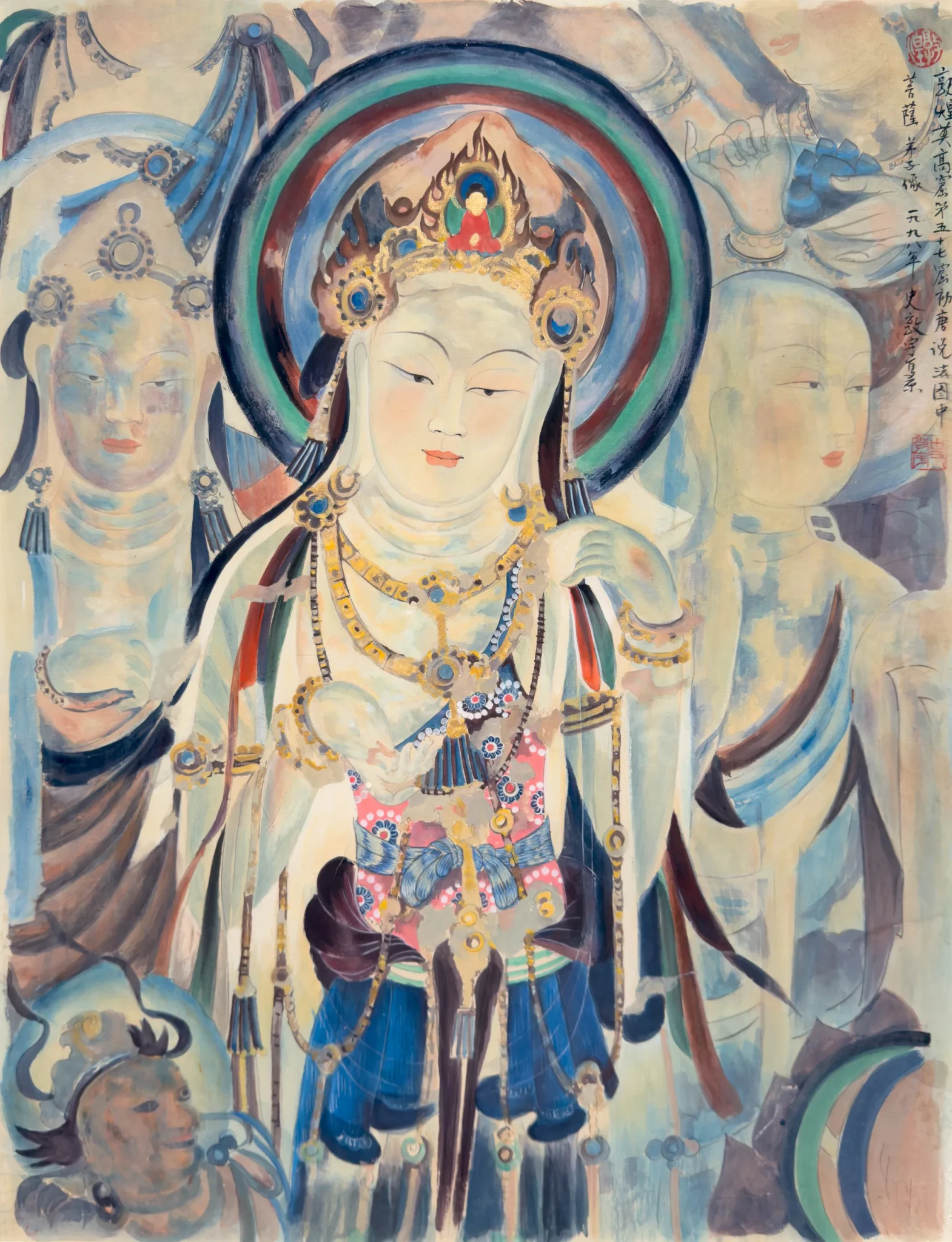
The Tang Dynasty works show the graceful side of Dunhuang. Beautiful Bodhisattva (Early Tang Dynasty, Cave No. 57), from 1998, is a good example: a haloed figure in jewelled robes that lives up to its name.
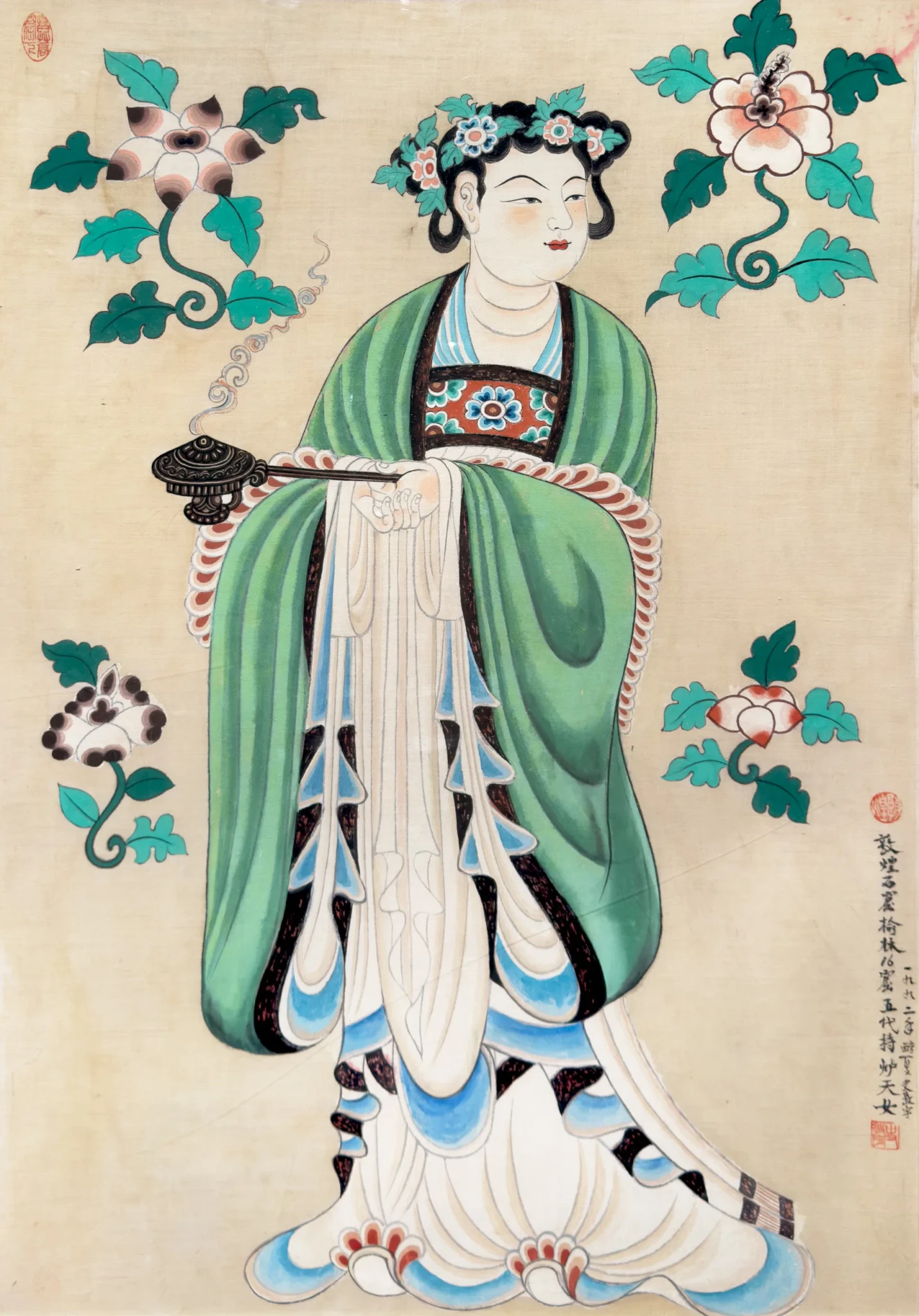
Not everything comes from Mogao. Several works draw on the nearby Yulin Caves, including Celestial Maiden Holding a Censer (Five Dynasties, Yulin Cave No. 16). Painted in 1992, it is one of the earliest dated pieces in the show.
Yulin Cave No. 25 contributes three works, the same as Cave No. 3 and Cave No. 254. Alongside Drum Dancer, it is the source for Bodhisattva Offering Flowers and Statue of the Buddha from the ‘Sutra on Contemplating the Infinite Life’, both painted in the 1990s.
For stillness, look for The Reclining Buddha. It’s a calm counterpoint to the battle and sacrifice scenes elsewhere in the room.
At the other end of the timeline, Yuan Dynasty Cave No. 465 provides Green Tārā and Esoteric Buddhism: Hevajra, both from 2001. Hevajra is a blue, many-armed deity in union with his consort, and he is the boldest image here by a long way!
Two Venues, One Fortnight
The Arts House leg runs from 17 to 22 October 2026. The exhibition then moves to Confluence Art Space at Havelock 2 from 23 October to 1 November 2026. Confluence Art Space, the Singapore gallery presenting the show, is led by founder Goh Chee Keong. Its programme has included Zao Wou-Ki, Zhang Daqian, Wu Guanzhong and Lim Tze Peng.
The opening reception on Saturday, 17 October, starts at 3pm. Speaker of Parliament Seah Kian Peng attends as Guest of Honour, and Shi is scheduled to speak at 4.20pm. An RSVP to enquiry@confluenceartspace.com is required, and the invitation points drivers to parking at Parliament House and National Gallery Singapore. It’s the best chance to hear the artist explain her family’s work in her own words.
For a full Dunhuang day, combine this show with ACM’s Sacred Caves: Dunhuang, Buddhism, and the Silk Road, which runs until 7 March 2027. It pairs life-size cave reproductions with original artefacts, and our guide to the Mogao caves you can walk into at ACM covers it in detail. The museum gives you the big picture, and Shi’s paintings give you the family who spent their lives with it.
🗓️ Date: 17 to 22 October 2026 (The Arts House); 23 October to 1 November 2026 (Confluence Art Space)
📍 Location: Gallery II, The Arts House at the Old Parliament Singapore; Confluence Art Space, 2 Havelock Road, #02-29 Havelock 2, Singapore 059763
🔗 Details: Confluence Art Space
A woman born among these murals has spent her life bringing their faded colours back, and the result hangs for barely two weeks across two venues. Visit the Confluence Art Space website before you go, then catch Daughter of Dunhuang at The Arts House or follow it to Havelock 2 from 23 October!
Photos and Visuals courtesy of Confluence Art Space.
Read us first on Google: add DANAMIC as a preferred source and our stories show up more in your Top Stories and AI results.