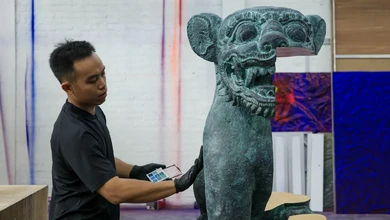
Some of the most celebrated rooms at the Mogao Caves, a cliffside complex of Buddhist temples in northwest China, need special permission to enter, and one is shut to the public entirely. Replicas of three of them now sit beside the Singapore River, and anyone with a ticket can walk straight in.
Sacred Caves: Dunhuang, Buddhism, and the Silk Road has been open at the Asian Civilisations Museum (ACM) since Friday, 25 September 2026, and runs until 7 March 2027. It was put together with the Dunhuang Academy, the Chinese institution that has conserved the caves since 1944. The show pairs four life-size cave reproductions with original paintings, sculptures, manuscripts, and textiles, and it is the first time reproductions like these have been shown in Southeast Asia.
Four Caves, Three Locked Doors
Some context first. Dunhuang was an oasis city on the edge of the Gobi Desert, where Silk Road routes linking China with Central Asia, India, the Middle East, and Europe converged. Between the 4th and 14th centuries, its Buddhist community carved a vast complex of cave temples into the cliffs nearby, and that complex is now a UNESCO World Heritage Site.
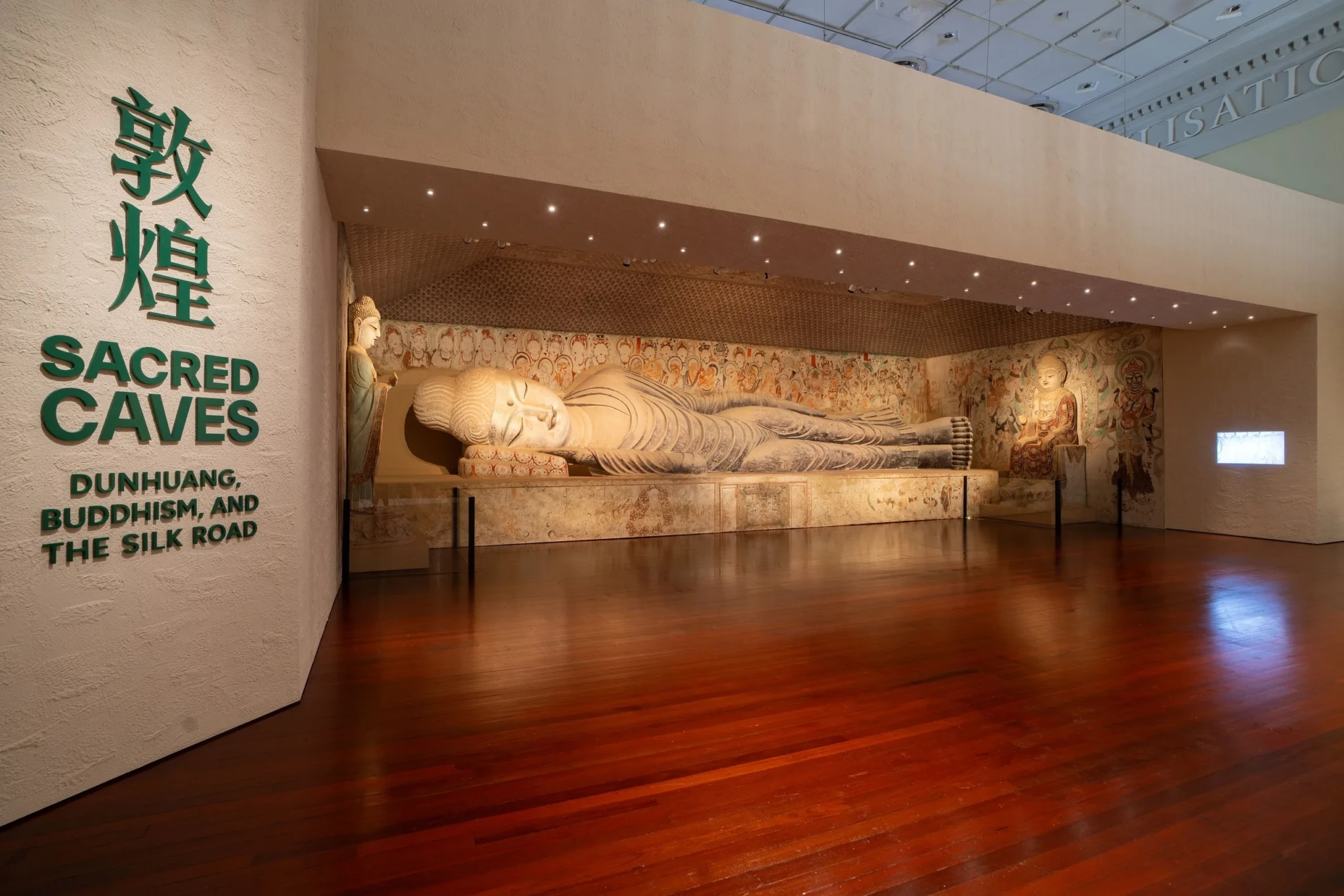
The first room visitors meet is Cave 158 in the Level 2 Foyer, home to the largest reclining Buddha at Mogao. The original measures 15.8 metres, and ACM’s copy is scaled down only slightly, so picture a Buddha longer than three HDB living rooms laid end to end. He’s shown entering nirvana while mourners from across Asia wail around him, resting on a pillow patterned with ducks borrowed from Persian textile designs. Even the pillow has travelled.
Cave 3 is the one to plan a visit around. It’s completely closed to the public at Mogao, and it is the only surviving cave in Dunhuang devoted entirely to Avalokiteshvara, the Bodhisattva of Compassion, known to many Singaporeans as Guanyin. On both side walls the bodhisattva stands with eleven heads and a thousand arms fanned out like a halo, each palm marked with a watchful eye.
Over in the Special Exhibitions Gallery, Cave 249 earns a slow lap for a different reason. It’s the only reproduction made entirely by hand (the other three were digitally scanned and printed), and its walls cram a four-eyed, four-armed demigod holding up the sun and moon alongside the Chinese gods of thunder, lightning, wind, and rain.
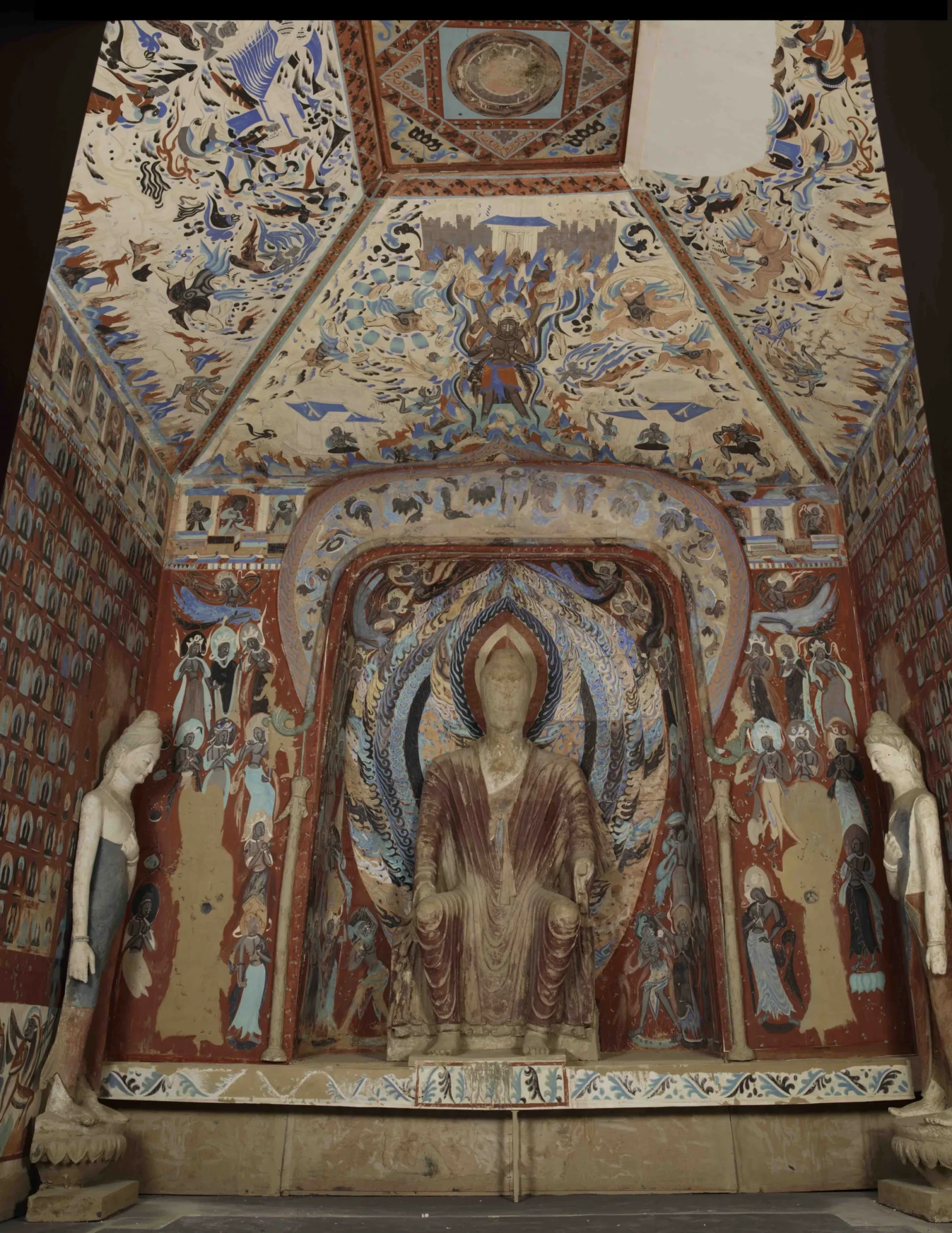
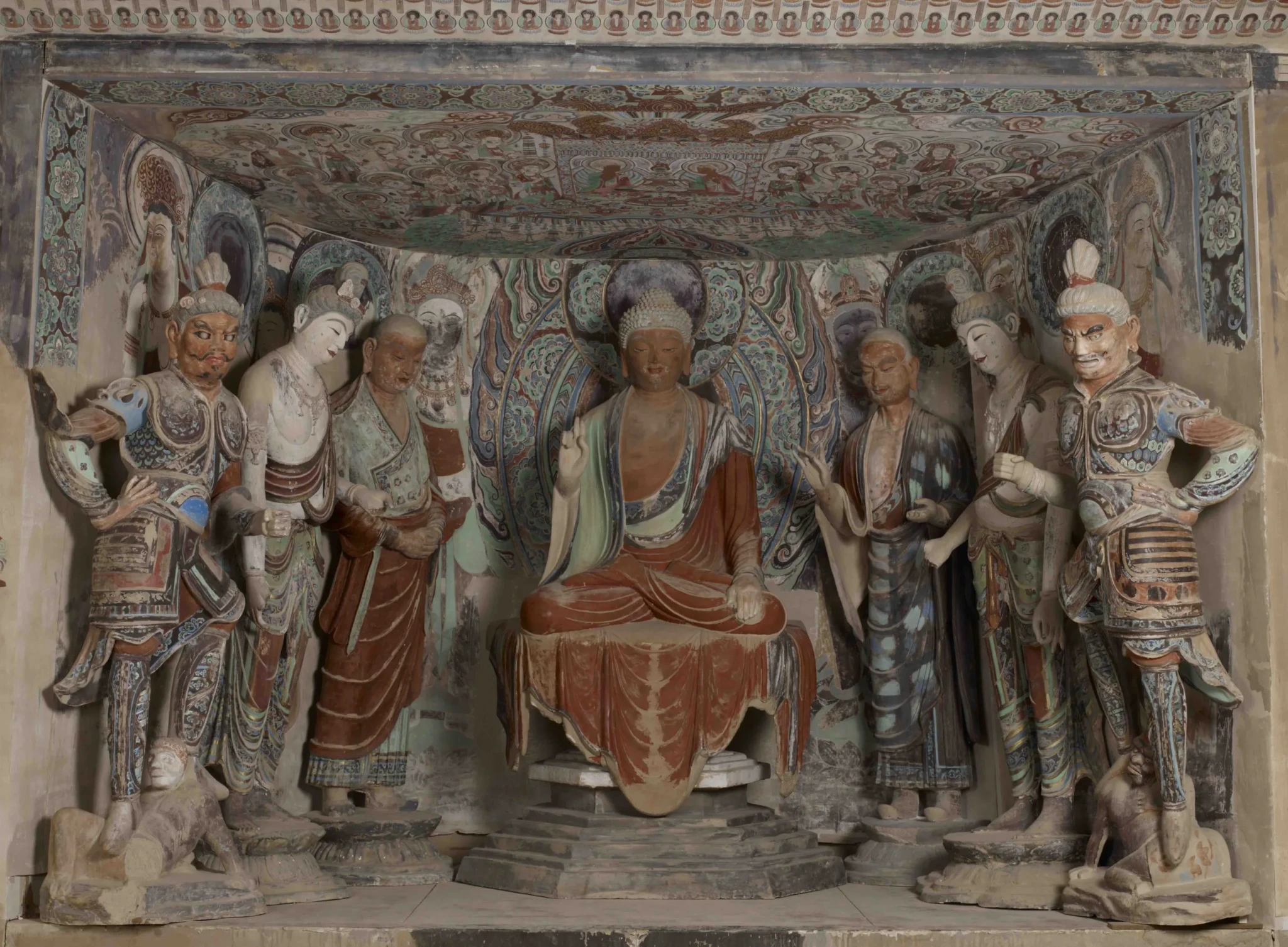
Cave 45 completes the set with one of the finest Tang dynasty sculpture groups at Mogao: a Buddha flanked by disciples, bodhisattvas, and guardian kings, softly modelled in a style shaped by Indian sculpture. Access to the original is strictly limited for conservation, which makes a full-size copy the most practical way most people will ever stand this close to it.
Three Hares, Three Ears
The Special Exhibitions Gallery opens with a 1954 copy of the ceiling of Cave 407 by Duan Wenjie and Li Fu. Three hares chase one another in a circle while sharing only three ears, yet each seems to have a full pair, an optical trick that has kept people staring for centuries.
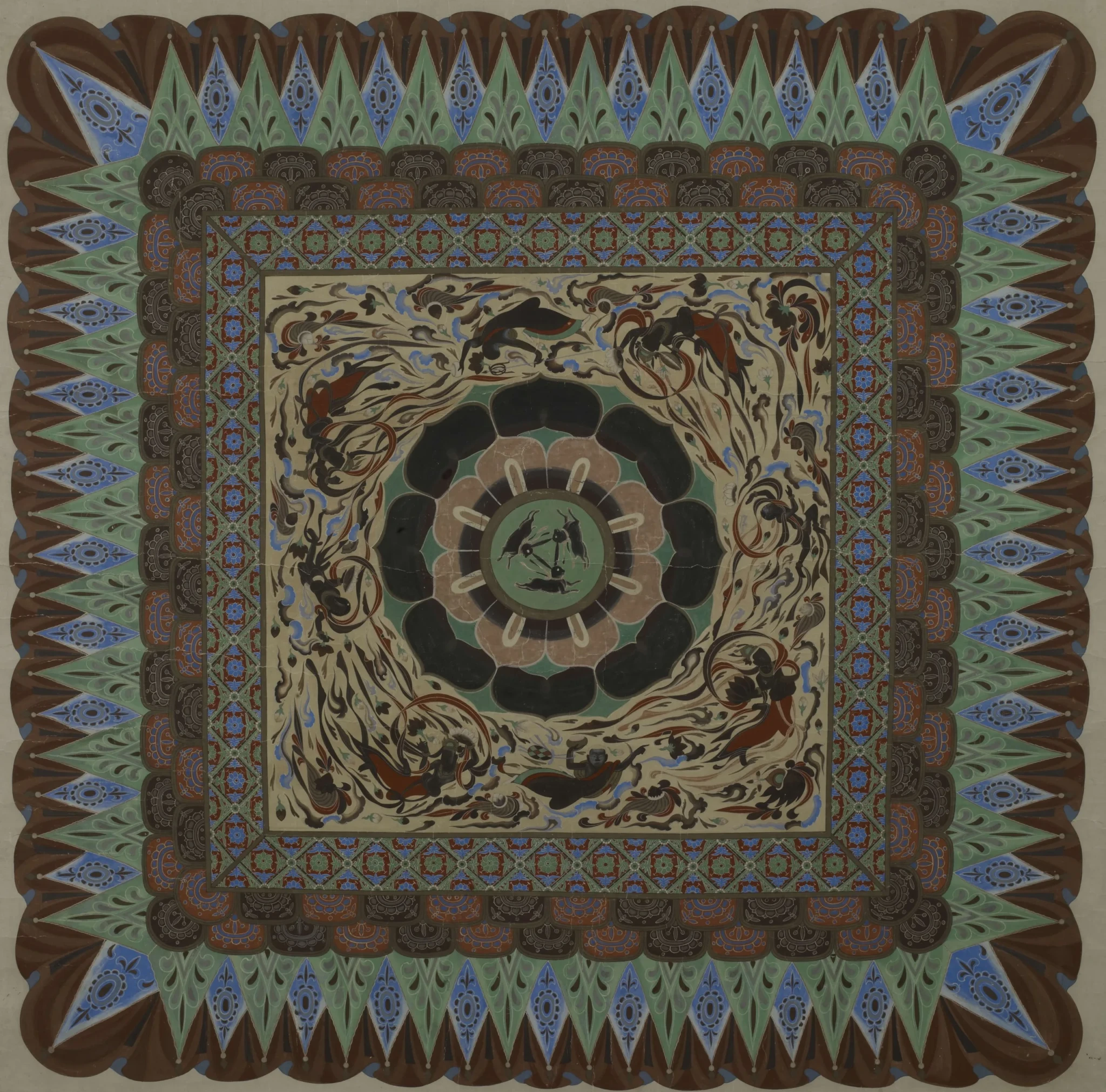
The same design turns up in Iran, India, Egypt, and as far away as England, standing for rebirth in Buddhism and the Holy Trinity in Christianity. Of everything in the show, this ceiling makes the Silk Road argument fastest, since it’s basically a meme that went viral a thousand years before the internet!
A Passport, a Coin, a Camel
The City section fills in the traffic that made all this possible. A Tang dynasty tomb brick shows a Sogdian (one of the Central Asian traders who carried goods and religions across Eurasia) leading a camel, the sort of caravan the poet Zhang Ji described as “the sound of countless bells across the sand dunes”.
Nearby, a travel pass fragment from 748 works like an ancient passport, logging place names and dates along a route east from Dunhuang. It carries no official stamps, so it may be an administrative copy, though its format closely matches a famous 855 pass issued to the Japanese monk Enchin.
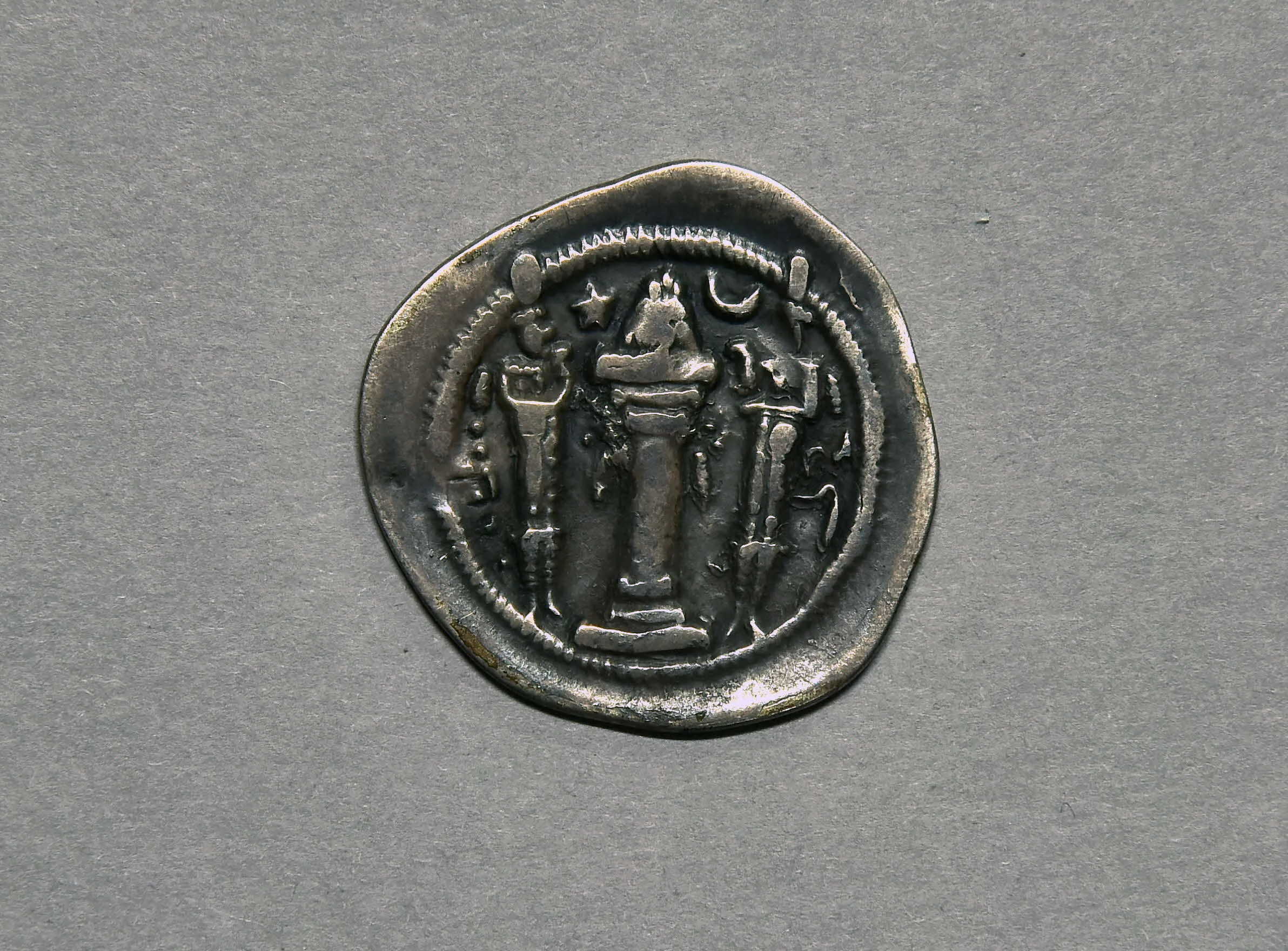
The small silver coin is the object worth leaning in for. It was minted in Sassanid Iran around 476 to 477 under King Peroz I, then buried with a monk at Mogao in the early 7th century, which means it stayed in circulation for over 100 years.
That’s the thread Clement Onn, director of ACM and the Peranakan Museum, pulls on when he says “cultures have never developed in isolation”. It lands harder here than in most museum quotes, because a Persian coin in a Chinese monk’s grave makes the case without any help from the wall text.
The People Who Painted Mogao
Devotion gets its own section, anchored by the Jataka of the Nine-Coloured Deer from Cave 257. It tells of a deer (the Buddha in a past life) that saves a drowning man, is betrayed by him for a reward, and is finally spared by the king, with the story unfolding from both ends of the painting towards the middle.
The People section is where Mogao stops feeling like a temple and starts feeling like a town. It holds the earliest surviving example of movable type in the world, artists’ tools, and a portrait of Lady Wang of Taiyuan with maidservants in men’s robes, a fashion Tang women loved in the 7th and 8th centuries. A fragmentary sculpture that reveals how Mogao’s figures were built is on display outside Dunhuang for the first time, and photographs taken by James and Lucy Lo in 1943 and 1944 trace how the caves were documented in modern times.
Blind Boxes and a 6m Apsara
The extras are generous for a history show. An interactive stamping trail runs across ACM, the Bank of China, and Fullerton Hotel, and visitors who collect at least six stamps can redeem a blind-box apsara figurine (apsaras are the celestial figures floating across Buddhist murals) from 2 October 2026. Three designs hold objects from ACM’s collection, while a secret fourth draws on a familiar Singapore custom, which is the one worth hunting for.
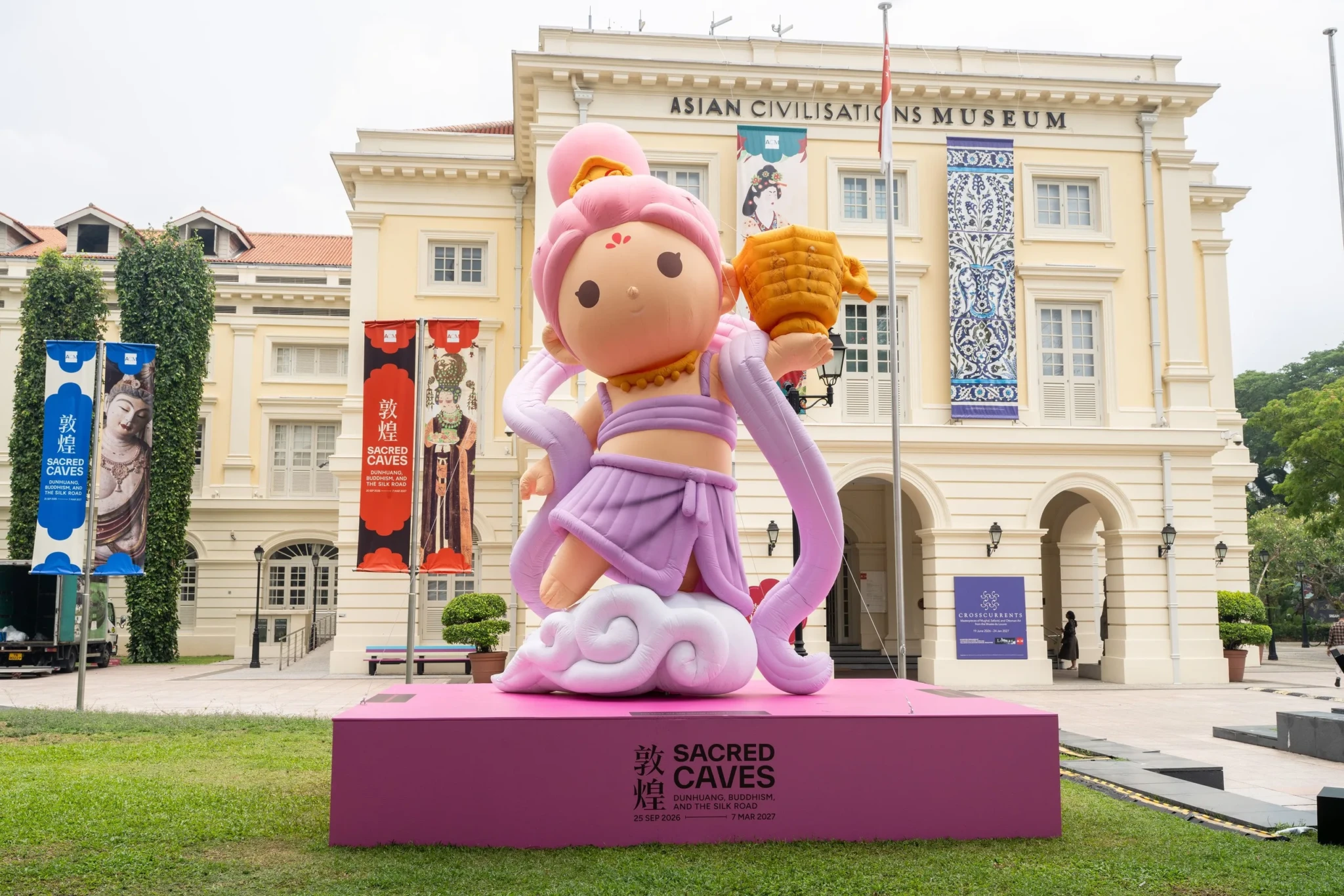
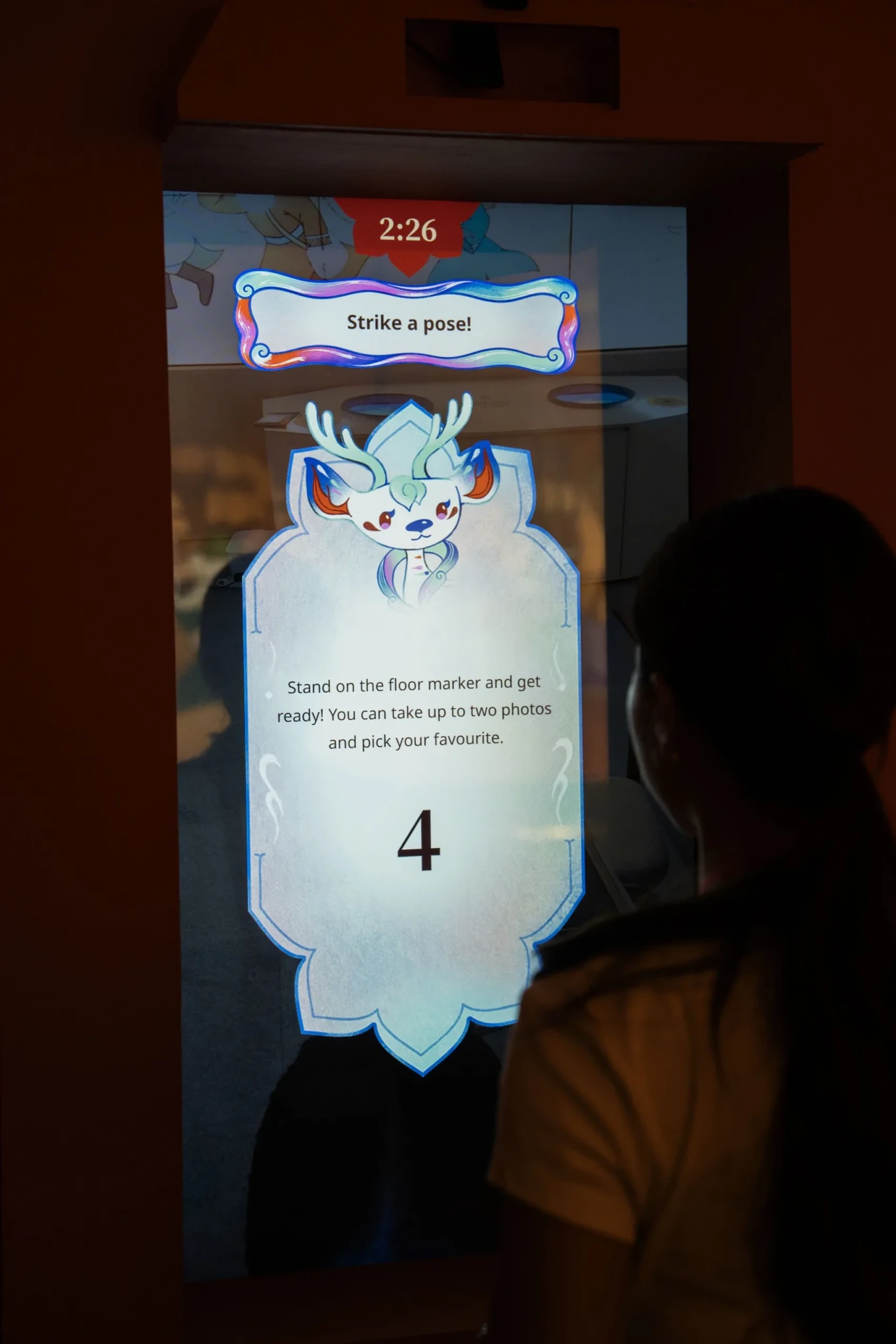
A separate digital trail hands out tap-enabled paintbrushes at the Cave of Colours in the lobby. Colours collected through the galleries become a digital wallpaper and a portrait in Mogao-inspired costume, and the route ends at a six-metre inflatable apsara on ACM Green.
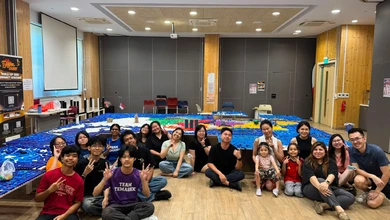
Families should head to ACM & Me, the Level 1 children’s space, which has added Tang-style dress-up, a zoetrope that animates the deer story, and a light room inspired by the three hares. It runs 10am to 6pm daily but closes from 12.30pm to 2pm for cleaning.
Down the road at the Bank of China Building on 4 Battery Road, a free virtual reality (VR) tour explores Mogao Cave 285, open Monday to Friday, 9am to 4pm, and Saturday, 9am to 12pm, with advance online reservations required.
Dates Worth Circling
For the best context in the building, book a curator tour with Louise Lui, ACM’s curator of Chinese Art and the person behind the objects on show, on 30 October or 27 November 2026 at 7.30pm, priced at S$25 on Peatix. It’s the only slot where someone can explain why that ceiling has three ears.
- Crossing Cultures at ACM: Roads Less Travelled: 16 to 18 October 2026, Friday 7pm to 9.30pm, weekend 2pm to 9.30pm, free and ticketed activities
- ACM Adventures: Caves of Wonder: 29 November 2026, 11am to 4pm, storytelling and shadow puppetry, free admission to most programmes
- At the Crossroads symposium: 8 to 10 January 2027, 10am to 6pm, ticketed
- Light to Night at ACM: 8 to 24 January 2027, selected dates, free admission to most activities
- Sacred Caves Weekend Festival: 27 and 28 February 2027, free and ticketed activities
🗓️ Date: 25 September 2026 to 7 March 2027
⏰ Time: Daily, 10am to 7pm (until 9pm on Fridays)
📍 Location: Asian Civilisations Museum, 1 Empress Place, Singapore 179555
🎟️ Singaporeans and permanent residents (PRs): S$10 for adults; free for students, seniors, and children aged six and below
🌏 Foreign residents and tourists: S$25 for adults; S$20 for students and seniors; free for children aged six and below
💳 Deal: 1-for-1 admission for Bank of China Singapore cardholders
🚇 Getting there: Raffles Place MRT (Mass Rapid Transit) station; buses 75, 100, 107, 130, 131, and 167
Five months feels like plenty until it’s suddenly February, so pick a Friday evening, give Cave 3 the unhurried look the real one will never allow, and go home with an apsara in your bag. Tickets, trail details, and programme sign-ups sit on the Sacred Caves exhibition page, and the Asian Civilisations Museum website has everything else on at the museum this season!
Photos and Visuals courtesy of Asian Civilisations Museum and the Dunhuang Academy.
Read us first on Google: add DANAMIC as a preferred source and our stories show up more in your Top Stories and AI results.