Ask Nicholas Aggs which of the 24 songs in the Changi Souvenir Song Album needed the most reconstruction, and he answers a different question. “Interestingly, almost nothing needed recovering, because the music itself survived intact,” says the Head of Music at the Australian International School (AIS). He researched and arranged the songs that Australian prisoners of war (POWs) wrote and performed in Changi during the Second World War.
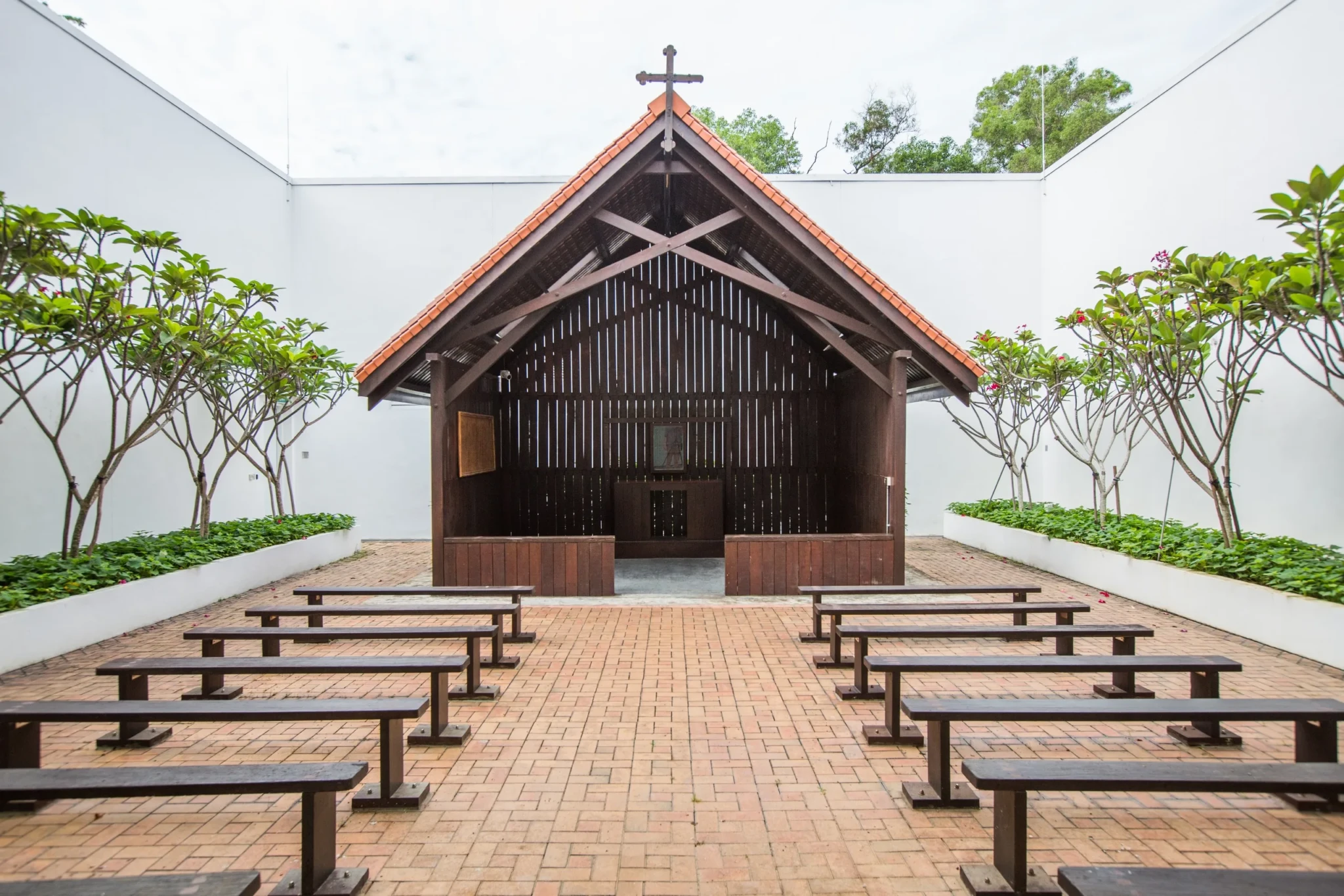
Getting 16 of those songs to ring out at Changi Chapel and Museum on 11 September 2026 was harder than it sounds. AIS student singers performed them over a jazz trio, and the work behind that hour came down to a long run of judgement calls about chords, bass lines and single notes. When we previewed the concert, the story was that the songs were coming home. The interview shows how much care went into making them sound alive once they got there.
24 Songs, Every Note on the Page
The album was printed in 1947 with all 24 songs fully notated, including melodies, lyrics, piano accompaniment, and chord symbols. The publishers didn’t re-set the music in type. They photographed Ray Tullipan‘s handwritten manuscripts, so what survives is, as Aggs puts it, “the same pages that emerged from the Changi experience.” Tullipan and fellow prisoner Slim de Grey composed the songs for the concert party that entertained their camp.
The National Museum of Singapore acquired the album in 2020. Asmah Alias, Director of Galleries, Exhibitions and Museums at HeritageSG, which runs the Liberation of Singapore commemorations, says the songs were written by members of the 8th Division Concert Party while they were interned in Changi Prison. Aggs first studied the book in person at the museum. He then worked from photographs of each page to produce modern transcriptions of all 24 songs.
Three Layers That Disagree
Every song carries three layers of information: the sung melody, the written piano part, and the chord symbol printed above it. “In a clean edition all three agree. In this album they frequently do not,” Aggs explains. He found those clashes in every song in the book.
He didn’t rule each clash an error. He tested them by ear, and his method was to “play the chord as written, then what the piano part says, then what the melody implies, and keep going until you find the version that sounds best and swings hardest.” Sometimes the piano part won, and sometimes the chord symbol did. Occasionally a ‘wrong’ note stayed put, because in his words, “smoothing it out would have been vandalism.”
His tiebreaker was a 1993 Larrikin Records recording of Slim de Grey, Keith Stevens, and Jack Boardman. That trio was the composer himself, a fellow Concert Party member, and the man who led its orchestra. Wherever the page contradicted itself or left something out, Aggs could go and “hear what the men who made the music actually did with it.” That is the most convincing part of the whole project, because the final calls were checked against the men who first played these tunes, not against paper alone.
Double Bass, Drums and Two Year 9s
Aggs’s governing principle was that “these are not museum pieces.” The songs grew out of the swing music of their era and were written for a working band. Instead of plain piano accompaniment, he assembled a jazz rhythm section of piano, bass, and drums.
The line-up came from inside the school. Aggs has spent the past year learning the double bass, and two Year 9 students with “a real thirst for jazz” took the drums and piano. It took many rehearsals to give the singers solid footing, because “a rhythm section is harder than it looks.” Once the band locked in, Aggs says, “the music finally had the engine it was written to sit on top of.”
The changes he made were practical ones, such as adjusting keys for the student voices and adapting the instrumentation. The melodies kept their “surprisingly challenging leaps in the vocal lines.” At the first full rehearsal, the singers sat and listened to one another and applauded at the end of every song. There’s a happy side effect too: jazz has taken root at AIS “in a way it hadn’t before.”
What the Songs Say About Changi
This is where the numbers get striking. “Of the sixteen songs we performed, only two admit any sadness at all,” Aggs points out. For him, that ratio is the whole point: “fourteen cheerful songs and two honest ones is not a man who felt fine. It is a man deciding to sound like it, because a thousand others were sitting in front of him.”

The subjects back him up. The songs dream about a castle in the air and moonlight over a desert none of the men had ever seen. One is about a dance craze they invented and named themselves. De Grey wrote Big House Blues while the men were being marched to the gaol. He was a wishful thinker in a friend’s phrase, and that is where Back in Circulation, a song about being let out, came from.
25 Words and a Song
Of the two sadder songs, They’ve Taken My Old Pal Away is the one to seek out. De Grey wrote it after his closest friend was sent to Sandakan, in Borneo, and did not come back.
Aggs gives the context that makes it hit harder. Mail from the camp was limited to printed cards of twenty-five words, and the censors removed anything that mattered. In that setting, he says, “a song was one of the few places a man could say a true thing at normal length.” It’s the line from the interview that best explains why these songs matter to anyone who never lived through Changi.
First Time Home in Singapore
The songs have had a long life in Australia. In 2022, all 24 were recorded for Chris Latham’s Flowers of Peace project, and nine of them were featured in the POW Requiem premiere in Canberra that October. A Changi Songbook stage production played Canberra the same year.
This month was the first time since the war that the songs were performed in Singapore. That made Changi, “a few hundred metres from where they were written,” the right place for it. The concert, Heritage in Harmony: A Commemorative Event, opened the Liberation of Singapore weekend, which ran from 11 to 13 September at Changi Chapel and Museum and Reflections at Bukit Chandu. With a one-hour slot, Aggs chose the 16 songs he considers the best and called the cut “a matter of time rather than quality.”
Why the 81st Year
So why now, and not at a tidier anniversary? “While milestone anniversaries often attract greater attention, reflection should not be confined to round numbers,” says Asmah. Last year’s 80th anniversary was when HeritageSG began stewarding the commemorations at both sites, and this year’s programme builds on that start.
It’s a fair call. These songs were written to lift an ordinary night in the camp, and they never waited for a ceremony to do it.
🗓️ Performed on: Friday, 11 September 2026
⏰ Time: 5pm to 7pm
📍 Location: Changi Chapel and Museum
🎶 Programme: Heritage in Harmony: A Commemorative Event, 16 of the album’s 24 songs
🎷 Performers: AIS student singers, with Nicholas Aggs on double bass and two Year 9 students on drums and piano
📖 The album: National Museum of Singapore collection, accession 2020-00502
The concert is over, but the place where these songs were written is still open to visitors. Changi Chapel and Museum’s galleries were curated by the National Museum of Singapore, and they fill in the prison life that Tullipan and de Grey chose to sing their way around. You can read about what’s inside from when the museum reopened in 2021. Keep an eye on the Changi Chapel and Museum programme page for next year’s Liberation of Singapore line-up, and if these songs come back, go and hear how well an 80-year-old songbook can swing!
Photos and Visuals courtesy of HeritageSG and the National Museum of Singapore.
Read us first on Google: add DANAMIC as a preferred source and our stories show up more in your Top Stories and AI results.