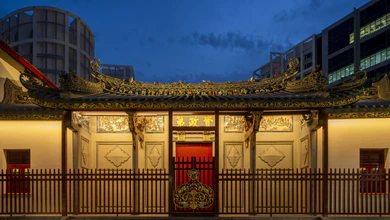
Somewhere on your feed this week, someone is rolling a pea-sized ball of clay into a bowl of laksa with a toothpick. Miniature food is a whole genre now, and Singaporeans are deep in it. In Paya Lebar, about 100 residents took that same impulse, scaled it up to 2.1 metres, and iced the result with their own estate.
The object in question is a birthday cake for Singapore’s 61st, built from modelling clay rather than sugar, and it now carries a Singapore Book of Records entry as a largest cake sculpture at 2.1m by 1.0m. It went up as part of PAssionArts Festival 2026, the People’s Association arts festival that fills the heartlands every National Day period.
The Cake Is Basically a Map of Kovan
Read the tiers and you get a neighbourhood inventory. Kovan Community Club is on there. So is 105 Hainanese Market, the hawker centre everyone just calls 105. So is 209 Kovan Market, the Tua Jia Kar well, and Paya Lebar Air Base, complete with a control tower, a plane, clouds and string lights.
The picks came from longtime Kovan residents working off personal memory. That is why the roster reads more like a group chat than a heritage trail: a well, two wet markets, a community club and an airbase, sitting on the same cake with no hierarchy between them.

There is a quiet joke buried in the air base tier. Paya Lebar Air Base is slated to move under long-announced government plans, which means a bunch of neighbours have already built the miniature version that will outlast the real one.
Three Weekends, About 100 People, No Art Degrees Required
Artist Jesse Leong led the build across three July workshops, working with roughly 100 residents who mostly do not make art for a living. The method was collaborative by design. People turned up on a weekend, picked a landmark that meant something to them, and rolled it.
That is a genuinely fast production schedule for a piece this size. Compare it to how the miniature-craft internet actually works, where a single creator spends weeks on one bowl of noodles and films every step. Here the labour was spread across a hundred pairs of hands over three Saturdays and Sundays, and nobody was optimising for a reveal shot.
The People’s Association describes its approach to this stuff as “volunteer-driven, resident-centric and socially-connected”. Dry phrasing for what is basically a craft jam session in a community club.

The Festival Around It Got Noticeably Bigger
PAssionArts Festival 2026 runs across 79 festival villages this year, up from 67 in 2025, with 82 Community Arts and Culture Clubs involved. Entry is free, though some activities need registration first. The theme is “Celebrate Our Neighbourhood Gems”, which is, functionally, a diorama brief handed to an entire island.
The festival has been running since 2012, set up by the People’s Association with support from the Ministry of Culture, Community and Youth. Last year’s SG60 edition put 20 giant “Delight” installations across the heartlands. This is not a one-off stunt year, it is a machine that produces large public objects on an annual cycle, in the same period when SG60 programming filled venues like the SCCC.
The clay cake also is not the only build worth walking to. Zhenghua has a floral cascade this year, and Punggol Coast has a sculpture made from upcycled plastic bottles, which gives the festival a second hook for anyone who follows sustainable-material design more closely than they follow craft.

Why This One Actually Travels
Recognition is the whole engine. A miniature bowl of ramen made by a stranger gets a scroll and a like. A miniature of the hawker centre you have eaten at since primary school gets a screenshot and a “wait, that’s 105” sent to three people. That is a different order of sharing, and it is the reason a community club project can out-travel content made by people who do this professionally.
The official channel is small. PAssionArts runs an Instagram account with just over 4,300 followers, which is modest for a national arts programme, and its bio reads “Discovering Art in every neighbourhood”. So the cake’s reach depends almost entirely on residents posting it, hyperlocal community club accounts resharing it, and whoever walks past with a phone. Institutional art with algorithmic distribution, borrowed from the people who made it.
One more thing that gives this legs. The clay will not last forever, but the Book of Records entry does, which means the record will outlive the object it was awarded for. Not a bad deal for three weekends of work and a hundred people who mostly just wanted to build their own street. If you’re mapping out where to go this month, this one sits comfortably next to the big-ticket things to do around the island and costs nothing.
🎂 The record: Singapore Book of Records entry for a largest cake sculpture, 2.1m by 1.0m, made from modelling clay
🎨 Made by: Around 100 Paya Lebar residents across three July weekend workshops, led by artist Jesse Leong
🏘️ On the cake: Kovan Community Club, 105 Hainanese Market, 209 Kovan Market, the Tua Jia Kar well and Paya Lebar Air Base
💎 Theme: Celebrate Our Neighbourhood Gems
📍 Festival scale: 79 festival villages, up from 67 in 2025, with 82 Community Arts and Culture Clubs taking part
🎟️ Entry: Free, with registration required for some activities
🌿 Also worth seeing: The Zhenghua floral cascade and the Punggol Coast upcycled-bottle sculpture

PAssionArts workshops are open to residents of the estates that run them, they cost nothing, and they happen every year in the weeks before National Day, so the move is to follow PAssionArts and the People’s Association on their own channels and watch for the 2027 workshop calls when they open. If you want to be the person whose hawker centre ends up on the next record-breaking build, that is where the sign-up sheet lives. And if large-scale public art is your thing generally, the Night Festival crowd will be right at home here.
Visuals Courtesy of PAssionArts Festival.
Read us first on Google: add DANAMIC as a preferred source and our stories show up more in your Top Stories and AI results.