Alibaba launched Qwen4-Max in Singapore on 16 November 2026. You can use it today through the Token Plan and API on QwenCloud, or inside Alibaba’s own QwenWork and QwenStudio apps. If AI already helps you with assignments, side projects or that cover letter you keep rewriting, this is the newest heavyweight competing for the job. Alibaba says it uses 35% fewer tokens.
That’s a big promise, so it’s worth looking at what sits behind it, and at what a student, creator or first-jobber can do with it this week.
Big Brain, Lighter Bill
According to Alibaba, Qwen4-Max is the most capable model in the Qwen family so far. It has 2.4 trillion total parameters, which are the internal settings a model learns during training. It handles images natively, and it has a one-million-token context window, meaning it can keep a very long conversation, document pile or codebase in view at once. Tokens are the small chunks of text an AI reads and writes, and they’re also how most AI services bill you.
The clever part is the design. Qwen4-Max is a Mixture-of-Experts (MoE) model, which splits its brain into specialist sections and wakes up only the ones a task needs. Alibaba says only 71 billion parameters fire for each token. That’s 25% fewer than its predecessor, Qwen3.8-Max, even though both are the same 2.4-trillion size. Fewer active parameters means less computing per answer, and that’s where the lower running cost comes from.
Alibaba credits the gains to the new Qwen4 architecture. It upgrades the MoE design in three places: attention (how the model decides which words matter), residual connections and embeddings. In plain terms, the same-sized model now does more with less effort, which is the kind of upgrade you feel in your wallet rather than in a flashy demo.
Sixth Place in Coding
Alibaba says the model ranked 6th on Code Arena, a leaderboard built on real-world coding tasks, so it sits near the top of the pack without leading it.
Alibaba names four other tests where it says the model scored strongly: Agents’ Last Exam, Vals Index, JobBench and Chartography. Two of them stand out for this crowd.
What Work360 Measures
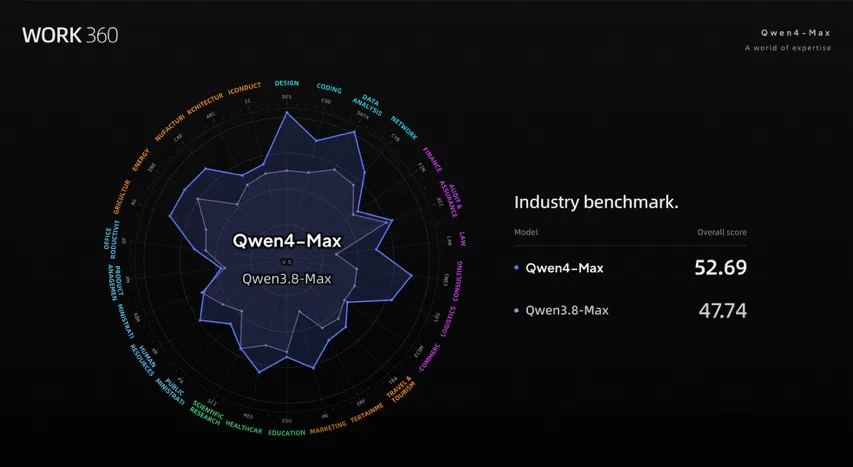
The figure Alibaba leans on hardest comes from Work360. It’s Alibaba’s own proprietary benchmark, covering challenging industry tasks across 721 specialised fields. On it, the company says Qwen4-Max beats Qwen3.8-Max overall. It also uses 35% fewer tokens in its High effort reasoning mode and cuts the average cost per task by around 60%.
Since the test is Alibaba’s own, treat those numbers as the company’s claim rather than a neutral verdict. They still point at something that matters. A model that reaches an answer in fewer tokens costs less for anyone paying per token, and actual user pricing depends on the service and plan.
For pricing, check QwenCloud’s own pricing page before you budget a project around the model.
Machines, Coolants and Molecules
Alibaba’s demonstrations aim mostly at industry, but a few are fun to picture. In car manufacturing, the company says the model cut manual workpiece programming time by 95%, from about 475 minutes to 24 minutes. It got there by checking its own work for overcuts and missed material before any metal got cut, which is a lot more patience than most of us bring to group projects.
The science claims are bolder. Alibaba says Qwen4 ran for 48 hours straight through four rounds of designing, making and testing molecules, and found an experimentally validated coolant for next-generation chips. In an Alzheimer’s research experiment, it reportedly made 454 tool calls and 3,239 metric evaluations to design and refine 24 candidate molecules. Candidate is the key word there: these are starting points for researchers, not medicines.
Closer to home for creators, Alibaba says the model supports 3D modelling, game development and agentic video creation. “Agentic” means the AI carries out a chain of steps by itself rather than answering one prompt at a time. Alibaba says it can speed up forward-deployed engineering (FDE) too, where engineers build AI tools directly with clients in fields like finance, law and healthcare.
Should Students Bother?
For coding projects and long research tasks, yes, it’s worth a test drive. The million-token window and the multi-step agent focus suit the jobs where smaller chatbots lose the plot halfway through, like a final-year project repo or a stack of readings for one essay. QwenStudio is the easiest door in for most people, while QwenWork is pitched at the work side of things.
First-jobbers should go in with clear eyes. An AI teammate that drafts reports faster is great, but it won’t fix a workplace that already expects the 11pm reply. Use the time it saves on yourself!
Hobbyists have a reason to keep watching. Alibaba says smaller open-weight models from the Qwen4 series will be released to developers worldwide soon. Open weights mean you can download and run the model on your own hardware, though that timing is Alibaba’s plan rather than a fixed date.
Guardrails Built In
Alibaba says safety runs through the whole training process. Coding training included security checks alongside functionality tests, which it says reduced vulnerabilities such as injection flaws, memory safety bugs and broken access control. For cybersecurity, it kept defensive material for finding and fixing bugs and removed offensive attack content. Extra safety datasets target chemical, biological, radiological and nuclear (CBRN) risks.
Strip away the trillion-sized headline, and Qwen4-Max is really a bet that you’ll pick the AI that does more work for less money. Alibaba’s own numbers say it delivers, and the only way to know if it fits your workflow is to throw a real assignment, side project or job application at it. Try it free of hype on QwenStudio, explore QwenWork for office tasks, or sign up on QwenCloud for the Token Plan and API, and keep an eye out for those smaller open-weight models landing soon!
Photos and Visuals courtesy of Alibaba Group.
Read us first on Google: add DANAMIC as a preferred source and our stories show up more in your Top Stories and AI results.