Grand Theft Auto VI (GTA 6) launched on 19 November 2026, and email security company KnowBe4 says scammers spent recent weeks before it disguising phishing emails as free copies of the game, many of them aimed at work inboxes. If you’re in Singapore and heading to Vice City, you’re the target. The most convincing version looks like a perk from your own HR team.
The timing makes sense from a scammer’s point of view. Fans have waited 13 years for this sequel, and the release slipped more than once along the way. When Rockstar Games dropped the second trailer in May 2025, the game was still pencilled in for 26 May 2026. Estimates put digital pre-orders at roughly 10.31 million copies across PlayStation and Xbox, worth over US$1 billion. Those numbers are third-party estimates rather than sales figures from Rockstar or its parent company, Take-Two Interactive. Either way, almost every office has someone itching to play, and scammers know it.
Where the Numbers Come From
The findings come from KnowBe4’s Threat Lab. According to the company’s Phishing Threat Trends Report Vol. 8, its statistics are drawn from emails processed by KnowBe4 Defend, the company’s email security product. That means the data covers organisations using Defend and doesn’t represent every inbox on the planet. It’s still a useful window into what lands in corporate mail.
What it shows is a sharp climb. In September 2026, GTA-themed phishing made up 0.005% of threats KnowBe4 tracked. Since then, gaming-related phishing overall has jumped 1,300% compared with its monthly average from March to August. In the week that began on 26 October, GTA lures made up 9.6% of all phishing volume. Over the weekend of 31 October to 1 November, GTA-related impersonations made up 42.4% of all phishing emails KnowBe4 processed, which works out to more than two in every five.
Two Waves, One Game
KnowBe4 describes a two-part strategy. The first wave is loud and sloppy on purpose, built to flood corporate security teams with background noise. These emails come from rotating webmail accounts, and the body is blank apart from a single link. Leaving out the text means there’s nothing for language-reading spam filters to flag.
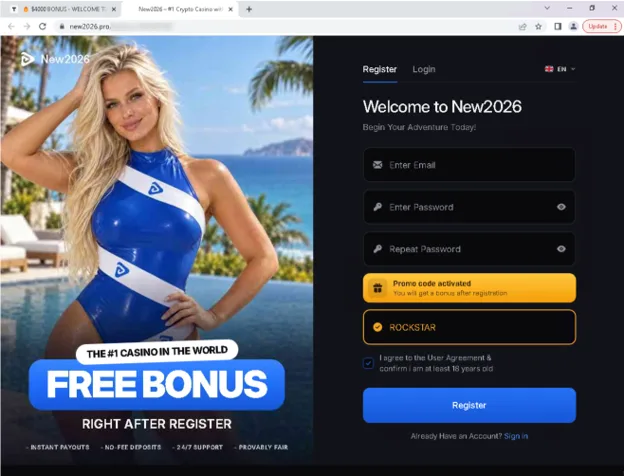
Click that link and you land on an anonymous page hosted on Telegram’s graph[.]org. KnowBe4 says these pages use Vice City neon styling, AI-generated images of the game’s leads Lucia and Jason, and Rockstar Games branding. They dangle a “$4,000 bonus” with the promo code ROCKSTAR, then push victims towards fraudulent online casinos or crypto platforms that harvest passwords, card details, and cryptocurrency deposits. This wave mostly hits the United States (47%) and United Kingdom (35%), with the education sector taking 39% of it.
The second wave is the one worth worrying about at work. Scammers pose as an employee benefits programme offering a “free Grand Theft Auto 6 Pre-Order”. The offer is supposedly limited to the first 250 employees and expires in 48 hours. Some even include a fake verification banner saying no payment information is collected, which is designed to make you relax.
These campaigns are smaller, averaging 20 attacks each, but they’re aimed at company logins rather than your wallet. KnowBe4 found 83.2% of them arrive on weekends, when people idly check work email and a “free game” perk feels like a pleasant surprise rather than a red flag. That’s a smart bit of timing, and an unpleasant one.
How the Emails Get Past Filters
Here’s where it gets clever. Rather than faking a known brand, KnowBe4 says attackers register look-alike vendor domains. Those domains pass the three standard email authentication checks: SPF (Sender Policy Framework), DKIM (DomainKeys Identified Mail), and DMARC (Domain-based Message Authentication, Reporting and Conformance). To an email filter, the message looks properly signed and legitimate.
The QR code is the other trick. Instead of embedding a QR image, attackers build the code out of Unicode text block characters or HTML tables. Image scanners looking for QR codes don’t see a picture, so they wave it through. KnowBe4’s report traces a similar move to an earlier campaign. After the Kumamoto earthquake in Japan in April 2026, scammers posing as the Japanese Red Cross Society built a fake PayPay donation QR code out of a table.
Then comes what KnowBe4 calls the “device shift”. The email asks you to scan the code with your personal phone. That moves you off the company network and out of reach of its web filtering and EDR (Endpoint Detection and Response) tools, which are the systems meant to catch you visiting a dodgy page. On your own phone, you’re on your own. The free pre-order is the bait, and your work login is the catch.
Why Singapore Should Pay Attention
The latest Singapore Police Force (SPF) numbers offer some context. Its Mid-Year Scam and Cybercrime Brief 2026 shows total scam losses fell 17.9% to about S$410.6 million in the first half of 2026, and cases dropped 14.4% to 16,821. That’s genuinely good news. Phishing still ranked second among the top scams of concern, with 3,104 cases and S$9.6 million lost. It sits in the top three scam types for every age group under 50.
KnowBe4’s own report adds a local wrinkle that fits the fake-HR playbook neatly. Colleague impersonation makes up 15.9% of dangerous mail reaching Singapore organisations, the highest rate the company recorded in any market. An email pretending to come from your own HR team lands in exactly that gap.
Your Scam-Spotting Checklist
Drawing on KnowBe4’s guidance and SPF’s advice, here’s what to watch for:
- Real perks live on your intranet or HR portal. A legitimate company benefit won’t arrive as an unsolicited external link or an urgent QR code.
- “First 250 staff” and “48 hours” are pressure tactics. Genuine benefits don’t depend on artificial urgency.
- A work email asking you to scan with your personal phone is a red flag. That request exists to get you around company security.
- “No payment info collected” banners prove nothing. KnowBe4 found scammers add them to lower your guard.
- Blank emails with one link deserve deletion. So does any page promising a “$4,000 bonus” with the code ROCKSTAR.
- Get backup. SPF recommends installing the ScamShield app, switching on two-factor authentication (2FA), and calling the ScamShield Helpline at 1799 if you’re unsure.
Play It Safe at Launch
GTA 6 is worth the excitement, and nobody should feel silly for being hyped after 13 years. The scam works because it borrows that feeling and adds a ticking clock, so the best defence is a pause before you scan. If something looks like a freebie from HR, check the HR portal or ask a colleague first, then get back to your first night in Vice City. For the full breakdown of how these campaigns work, read KnowBe4’s Phishing Threat Trends Report, find out more about the company’s work, and share this checklist with the friend in your office group chat who is already counting the hours.
Visuals courtesy of KnowBe4.
Read us first on Google: add DANAMIC as a preferred source and our stories show up more in your Top Stories and AI results.