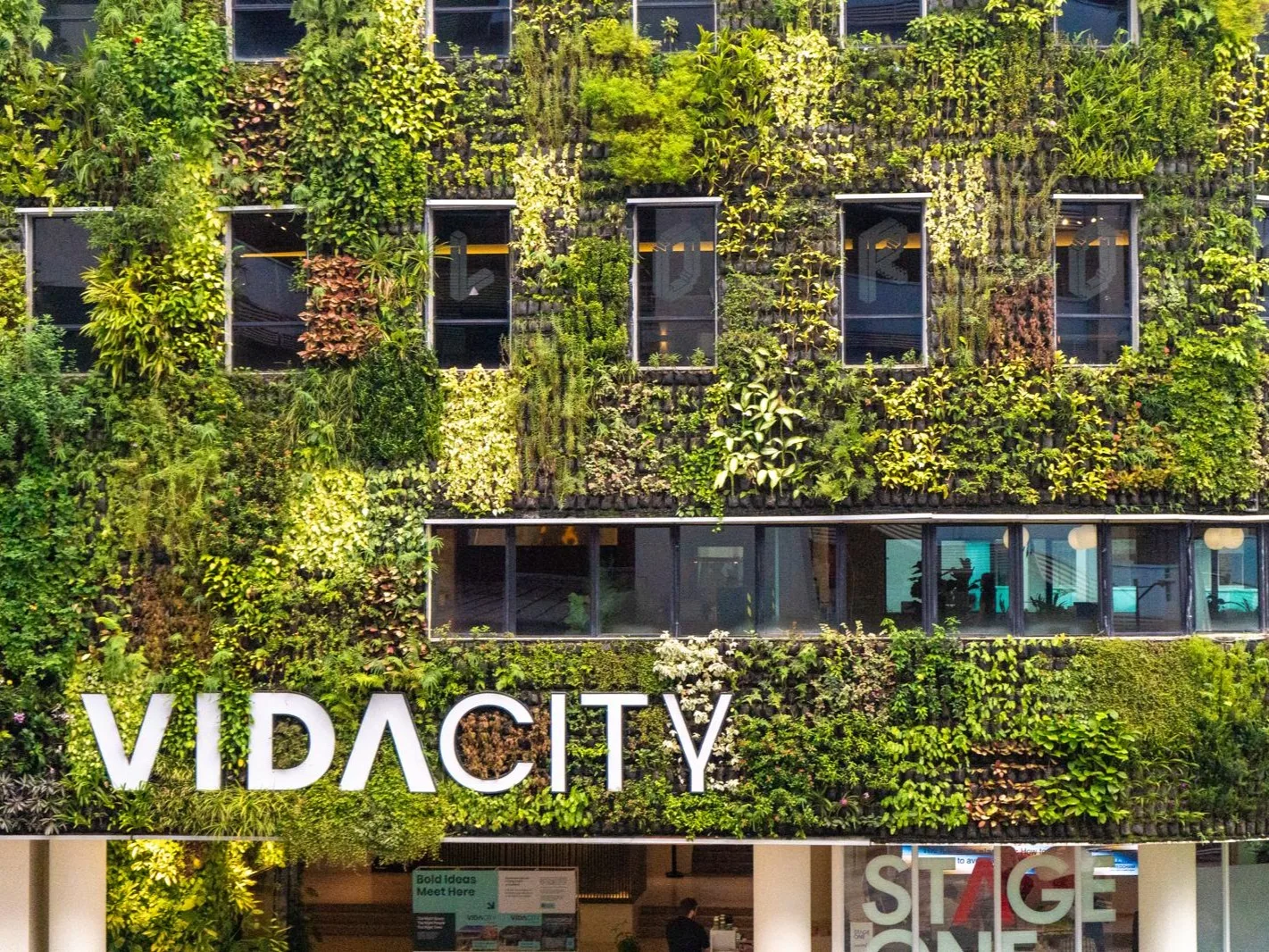
Singapore green-infrastructure firm GWS Living Art and sustainability hub Vidacity unveiled a 1,035.4 sq m green wall at JTC LaunchPad @ One-North on 30 October 2026, with 400 plant cultivars and species growing across it. Early readings from the project’s own sensors record an average cooling effect of 1°C across the façade. If you’ve ever walked past a sun-baked concrete wall at 3pm and felt the heat bouncing back at you, that’s the problem this wall is trying to solve.
GWS Living Art bills the project as Asia Pacific’s most biodiverse green wall. The bigger draw, though, is what the plants are doing up there. The wall is a running experiment, and every leaf on it is part of the data.
Four Sides, Sun to Shade
Each side of the building gets its own mix of light and heat, so the planting was laid out to match.
Most green walls are planted to look good on launch day and stay that way. This one was built for the plants to adapt to the conditions around them, which means the wall is expected to keep changing as some varieties settle in and others struggle. That’s a far more honest way to grow a wall in Singapore’s heat, where the sunny side and the shaded side of the same building are almost different climates.
What the Sensors Picked Up
Environmental sensors installed across the façade gave the project its first numbers. According to GWS Living Art, the green wall recorded an average cooling effect of 1°C over the course of the day across all elevations.
The more striking figure comes from the north-facing elevation. When temperatures around the adjacent concrete peaked at 32.7°C, those around the green wall stayed below 30.0°C, a gap of more than two degrees at the hottest point. The readings suggest the planting softens daily swings too, with a narrower temperature range around the green wall than around the bare concrete.
These are early figures from the project’s own monitoring, so they’re a first look rather than a final verdict. Still, the north-side result is the one to remember. Two degrees is roughly the difference between a walk to the MRT that feels bearable and one that leaves your shirt stuck to your back!
A Lab With NUS Scientists
The research side has serious names behind it. Associate Professor Adrian Loo, Deputy Director of the National University of Singapore (NUS) Centre for Nature-based Climate Solutions, and Associate Professor Stephen Tay from the Department of the Built Environment at the NUS College of Design and Engineering are supporting the study. Together with the project partners, they’ll track how different plant varieties respond to real light, heat and exposure. The team will also test new installation, irrigation and maintenance approaches.
GWS Living Art designed and installed the wall. Vidacity provided the site and platform for the collaboration, while the National Parks Board (NParks) and JTC supported the project.
“Cities need greenery that does more than ‘soften’ concrete,” said Zac Toh, Founder and Director of GWS Living Art. “This project explores what a green façade can become when it is designed as living infrastructure with a habitat, a climate-responsive surface and a place where new ideas in planting and maintenance can be tested in full view of the city.”
GaiaWall 2.0 Behind the Leaves
The launch doubled as the debut of GaiaWall 2.0, the newest version of GWS Living Art’s green-wall technology.
It’s the least photogenic part of the story, but it might matter most in the long run. A huge living façade only makes sense for developers if it’s practical to keep alive. GWS Living Art says GaiaWall 2.0 supports its aim of proving that large green façades can be expressive in design and manageable to maintain at the same time.
Why Your Future Neighbourhood Cares
Toh framed the early results as proof of what happens when greenery is treated as part of a building rather than an add-on. “That knowledge can help shape more liveable and climate-responsive developments as Singapore continues to grow,” he said.
That’s the part worth caring about if you’re 25 and planning to live in this city for the next 50 years. The findings from this one wall are meant for the architects, developers and planners deciding how nature fits into the HDB estates, offices and campuses that come next. Seeing the experiment run at a startup hub makes sense, too. LaunchPad @ One-North has housed more than 2,400 startups since 2015, including Carousell, PatSnap and Nium, across seven blocks.
GWS Living Art, founded in 2017, says it has delivered projects for more than 200 clients across Singapore, Asia and the United Arab Emirates (UAE). Vidacity, launched in 2024, runs sustainability living labs at multiple sites across Singapore.
🗓️ Date: Unveiled Friday, 30 October 2026
📍 Location: Vidacity @ One-North, JTC LaunchPad @ One-North
📐 Size: 1,035.4 sq m across four elevations
🌱 Planting: 400 plant cultivars and species
🌡️ Early Reading: Average 1°C cooling across the façade, per the project’s sensors
🔬 Research Support: Assoc Prof Adrian Loo and Assoc Prof Stephen Tay, NUS
🧱 New Tech: GaiaWall 2.0 modular green-wall system
The wall isn’t finished telling its story, since the sensors and plants will keep producing data long after launch day. If you want to see how a façade full of 400 varieties copes with Singapore’s sun, follow GWS Living Art for updates on the wall and GaiaWall 2.0. You can keep up with Vidacity and JTC LaunchPad @ One-North as the experiment grows, one leaf and one degree at a time!
Photos and Visuals courtesy of GWS Living Art and Vidacity.
Read us first on Google: add DANAMIC as a preferred source and our stories show up more in your Top Stories and AI results.