If your idea of a long weekend is checking into an Oasia or a Village hotel without leaving the island, your stays are about to count for more. From 1 April 2027, the planned go-live date, Far East Hospitality properties are set to join GHA DISCOVERY, a loyalty club whose rewards travel with you to hotels across Asia, Europe and beyond.
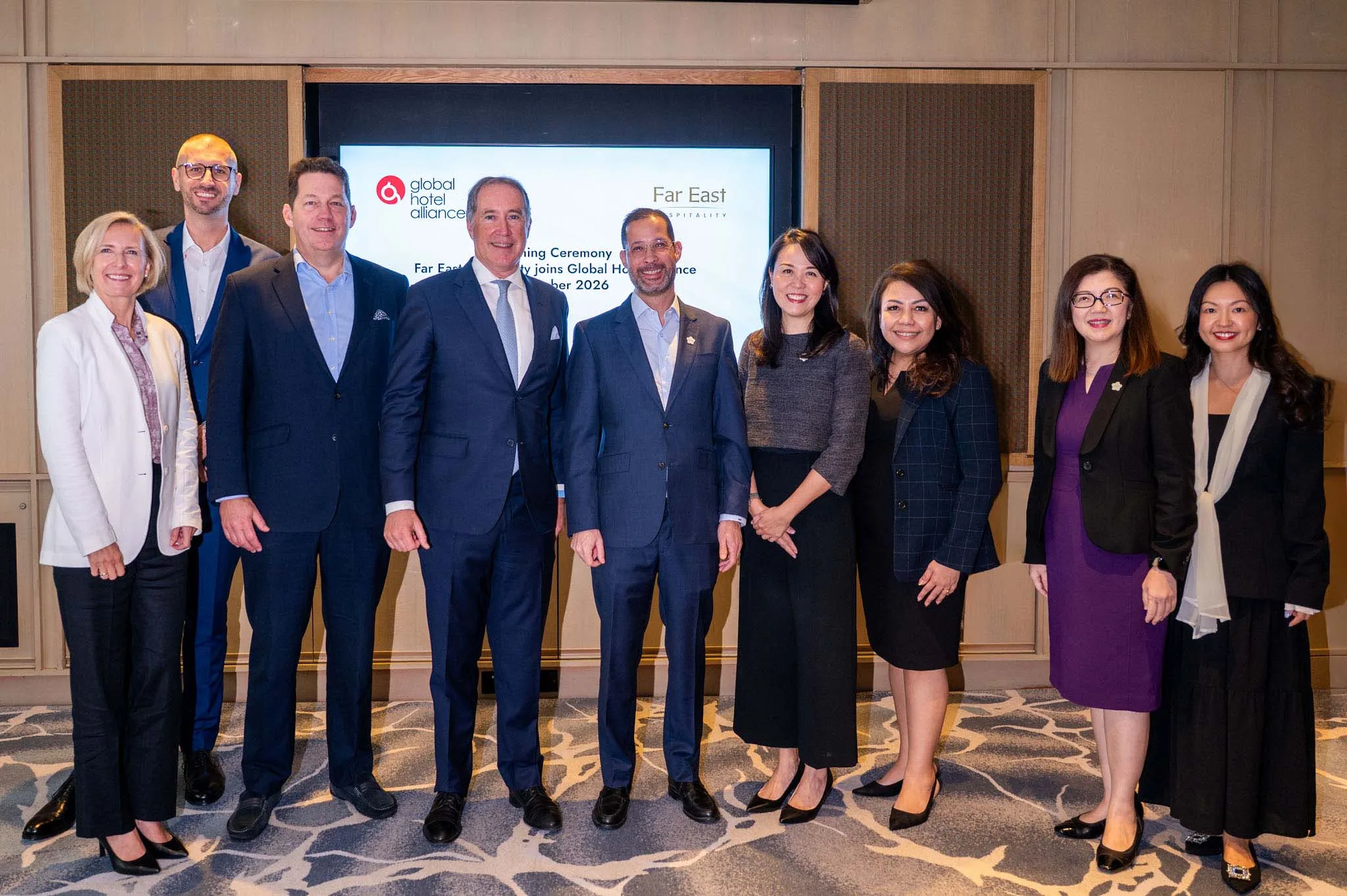
The deal was announced on 21 October 2026. Global Hotel Alliance (GHA), the group behind GHA DISCOVERY, welcomed Far East Hospitality (FEH) into its portfolio, bringing 26 hotels and serviced residences and 6,212 rooms across Singapore, Malaysia and Japan. Five FEH brands are in: Oasia, Quincy, Rendezvous, Village and Far East Collection.
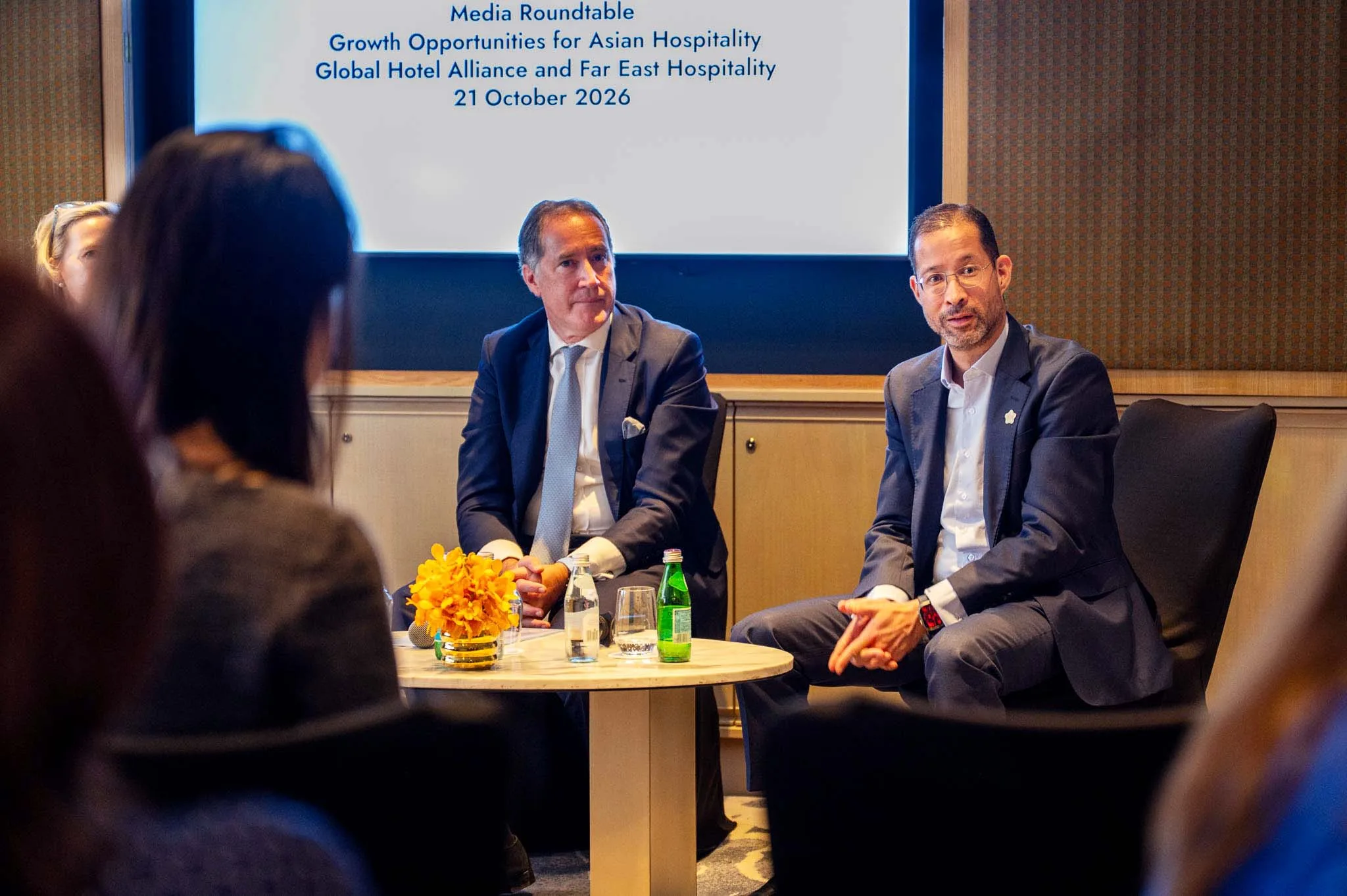
A signing ceremony opened the day. Afterwards, GHA chief executive Chris Hartley and FEH managing director Mark Rohner sat down with media at the Fairmont Singapore for a roundtable, moderated by Andrea Krenn, GHA’s Head of Global PR.
What Changes for Guests
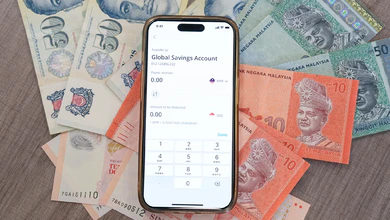
GHA DISCOVERY connects more than 38 million members, and its currency is DISCOVERY Dollars (D$). GHA says D$ can be earned and redeemed across all GHA brands. Members get member rates, room upgrades, local offers, and experiences on top.
For FEH’s guests, that’s the headline change: their hotel stays plug into a much bigger network than a single Singapore group could offer on its own. Rohner said the work is “all on track to go live 1st of April”, though as with any launch, treat that as the company’s plan until the switch actually flips.
Hartley’s numbers explain why a local group would care about this club in particular. He said GHA has 600,000 Singapore-based GHA DISCOVERY members, who spend “thirty, forty million US dollars” in Singapore hotels. About 20% of the business GHA drives in Singapore comes from Singaporeans on staycations, he added, so locals aren’t an afterthought here. They’re a real slice of the trade.
He said two-thirds of GHA’s bookings now come through its app, and that cross-brand revenue (members staying at one GHA brand and then another) is up 40% so far in 2026. For a staycationer, the app is where the action is going to be.
Which FEH properties should be on your radar? Rohner pointed to the 606-room Village hotel on Sentosa, and it’s the obvious one for the island-weekend crowd: a big resort-style property where a family or a group of friends can spread out.
Why a Homegrown Group Wanted In
GHA has deep Singapore roots. Hartley said the alliance turns 22 this year, having been founded here in 2004 as a joint venture, with Pan Pacific Group as a founder partner alongside Kempinski. It was, in his words, “designed as a joint venture to help independent brands stay independent and protect their interests against the ever-growing size of the online travel agents and the major global brands.”
Today GHA covers about 1,000 hotels in about 60 independent brands, and Hartley said roughly 70% of them are run by the same people who own them. That last detail matters to the economics, as we’ll get to.
Rohner said that about a year ago, FEH’s management team came to the conclusion that “we need to have a really strong loyalty solution”. They weighed the options and landed on GHA, which he described as a good fit for medium-sized companies. Translation for the rest of us: building a rewards programme big enough to compete on your own is hard, so joining a club of other independents makes more sense than trying.
FEH is putting people behind the plan. Rohner said the group has hired a director of loyalty based in Dubai, and he’s already set the date for judging whether it worked: 1 April 2028, one year after launch. He’ll look at whether a loyalty culture has taken root among front-line staff and general managers, how much business flows between brands, and whether more guests come back. It’s refreshing to hear a hotel boss name his own report-card date out loud.
The Booking Fight: OTAs Versus Direct
Here’s the part most travellers never see. When you book a hotel through an online travel agency (OTA), the booking sites and apps that compare rooms for you, the hotel pays for it. Hartley said an OTA booking costs a hotel roughly 18% to 20%, while a direct booking “may be as low as 5%, potentially 10% or 15%”.
Loyalty is how hotels try to win you back to their own channels. Hartley said that once members reach GHA’s top tier, Titanium (30 nights or more a year), “there’s only a 2% likelihood that they’ll book through an OTA”, down from about 50%. For owner-operated hotels, he pointed out, every dollar saved on commission goes straight to the owner rather than disappearing into a middleman’s margin.
Rohner was careful not to pick a fight. “I don’t think OTAs are going away. They are our partners,” he said. FEH is still investing in its own website booking engine, which tells you where the group would prefer you to click, even if it isn’t burning any bridges.
What the CEOs Said About AI
This is where the conversation got interesting. Krenn cited GHA’s own survey of chief executives across the independent hotel brands in its network: 91% of Asia-Pacific CEOs in that survey said AI assistants, rather than OTAs, will be the most influential hotel booking channel by 2030. Bear in mind that’s the view of hotel bosses inside one alliance, not travellers, and it’s a forecast rather than a measurement of what people do today.
Rohner said FEH is watching closely. On his last two or three trips, he said, “the discovery part is really all driven by AI”. So FEH is redesigning its website and hotel descriptions to answer the kinds of questions people type into large language models (LLMs), the tech behind chatbots like the ones many of us now ask for travel ideas. He was firm on one point, though: “direct customer service will never be replaced by AI”.
Behind the scenes, FEH already uses AI for email automation, central reservations, and staff scheduling, and Rohner said it will start a new AI-driven revenue management system (the software that sets room prices) next year.
Hartley sounded more wary. AI “could be a risk”, he said, recalling that 20 to 25 years ago, hotels “lost our inventory to third parties because we were slow to react”. That’s how the OTAs got so powerful in the first place. He expects the big players to build their own booking tools into AI agents, and believes a thousand hotels acting together can “get ahead of the game a little bit this time around”.
He was honest about the cost, too. Hartley described a coming battle for hotel content to reach customers early in the AI search process, and said “it may be expensive as well”, since AI companies will want to be paid. His goal is simple enough: when you ask a chatbot about a GHA hotel, he wants it to point you to GHA DISCOVERY.
The hotels lost the last tech shift to the booking sites, and this time they’re trying to show up before the chatbot decides for you.
Where FEH Goes Next
Rohner said that 25 of FEH’s properties are in Singapore (“a bit too much, probably”, he admitted) and five are in Japan. The group is eyeing Vietnam, Indonesia, and Thailand. In Malaysia it’s already in Kuala Lumpur, and Rohner wants Johor Bahru next, followed by Malacca and Penang.
That Japan foothold lines up neatly with GHA’s own traffic. Hartley said Japan is currently GHA’s most popular market, “believe it or not, at the moment”, which makes FEH’s Japanese hotels a handy place for members from elsewhere to discover the brands.
Don’t expect a splashy ad blitz, though. Hartley said GHA is a business-to-business organisation, and that bigger chains charge hotels three or four times more for their loyalty programmes to fund marketing. GHA is “dabbling” instead: next year that means a joint sponsorship with partner Leela of the Maharaja’s Polo event in Jaipur, plus some tennis and golf. “I don’t see us on the Formula One Grand Prix,” he said, which is about as clear as a CEO gets.
For Singaporeans, the appeal is easy to see. A homegrown hotel group you’ve probably stayed with is plugging into a 22-year-old Singapore-born alliance, and, going by the plan, stays at its hotels will start earning D$ from 1 April 2027. Keep an eye on the Far East Hospitality website for how the switch-over works, and if the 2028 report card comes back strong, that Sentosa weekend could end up paying for a night in Japan!
Photos and Visuals courtesy of Far East Hospitality and Global Hotel Alliance.
Read us first on Google: add DANAMIC as a preferred source and our stories show up more in your Top Stories and AI results.