Esports closed out its second run as an official medal sport at the 20th Asian Games on 2 October 2026, and it was the largest esports programme the Games has ever staged, with 11 events played at Aichi Sky Expo in Japan. Behind those matches sat a referee-support system that was tested at three events in Japan, Singapore and Vietnam between January and June 2026.
That system is the Tencent Esports Competition Solution (ECS), which Tencent Esports describes as a first-of-its-kind setup built for large-scale intercontinental esports competitions. It’s the unglamorous half of the story, and it’s the half that says the most about where competitive gaming stands right now!
From Demo Sport to 11 Medals
The climb has been quick. Esports appeared as a demonstration sport at Jakarta-Palembang 2018, became a proper medal event with seven events at Hangzhou 2022 (held in 2023), and grew to 11 across six game categories this time around.
Mobile Legends: Bang Bang made its medal debut in Hall D.
Some perspective helps, though. The Asian Games carried 41 sports, 68 disciplines, and 461 events in total, so esports accounted for 11 of 461. Medal status at the Asian Games is likewise a different thing from a place at the Olympic Games, which esports doesn’t have. What it does have is two straight editions on Asia’s official medal programme, and the second was bigger than the first.
One Hall, Many Rulebooks
A professional league gets to build its whole technical setup around a single game. A multi-sport event has no such luxury, because titles from different publishers arrived in Japan with their own game engines, version management systems, and device formats, and each had to be officiated to a consistent standard.
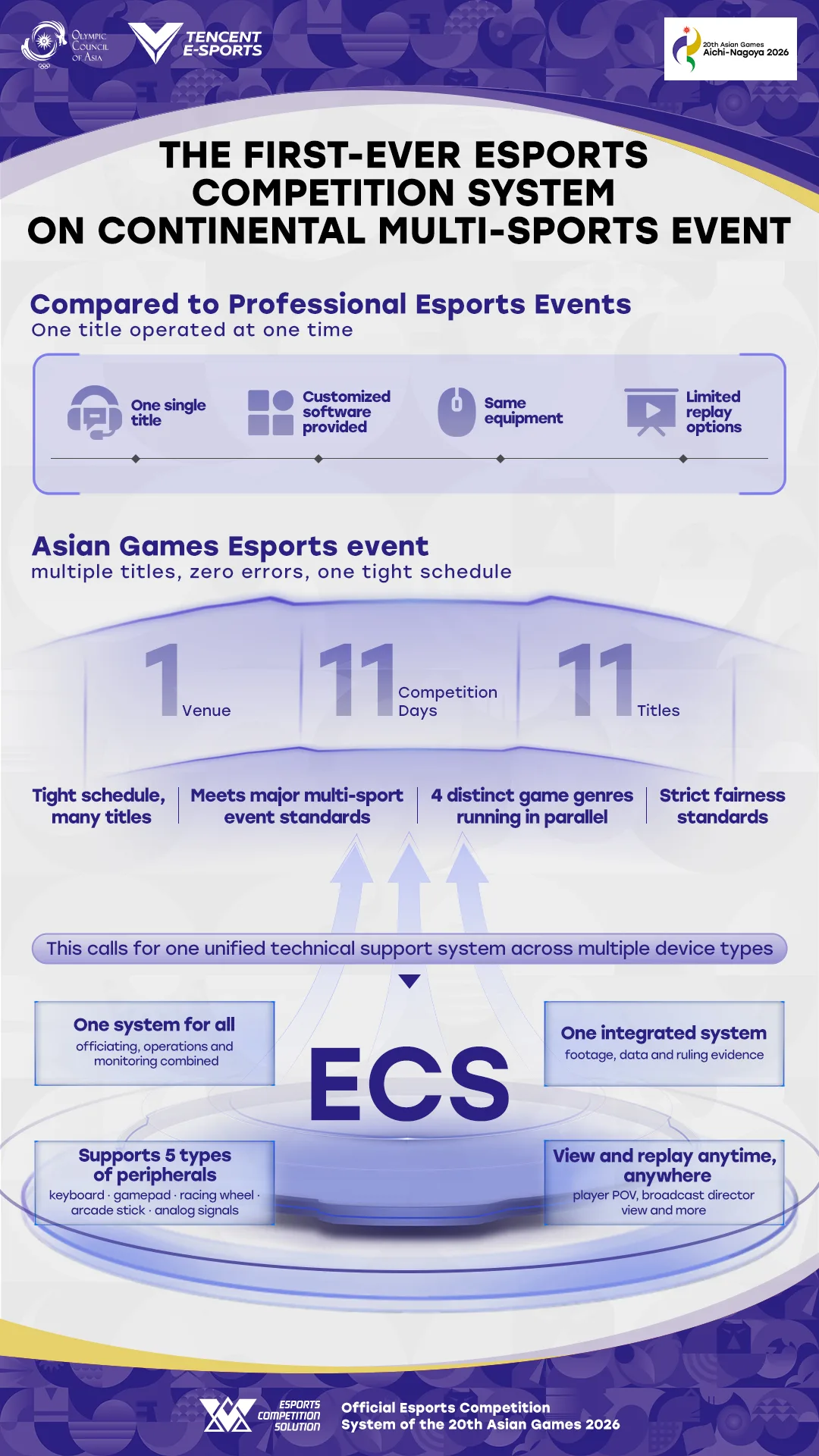
That’s a harder problem than it sounds. Picture a football referee who must, in the same fortnight, police a swim meet and a fencing bout with equal confidence. ECS was Tencent Esports’ answer, deployed across all 11 events to support referees, competition operations staff, and monitoring teams from check-in to archive.
Three Stops, 30 Live Indicators
According to Tencent Esports, ECS works in three stages. Before a match, the Inspection Station checks player peripherals, devices, and the competition environment while keeping check-in records, which is the esports equivalent of a weigh-in before a bout.
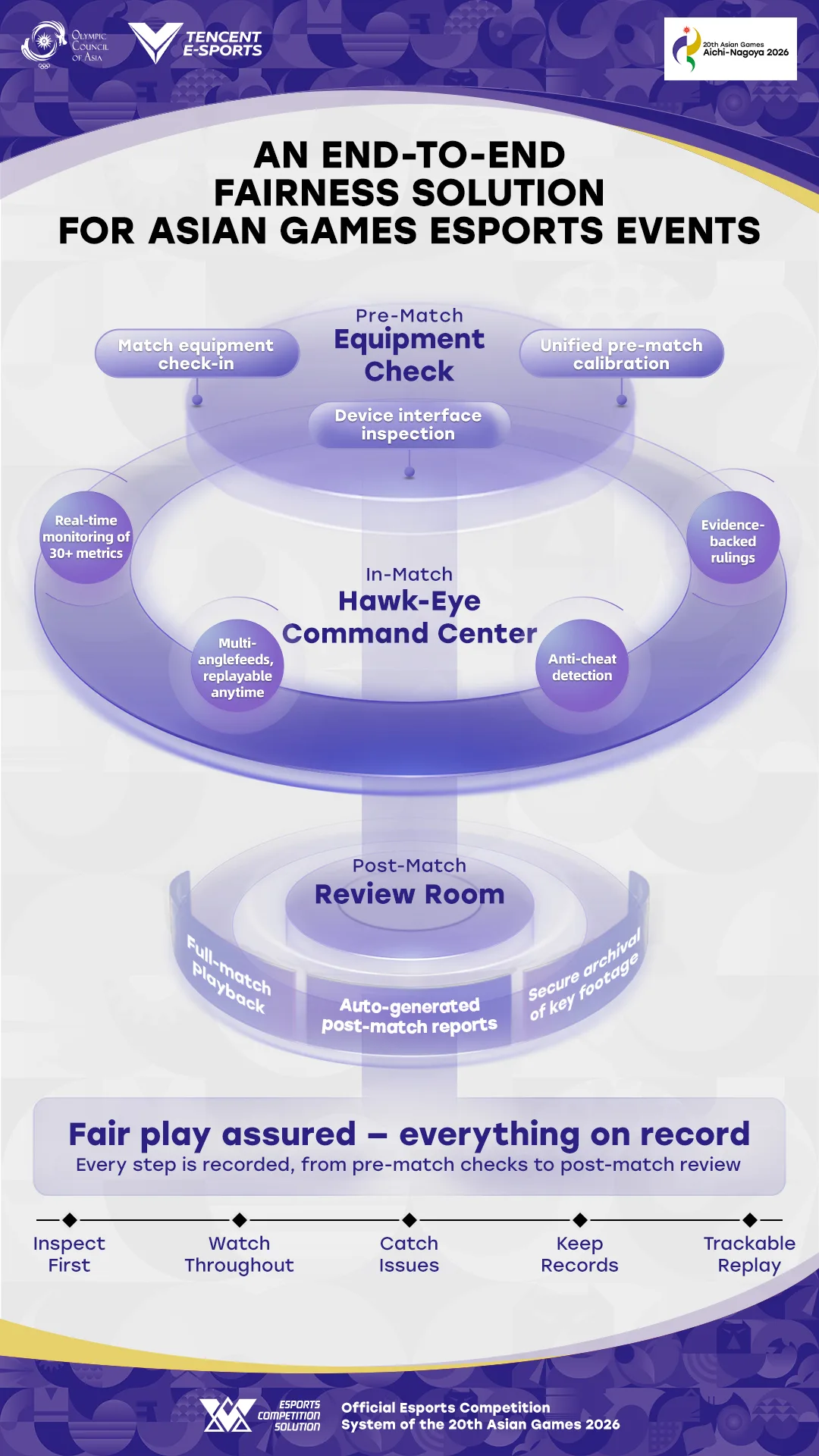
During play, the Monitoring Console tracks more than 30 indicators in real time, including device and network status. It pulls several video feeds together too: Player POV (the point-of-view feed of what a competitor sees), Observer View, and Hand Cam, a camera trained on a player’s hands.
Once the match ends, the Review Room gives officials access to records and footage for post-match review, record summaries, and video archiving. That stage matters most to anyone who has watched a disputed result dissolve into a comment-section shouting match, because it leaves a recorded trail to go back to.
Stress-Tested Across Japan, Singapore and Vietnam
ECS didn’t arrive in Japan cold. Tencent Esports ran three test events between January and June 2026 in Japan, Singapore, and Vietnam, trying the system across different venues, competition environments, and network conditions. The team then moved into the Asian Games venue in early September for integrated system testing.
The company’s track record comes from the previous Games, where it says its technical team supported 217 matches with zero technical incidents. That figure is Tencent’s own and refers to Hangzhou rather than Aichi-Nagoya. It sits alongside a 10-year strategic partnership between the Olympic Council of Asia (OCA) and Tencent Esports, which runs from 2025 to 2035.
OCA Director General Husain Al-Musallam said that “establishing more standardised and institutionalised competition systems will be an important long-term direction” for esports in Asia. He called the adoption of ECS at the Asian Games “another step towards this goal”.
What It Means for Players and Fans
Medals make the headlines, but the paperwork is what makes a sport. A sport gets taken seriously when its officiating does. Yati Zhang, Director of Tencent Esports, said as much in the announcement: “Esports entering multi-sport events means that its competition processes need to align with the standards of fairness established across traditional sports.”
For players, checked peripherals and monitored networks mean a result is far more likely to reflect what happened in the game than a faulty cable or a mismatched software version. For anyone eyeing a career around esports without the reflexes of a pro, the roles ECS was built for are worth noticing, because referees, competition operations staff, and monitoring teams are jobs too.
Fans, meanwhile, spent the Games posting about medals and national pride instead of technical hiccups. That’s the best compliment an officiating system can get.
🗓️ Date: 22 September to 2 October 2026
📍 Location: Hall D, Aichi Sky Expo, Tokoname, Japan
🎮 Programme: 11 medal events across six game categories
🏅 Status: Esports’ second edition as an official Asian Games medal event
🛠️ Tech: Tencent Esports Competition Solution (ECS) across all 11 events
The Asian Games esports programme is done for 2026, but the system behind it is meant to outlast it. Zhang hopes ECS can “serve beyond a single event and provide a reusable technical foundation for esports competitions across Asia”, and the OCA partnership has until 2035 to prove it. If the next big regional tournament runs on those three stages, this fortnight in Aichi will be where competitive gaming’s rulebook grew up!
Visuals courtesy of Tencent Esports.
Read us first on Google: add DANAMIC as a preferred source and our stories show up more in your Top Stories and AI results.