If you’ve ever answered a work message at 11pm with one eye on your phone and the other on your pillow, a new study suggests the reply isn’t doing much for your career. The Jobstreet by SEEK Singapore Workplace Culture Study 2026, released on 29 September 2026, found that 63% of Singapore employees feel the need to be always-on almost every day or a few times a week. Among those under that pressure, 62% say it has made no difference to their career progression.
That gap matters most to anyone in their first few jobs. Staying reachable drains real energy, yet only 18% of employers who expect always-on working rank after-hours availability among what they want most. The report covers both sides of the desk, so here’s the full picture, chart by chart, plus what workers and bosses can each change.
Who Was Asked, and When
Research firm Milieu Insight ran the survey on behalf of Jobstreet by SEEK between 18 and 26 August 2026. It polled 800 respondents in Singapore through Milieu Insight’s online proprietary panel, made up of 600 employees and jobseekers and 200 employers and hiring decision-makers.
The study defines “always-on” as being responsive and reachable, including outside working hours. Keep that definition in mind, because many of the sharpest numbers come from a subset: employees who say they feel always-on pressure, or employers whose organisations expect it. An 800-person online panel is a snapshot of the people who answered, not a census of every worker in Singapore. Even so, it puts the same questions to both bosses and staff, which is where the most telling results come from.
Flexible, but Not Lighter
Start with the paradox. 27% of employees say Singapore’s workplace offers more flexibility and work-life balance than it did in 2019. Yet 52% say workplace culture has become more stressful, and 46% say job scopes have grown more demanding. Employers see much the same: 30% report more flexibility, 48% notice greater stress and 45% see heavier job scopes.
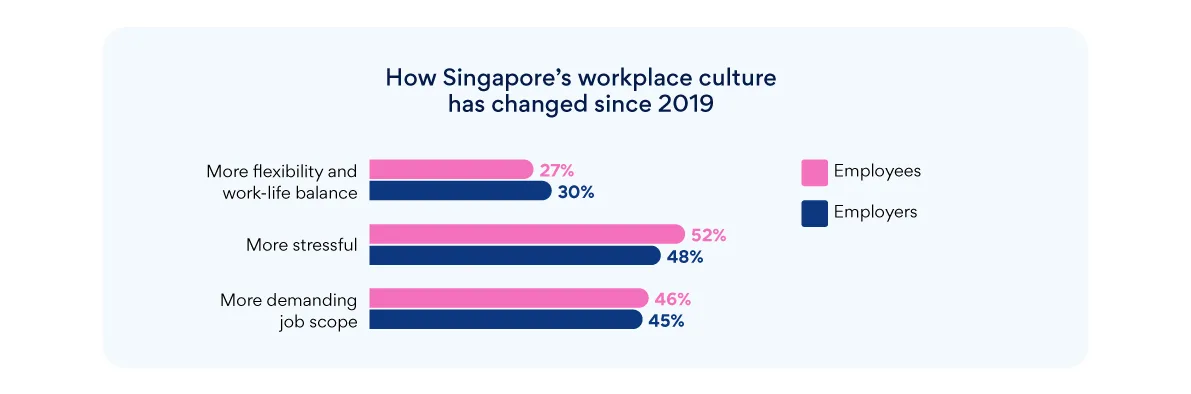
The report is careful to say flexibility didn’t cause the stress, and that’s fair. What changed is that the laptop now comes home on Fridays. The line between “at work” and “off work” got blurrier, and a fast reply became the easiest way to prove you were still pulling your weight from the sofa.
Flexibility has firmer footing these days. Since 1 December 2024, Singapore’s Tripartite Guidelines on Flexible Work Arrangement Requests have required employers to have a formal process for staff to request arrangements such as flexi-place or flexi-time, and to give a written decision within two months. The guidelines say nothing about what happens once you’ve logged off, and that’s the gap this study keeps circling back to.
Pressure From Beyond the Office
Both sides point to the same big forces. Artificial intelligence (AI) and automation top the list of what’s driving workplace change, picked by 56% of employees and 53% of employers. Economic uncertainty, inflation and the cost of living come next, at 53% and 46% respectively.
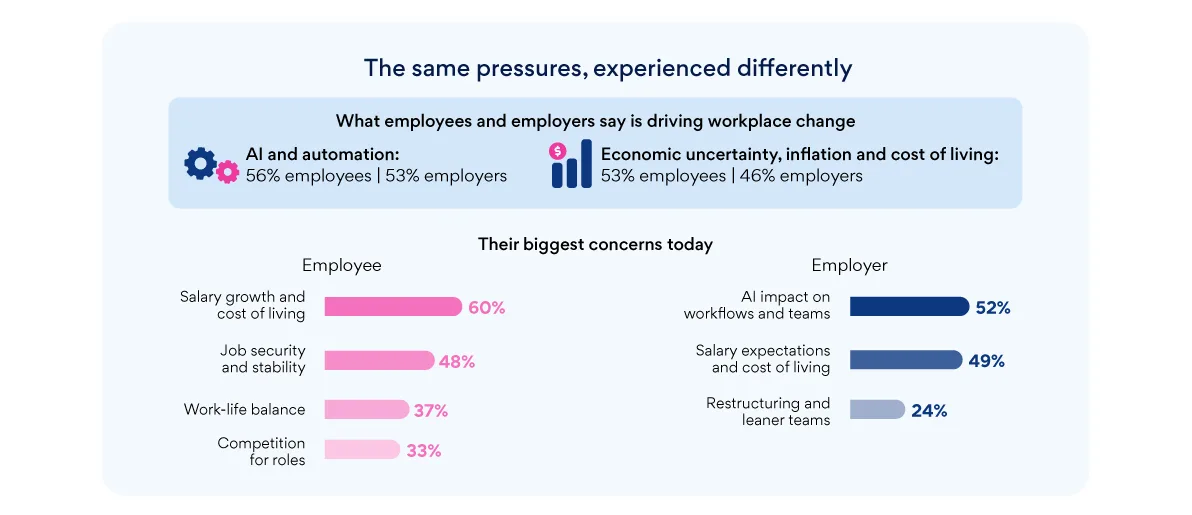
The two sides part ways on what keeps them up at night. For employees, the worries are personal: 60% name salary growth and the cost of living as their biggest concern, 48% worry about job security and 37% about work-life balance. One in three (33%) see increased competition for roles as a driver of change. Employers are thinking about operations. 52% are concerned about AI’s impact on workflows and teams, 49% are managing salary expectations amid rising costs, and 24% point to restructuring and leaner teams.
Put those together and the always-on habit makes sense. When your job feels less secure and AI is reshaping how your team works, being the person who always answers feels like kiasu insurance (Hokkien for “afraid of losing out”). The rest of the study shows how rarely that insurance pays out.
How Often the Phone Wins
For most respondents, this is a weekly experience. 32% of employees feel the need to be always-on almost every day and 31% a few times a week, which adds up to the headline 63%.
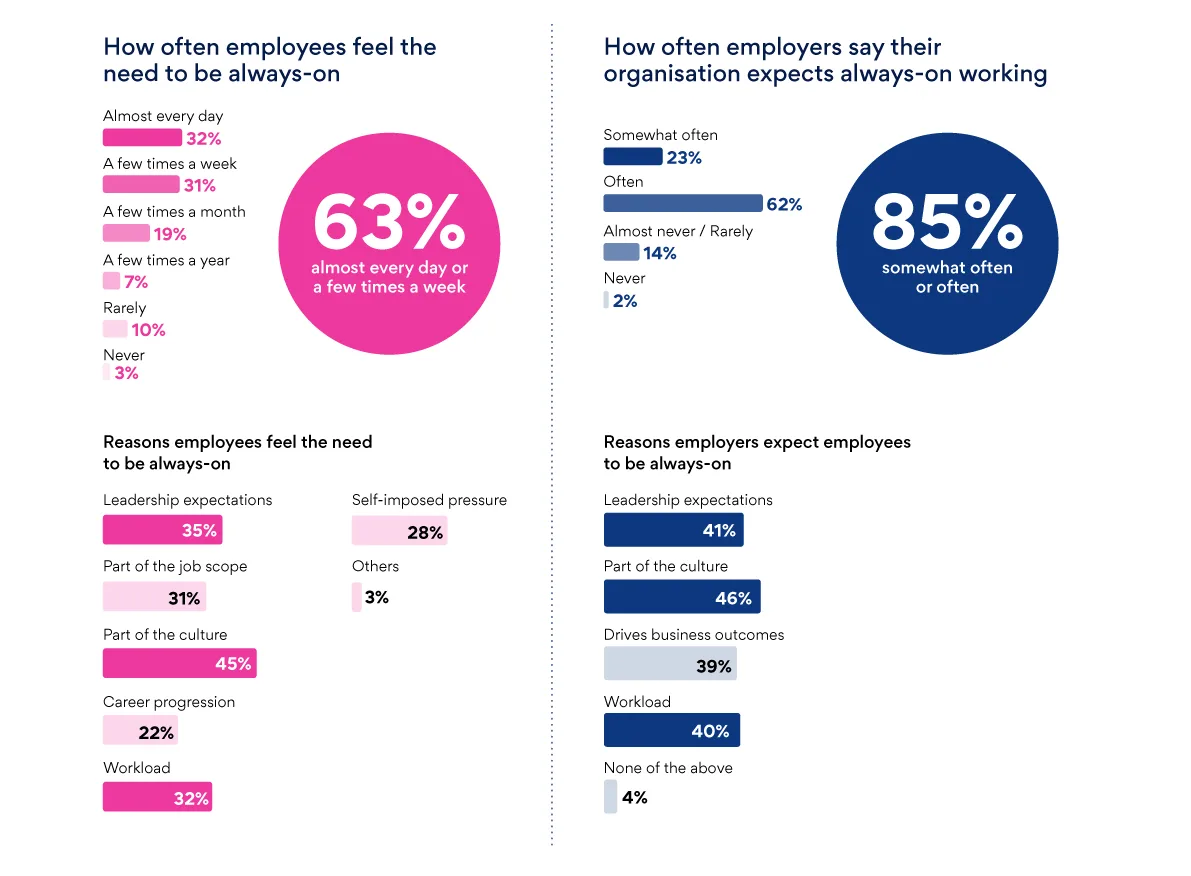
The expectation is real on the other side too. 85% of employers say their organisations expect staff to be always-on somewhat often or often. When the late-night ping arrives, employees aren’t misreading the room.
Age offers little escape. Frequent always-on pressure sits at 64% for employees aged 25 to 34, 62% for those aged 35 to 44 and 61% for those aged 45 to 54. The fresh grad and the senior manager are fielding roughly the same number of after-hours messages.
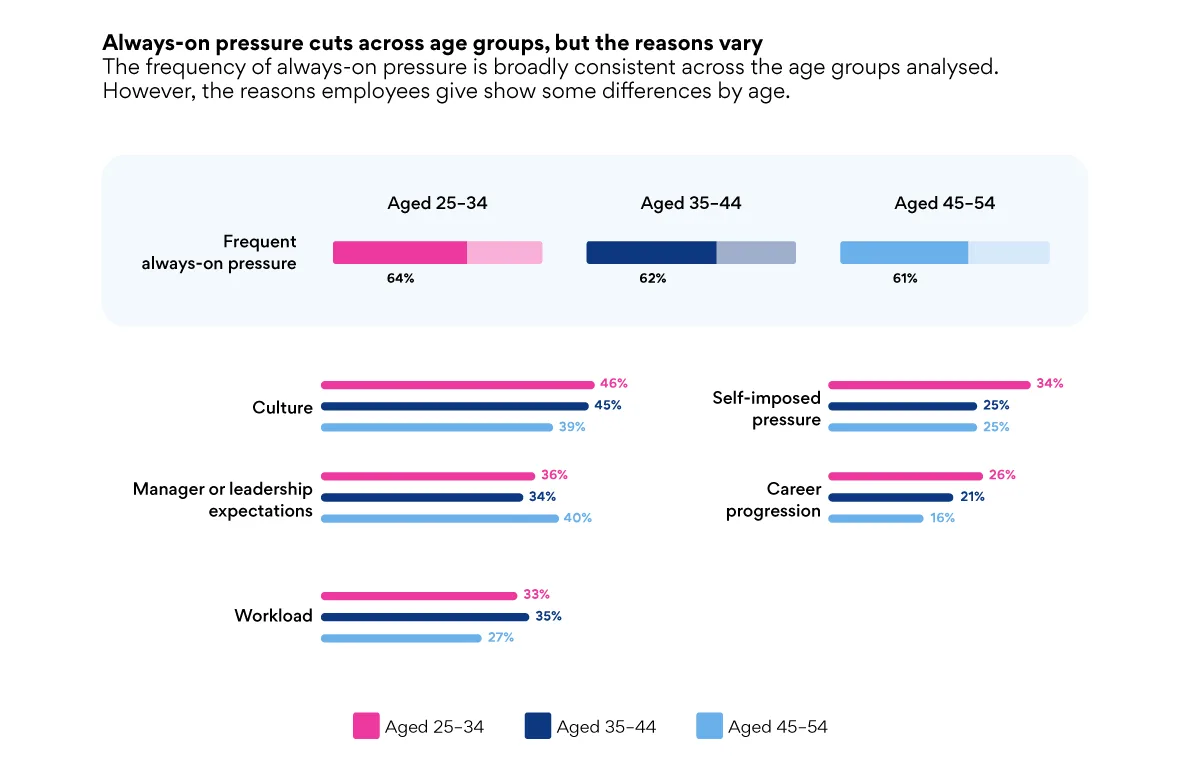
What shifts with age is the reason behind the pressure. Culture, manager expectations, career progression, self-imposed pressure and workload all weigh differently depending on the age group. The breakdown above is worth a look if you’re early in your career and suspect some of the pressure is one you’ve put on yourself.
Blame It on the Culture
Ask why, and both sides reach for the same answer. Among employees under always-on pressure, 45% say it’s part of the culture, 35% cite expectations from managers or leadership, and 32% say their workload is too heavy to finish during working hours. Among employers whose organisations expect it, 46% say it’s the culture, 41% cite senior leadership expectations and 40% admit the workload doesn’t fit into the working day.
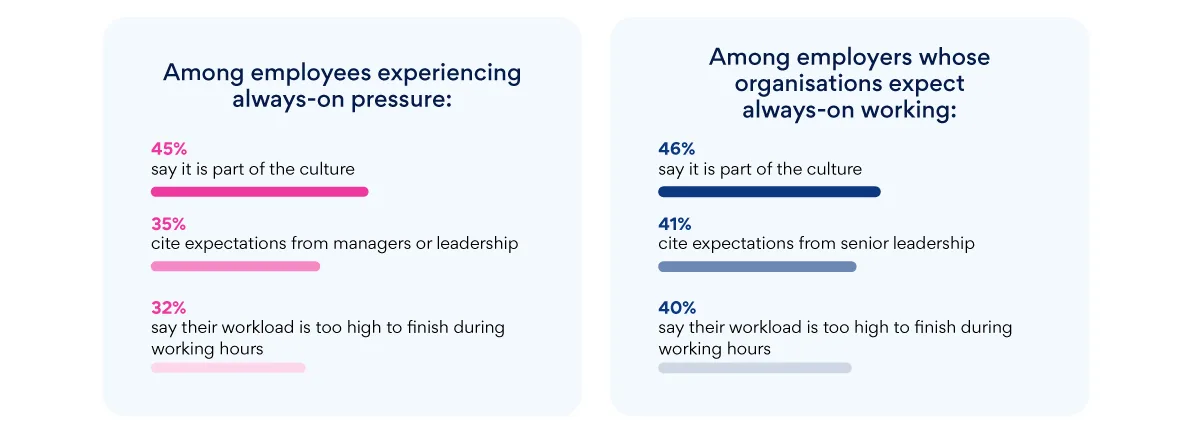
“Culture” can sound like the weather, something that happens to everyone and that nobody controls. The more useful reading is that leadership expectations and workload sit right behind it. A team can raise those in a meeting, and a manager can fix them.
Speed Versus Initiative
This is the misunderstanding at the heart of the study. Among employees under always-on pressure, 63% show it by responding quickly to requests and 52% by staying available outside working hours. Only 32% show it by taking initiative.
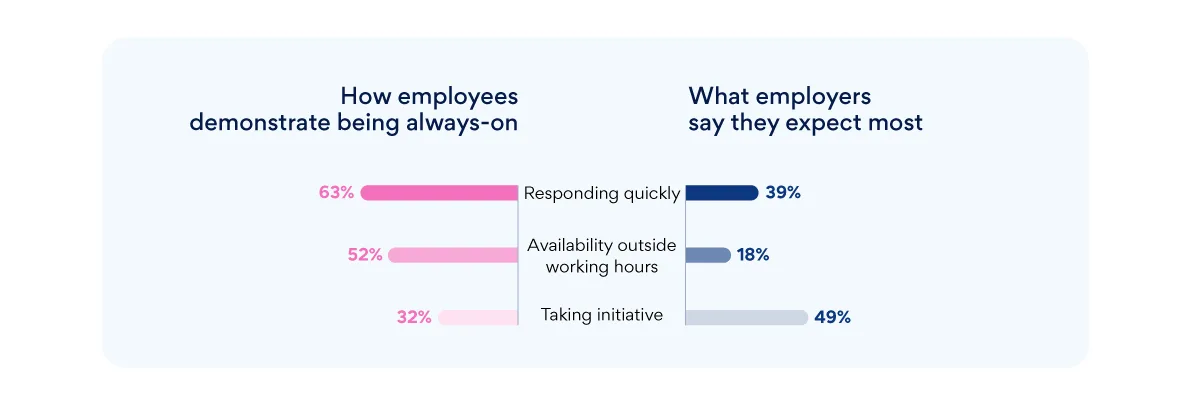
Employers whose organisations expect always-on working want something else first: taking initiative (49%) and delivering results (47%). Quick responses come in lower at 39%, and after-hours availability sits at 18%. That 11pm reply you hoped was earning brownie points is the behaviour employers rank lowest of the four!
Esther Lee, Managing Director (Singapore) at Jobstreet by SEEK, puts the gap down to communication. “The disconnect is less about what each side wants and more about whether organisations clearly communicate what good performance looks like,” she said. She added that responsiveness, initiative and commitment “should not become an unspoken expectation to remain constantly available.”
In fairness to employers, the report doesn’t paint the two sides as enemies. A manager can mean “take ownership” while an eager junior hears “reply within five minutes”, and neither of them ever says it out loud. Fixing that takes one honest conversation and nobody has to be the villain.
Plenty of Cost, Little Payoff
This is the part that should change how you treat your evenings. Among employees under always-on pressure, 63% say it has reduced their energy levels and 47% say it has lowered their job satisfaction. The return is far thinner: 62% say it has made no difference to their career progression, and 59% say it hasn’t changed how they’re recognised at work.
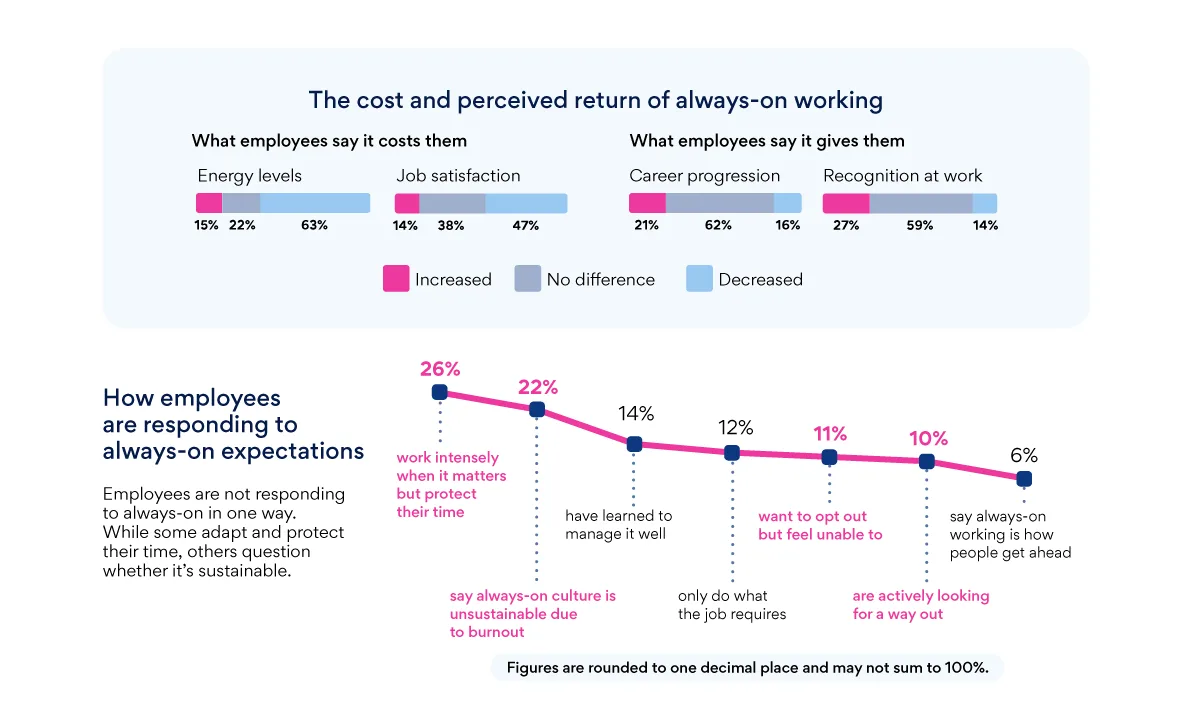
The effect on quality of work is mixed. 30% report an improvement, 52% see no difference and 18% report a decline. Only 6% believe always-on working is how people get ahead, which is a strikingly small number for a habit so many people keep up.
You’re trading energy you can feel for a career boost most respondents say never arrived.
People are already adjusting. The most common response, from 26%, is to work intensely when it matters and protect their time otherwise, which is the sensible middle path. Others are finding it much harder: 22% call always-on culture unsustainable because of burnout, 11% want to opt out but feel unable to, and 10% are actively looking for a way out.
Separately, 36% of all employees say they’re exploring new career opportunities in response to wider work concerns. The report is clear that this can’t be pinned on always-on working alone. Still, it shows how much is riding on this for any employer who wants to keep its people.
Bosses See the Risk
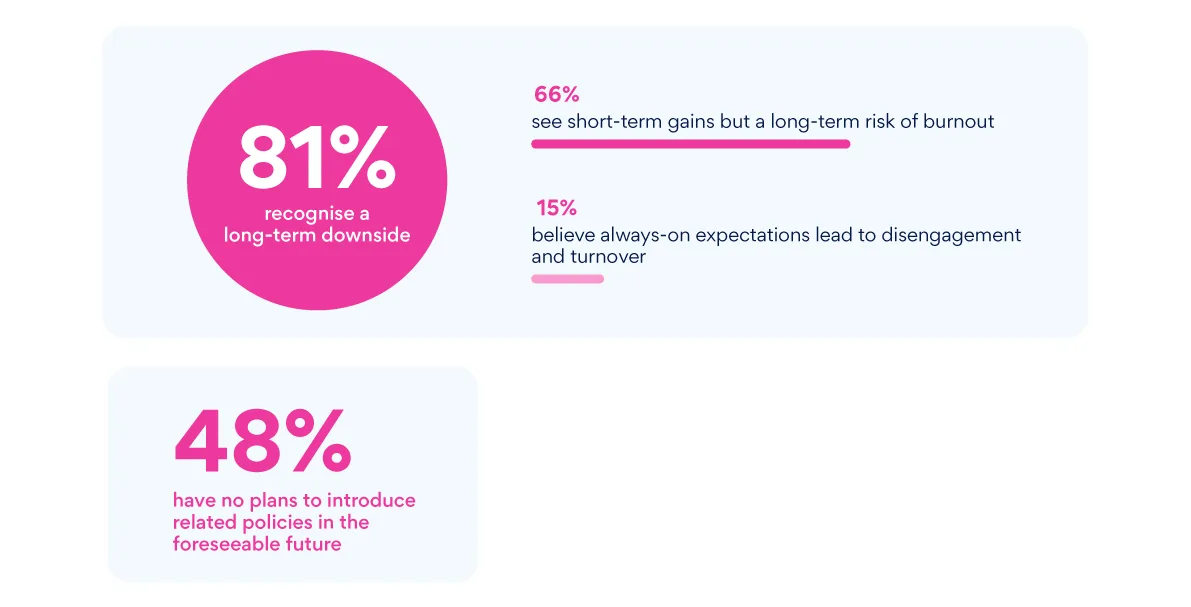
Employers aren’t in denial. Among those whose organisations expect always-on working, 81% recognise a long-term downside. 66% see short-term gains with a longer-term risk of burnout, and 15% believe it leads to disengagement and turnover. Even so, 48% of employers say their organisations have no plans to introduce related policies in the foreseeable future.
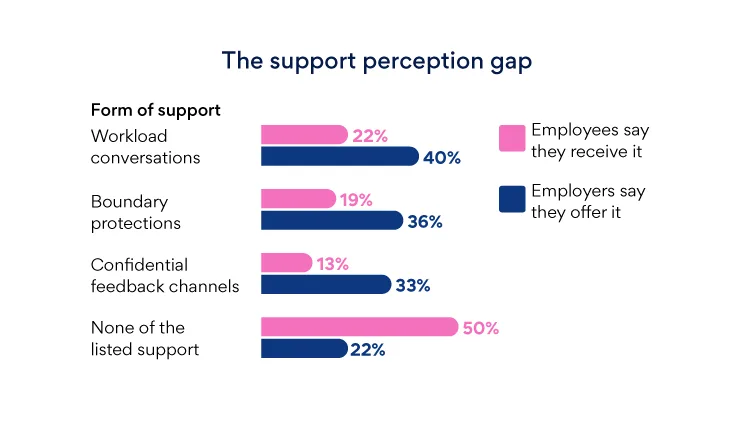
The support gap is the most striking result in the study. Half of employees say they receive none of the forms of support listed in the survey, compared with 22% of employers who say their organisation offers none. Workload conversations (22% of employees versus 40% of employers), boundary protections (19% versus 36%) and confidential feedback channels (13% versus 33%) all follow the same pattern. Support looks much better from the manager’s chair than it does from the desk.
What the Rules Say
Singapore has no legal right to disconnect. Neither the Employment Act nor the flexible work guidelines ban after-hours messages or contact during leave. The Tripartite Advisory on Mental Health and Well-being at Workplaces recommends that employers set reasonable expectations for after-hours communication and not require replies to non-urgent messages until the next working day, but it remains advice rather than an enforceable rule.
Company policies are spreading gradually. In a parliamentary reply in August 2026, the Ministry of Manpower (MOM) said 55% of full-time resident employees reported in 2025 that their employers had after-hours communication policies, up from 48% in 2022. If your company has one, read it before your next late-night ping. It may already say you can wait until morning.
What You Can Do
The report gives employees five pieces of advice, and two matter most if you’re starting out. The first is to agree with your manager on which situations need an after-hours reply. Once that line exists, staying quiet about everything else stops looking like slacking. The second is to ask how initiative, performance and progression will be judged, then aim your effort there instead of at your reply speed.
The other three are practical habits. Use calendar blocks, status messages and clean handovers so colleagues know when to expect you. Take stock of your workload regularly and raise trade-offs with your manager early, before an excessive load becomes normal. Plan leave and breaks before you’re running on empty: 43% of employees cope by taking leave or resting, but 9% say they lack the time or energy to recover.
Then there’s the “just checking in” message that lands on day two of your holiday in Japan. 37% of employees manage work concerns by setting clearer boundaries, yet only 11% speak with their manager. The report supplies two scripts for that conversation:
“I’ve reviewed my current priorities against the outcomes we need to deliver. My proposed focus is [X and Y], with [Z] following after. Can we align on this, including anything that genuinely needs an immediate response?” “I’ll be offline [after 9pm / while I’m on leave], so I’d also like to agree on any cover or handover needed during that time.”
Saying that once, out loud, takes far less out of you than staying on standby every night.
What Bosses Can Do
The bigger changes sit with employers, because they control workload, performance signals, manager behaviour and access to support. The report asks them to define the outcomes that matter and the expected response times. Managers should review team capacity whenever priorities change, and separate genuine emergencies from normal weeks when staff can put work down completely. The report wants managers trained to talk about workload, career progression and wellbeing, and AI and digital training tied to visible career pathways.
Start with the first item. Writing down expected response times costs a manager an afternoon and removes the guesswork behind those 11pm replies. It works only if leaders model the same boundaries themselves, since a “no rush” message sent at midnight still reads as a rush.
Current budgets lean elsewhere. 34% of employers plan to invest in AI and digital skills, 25% in better technology and workplace tools, 23% in flexible work arrangements and 22% in upskilling and reskilling. The areas closest to always-on pressure trail behind: 14% plan wellbeing and mental-health initiatives, 13% workload-management improvements, 12% leadership and manager development, and 12% additional hiring to ease workload pressure.
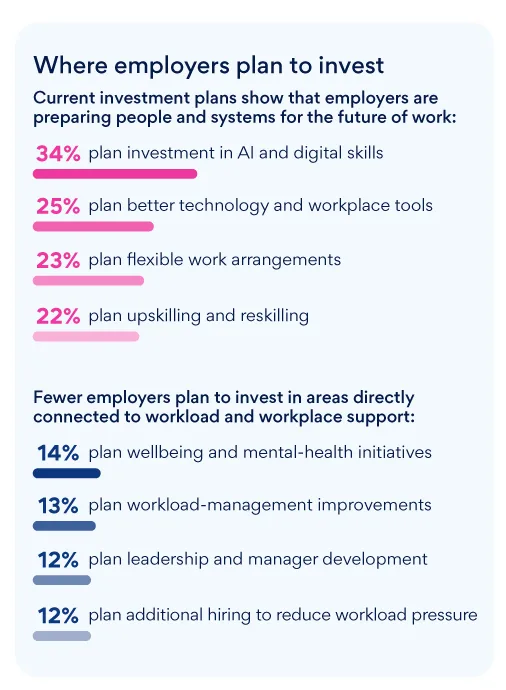
That ordering shows where the gap is likely to stay unless priorities change. A shiny new tool won’t help much if the manager using it still expects an answer before bed.
If It’s Already Too Much
If always-on work has worn you down, help exists outside your inbox. mindline at work, from the Ministry of Health’s Office for Healthcare Transformation (MOHT), offers tools and resources to help you cope with stress at work. Some employers run Employee Assistance Programmes (EAPs) with confidential counselling, so ask HR whether your company is enrolled.
For urgent distress, National Mindline is at 1771, or on WhatsApp at +65 6669 1771, and Samaritans of Singapore is at 1767. In an emergency, call 995 or 999.
Three Shifts Forward
Both sides see this as a shared problem, with 55% of employees and 45% of employers saying each side contributes equally to always-on working. The report proposes three shifts: from availability to outcomes, from flexibility to sustainable work design, and from support on paper to support in practice. The employer side carries more weight in all three, but the second script above is something you can use this week.
Jobstreet by SEEK sums up the goal as a workplace where employees “know what to switch on for, when they can switch off, and how good performance will be recognised.” Read the full Jobstreet by SEEK Singapore Workplace Culture Study 2026 for the complete age breakdowns and employer data. Then send it to your manager with a meeting invite attached, ideally one that ends by 6pm!
Photos and Visuals courtesy of Jobstreet by SEEK.
Read us first on Google: add DANAMIC as a preferred source and our stories show up more in your Top Stories and AI results.