Somewhere between the lobby you rage-quit last night and the leaderboard you never cracked sits an industry worth billions of dollars a year. Activision’s anti-cheat unit, Team RICOCHET, spent September laying it out in public, and the numbers are not what most players assume.
The team published its “cheating ecosystem” report on the official Call of Duty site on 18 September 2026, you can read the whole thing on the RICOCHET Anti-Cheat blog, and the tone was less patch note than case file. Cheating, by Activision’s account, stopped being a bedroom hobby a long time ago. It’s a supply chain, with developers at the top, resellers in the middle, and a subscription bill landing in somebody’s inbox every month.
If you play Call of Duty on PC in Singapore, this is the market sitting on the other side of your matchmaking queue, and the prices below are the ones a Singapore player would actually be paying.
The cheat economy, at a glance
| What a high-tier cheat costs | Upwards of US$100 (about S$135) a month, before the recurring spoofer fee |
| What a committed cheater burns a year | More than US$1,000 (about S$1,350), a PS5 and change |
| Cheat subscriptions, 15 games | Roughly US$3.5 billion (about S$4.5 billion) a year, citing threat intelligence firm Intorqa |
| The whole cheating economy | Around US$8.5 billion annually, Activision’s own estimate |
| Enforcement so far | 375+ reseller operations disrupted, 80+ cease and desist demands, 31 primary vendors shut down |
| Where to read it | RICOCHET Anti-Cheat blog, published 18 September 2026 |
| Next date on the calendar | Modern Warfare 4 on Nintendo Switch 2, 23 October 2026 |
US$8.5 Billion, 15 Games
Here’s the figure that should stop you scrolling. Citing Intorqa, Team RICOCHET says cheat subscriptions across just 15 games pull in roughly US$3.5 billion (about S$4.5 billion) a year. Widen the lens to include illicit account sales, boosting services, and hardware spoofing, and Activision puts the whole cheating economy at around US$8.5 billion annually.
To put that in perspective, that’s a shadow industry running on the back of games people play for fun, funded entirely by players who want to skip the part where they get good. These are Activision’s own figures, drawn from Intorqa’s February study rather than an independently audited market report, and press coverage has treated them as the company’s claims about the industry it polices.
The pricing is where it gets properly absurd. High-tier cheat packages run upwards of US$100 (about S$135) a month, and that’s before the recurring fee for a spoofer, the tool that disguises your hardware so a hardware ban doesn’t stick. Activision and multiple outlets report that a committed cheater can burn through more than US$1,000 (about S$1,350) a year. That’s a PS5 and change, spent annually, on not playing the game properly.
The Part Where It Costs You
The data angle is the one that should worry anyone who has ever been tempted. Cheat sellers operate in a grey market with no regulator, no refund policy, and no obligation to anyone. Activision’s report notes that buyers routinely hand over account credentials and payment information to these operations, which is a spectacular amount of trust to place in a business whose entire model is breaking someone else’s terms of service.
Think about who you’re giving your card details to. A vendor selling software designed to evade detection is not the sort of outfit that runs a tidy privacy policy, and the same storefronts have every incentive to hold on to whatever they collect.
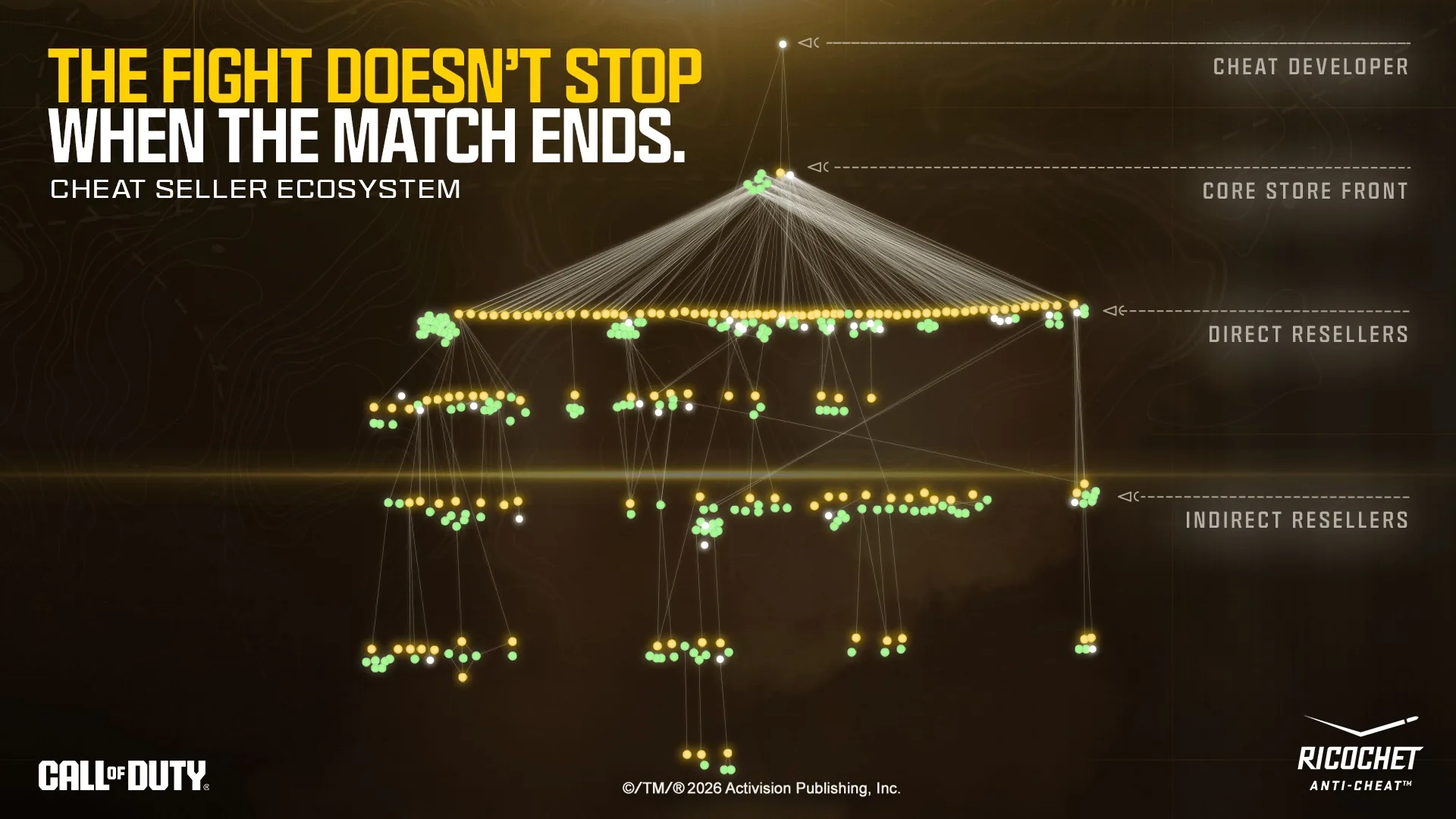
That diagram explains a detail most players miss entirely. Many of the “different” Call of Duty cheats sold under different logos are the same underlying product, reskinned and rebranded, sold through layers of resellers who may not even know what they’re distributing. Buy from three vendors and you might be funding one developer three times over.
375 Resellers, 31 Vendors Shut Down
The enforcement numbers are the meat of it. As of the September blog, Team RICOCHET says it has disrupted more than 375 cheat reseller operations, issued more than 80 cease and desist demands, and helped shut down 31 primary cheat vendors. Those figures have been repeated across Eurogamer, IGN, and other outlets, all attributing them to Activision’s report. Late August social posts from the team used the vaguer “more than 30 vendors”; the September blog locks it at 31.
What changed is the target. RICOCHET arrived as a kernel-level PC anti-cheat back in 2021, and its job then was catching cheaters mid-match. The 2026 version goes after the businesses instead, with lawyers, investigators, and infrastructure takedowns. Ban a player and you remove one account. Shut a vendor and you remove a storefront.
How the Bans Actually Work
Technically, RICOCHET runs a layered stack: memory signature scanning, behavioural analysis, machine learning models, and TPM 2.0 enforcement, which ties detections to a physical device rather than an account you can simply rebuy. The Trusted Platform Module is the security chip in your PC, and using it means a ban can follow the hardware home.
Enforcement escalates rather than swinging immediately, and the ladder runs in this order:
1. Shadow ban, suspicious accounts are quarantined into restricted lobbies with other suspects while the system gathers more evidence
2. Ranked restrictions
3. Temporary suspensions
4. Permanent bans
5. Hardware bans, the machine itself is locked out
Activision’s pitch to cheaters is financial. Every ban wipes out the subscription money already spent, which makes cheating, in its framing, a losing investment. It’s a smart line, though the community response has not been uniformly warm. The honest concern raised by players is not sympathy for cheat sellers, it’s due process: how detections work, what safeguards exist, and what happens when a system this powerful gets someone wrong.
What It Means for Your Lobby
The practical takeaway for PC players here is simple. The cheating you run into is not a handful of bored teenagers, it’s the retail end of an organised business, and the pressure Activision is applying lands on the supply rather than the symptom. Cheats get pricier, downtime gets longer, and the whole thing gets less worth the money.
This series has been part of the furniture here for years, from the days we reviewed Call of Duty: Black Ops 4 through to the modern re-imagining of Modern Warfare, and matchmaking integrity has never had this much money thrown at it. The timing is no accident either, with Modern Warfare 4 landing on Nintendo Switch 2 on 23 October 2026 and the franchise keen to show its lobbies are worth joining.
The full breakdown, including the ecosystem diagram and the reseller structure, is worth reading straight from the source on the RICOCHET Anti-Cheat blog. Keep an eye on the team’s updates, because the enforcement counts move fast and the next tally will tell you whether US$8.5 billion is starting to shrink!
Frequently asked questions
What is Call of Duty doing about cheaters?
As of its September 2026 report, Activision’s anti-cheat unit, Team RICOCHET, says it has disrupted more than 375 cheat reseller operations, issued more than 80 cease and desist demands and helped shut down 31 primary cheat vendors. The focus has moved from catching individual players mid-match to going after the businesses that sell cheats, using lawyers, investigators and infrastructure takedowns.
How do Call of Duty bans work?
RICOCHET combines memory signature scanning, behavioural analysis, machine learning models and TPM 2.0 enforcement. TPM 2.0 ties a detection to your physical PC, so the ban can’t be dodged by buying a new account. Penalties escalate in steps: a shadow ban into restricted lobbies, then ranked restrictions, temporary suspensions, permanent bans and finally a hardware ban.
How much does a Call of Duty cheat cost?
High-tier cheat packages cost upwards of US$100 (about S$135) a month. That’s before the recurring fee for a spoofer, a tool that disguises your hardware so a hardware ban doesn’t stick. Activision and several outlets report that a committed cheater can spend more than US$1,000 (about S$1,350) a year.
How big is the cheat industry?
Citing threat intelligence firm Intorqa, Team RICOCHET says cheat subscriptions across just 15 games bring in roughly US$3.5 billion a year. Counting illicit account sales, boosting services and hardware spoofing as well, Activision puts the whole cheating economy at around US$8.5 billion a year. These are Activision’s own figures, drawn from Intorqa’s February study, not an independently audited market report.
What is Activision’s Team RICOCHET?
Team RICOCHET is Activision’s anti-cheat unit for Call of Duty. It launched as a kernel-level PC anti-cheat in 2021 to catch cheaters during matches. In 2026 it also goes after cheat vendors and resellers directly. Its ‘cheating ecosystem’ report was published on the RICOCHET Anti-Cheat blog on 18 September 2026.
Visuals courtesy of Call of Duty.
Read us first on Google: add DANAMIC as a preferred source and our stories show up more in your Top Stories and AI results.