The raid boss casts something nasty, your interrupt is bound to Ctrl-Shift-4, and your left hand does a small origami fold across the keyboard that ends with the wrong spell going off. Razer has spent seventeen years building hardware for exactly that moment, and its latest answer is a keypad with 31 programmable controls sitting where your left hand already is.
The Razer Tartarus V2 Pro was announced on 17 September 2026, and it’s on sale now at US$199.99, roughly S$270, on Razer.com, in RazerStores, and through selected retailers worldwide. That’s the headline number for the Tartarus line’s most expensive model yet, and the rest of the spec sheet explains where the money went.
The Short Version
- How much: US$199.99, or about S$270. Europe gets it at €219.99.
- Where to buy: the Razer Singapore product page, RazerStores, and selected retailers worldwide. That page also carries the full spec sheet and local availability.
- When: announced 17 September 2026, on sale now.
- What you get: 31 programmable controls, Razer Analog Optical Switch Gen-2, a full-sized anti-drift TMR thumbstick with three dedicated buttons, up to 8000 Hz HyperPolling, and a wrist rest that slides and rotates.
- What you’ll need: Razer Synapse to set polling rate and push 24 keymaps across three onboard profiles. Actuation and Rapid Trigger can be retuned on the fly from the onboard LED array with no software open.
- Check before you pay: it’s a left-hand keypad, full stop, no right-hand or ambidextrous version has been announced. If you compete, check whether your game allows Snap Tap style automation.
- Cheaper in the same family: the membrane Tartarus V2 at US$79.99 and the analog Tartarus Pro at US$129.99.
What 31 Buttons Actually Buys You
That one hand controls a full ability bar, macro set, or genre-specific loadout, so your right hand never stops aiming. It works because a keypad is half a keyboard shaped for one hand: every key sits within reach without your fingers leaving home position.
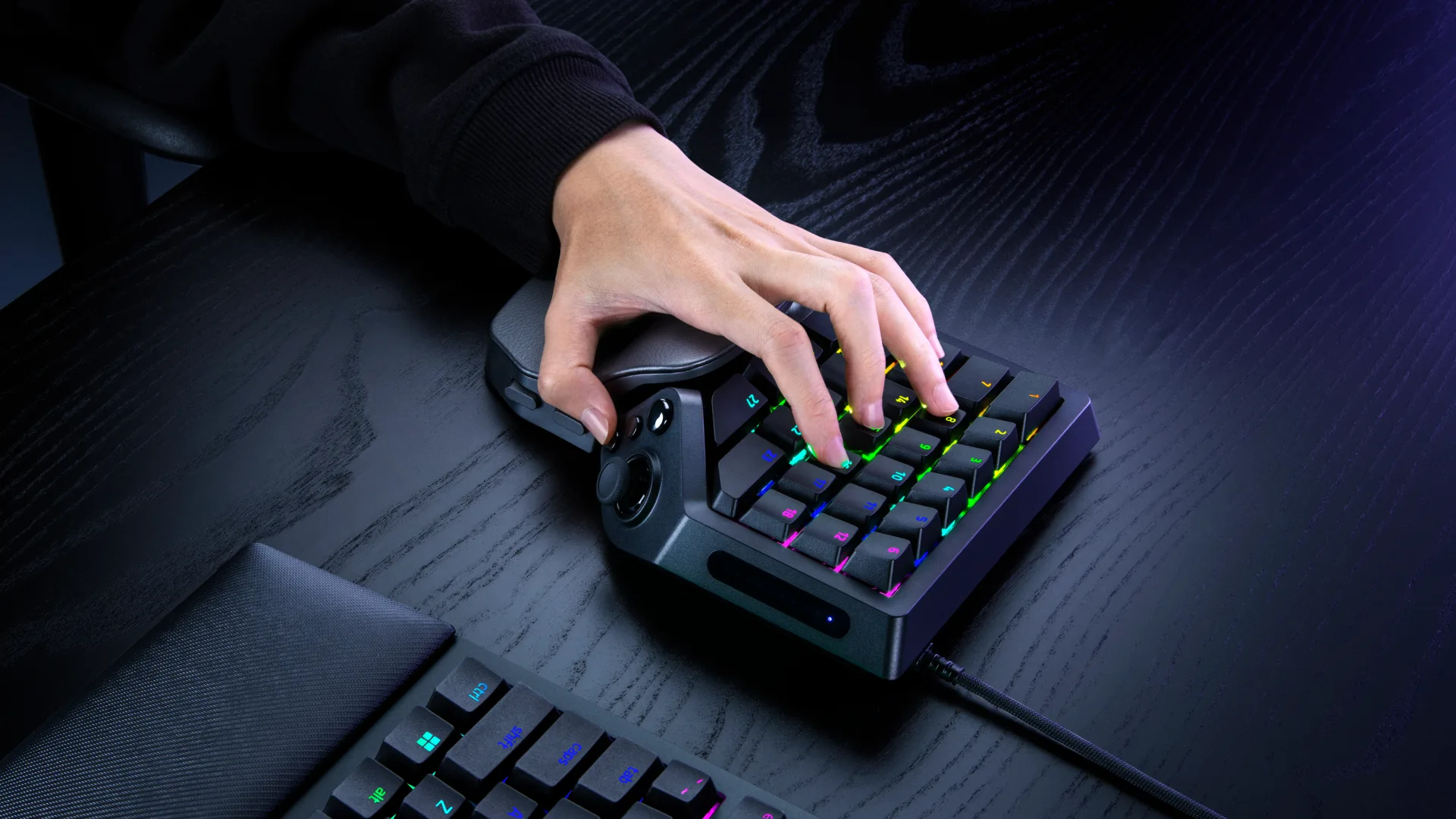
The Tartarus V2 Pro runs on the Razer Analog Optical Switch Gen-2, Razer’s flagship switch tech making its first appearance in a keypad. Analog means the switch reads how far you’ve pressed a key rather than just on or off, which is how a keyboard key can behave like a controller trigger. Actuation is adjustable across 0.1mm to 4.0mm, and Rapid Trigger resets sensitivity down to 0.1mm for machine-gun repeated inputs.
Every switch is individually lubricated and seated in a dense foam layer, rated for a 100 million keystroke lifespan. Textured doubleshot PBT keycaps finish the build, which is the kind of plastic that doesn’t go shiny after a year of the same three keys taking a beating.
The Thumbstick Is the Real Upgrade
Anchoring the whole thing is a full-sized anti-drift TMR thumbstick pulled from Razer’s controllers, backed by three dedicated buttons. Stick drift is the slow death of every analog stick you’ve ever owned, the one where your character starts walking left in an empty menu. TMR sensors read magnetic fields rather than grinding a physical contact down over time, and Razer’s claim here is zero stick drift.
That matters more for a keypad than it sounds. Radial menus in MMOs, smooth analog movement in a game that expects a controller, precise camera nudges: all of it lands on the thumb instead of being faked with four WASD keys.
8000 Hz, and the Honest Version of It
Here’s the number everyone will argue about in the replies. The Tartarus V2 Pro carries up to 8000 Hz HyperPolling, which Razer describes as eight times faster than the industry standard, and which it says is the first time true 8000 Hz has arrived in a dedicated keypad. Polling rate is how often the device reports its state to your PC. At 1000 Hz, that’s once a millisecond. At 8000 Hz, eight times in that same millisecond.
Whether you can feel the difference is the fun question. Independent testing on high-polling-rate mice has consistently found that 8000 Hz costs meaningful CPU time and raises interrupt load, with returns that flatten out somewhere past 1000 to 2000 Hz in actual aim metrics. Those measurements are for mice, not this keypad, so treat them as the shape of the debate rather than a verdict. The polling rate is set in Razer Synapse, and you’ll want to know your own frame rate is comfortable before you go chasing microseconds.
One thing worth knowing before you buy: the Advanced Input Control suite includes Razer Snap Tap and Razer Snap Flex. Snap Tap style hardware automation sits in a grey zone competitively. Valve’s August 2024 update banned hardware SOCD and Snap Tap style automation on official Counter-Strike 2 servers while leaving rapid trigger legal, and ESL and BLAST have followed that line for LAN events. Riot’s 2025 VALORANT Champions Tour ruleset goes the other way, permitting Snap Tap and SOCD keyboard technologies unless officials say otherwise. If you compete, check your game’s rules and switch the feature off before you queue.
Comfort Is the Underrated Feature
The wrist rest is the part reviewers keep circling back to, and it’s the part a press release struggles to make exciting. It slides out and rotates left and right, so instead of forcing your hand into one fixed angle, it moves to wherever your hand already wants to sit. Anyone who has finished a six-hour raid night with a numb wrist understands why that’s worth more than a polling rate.
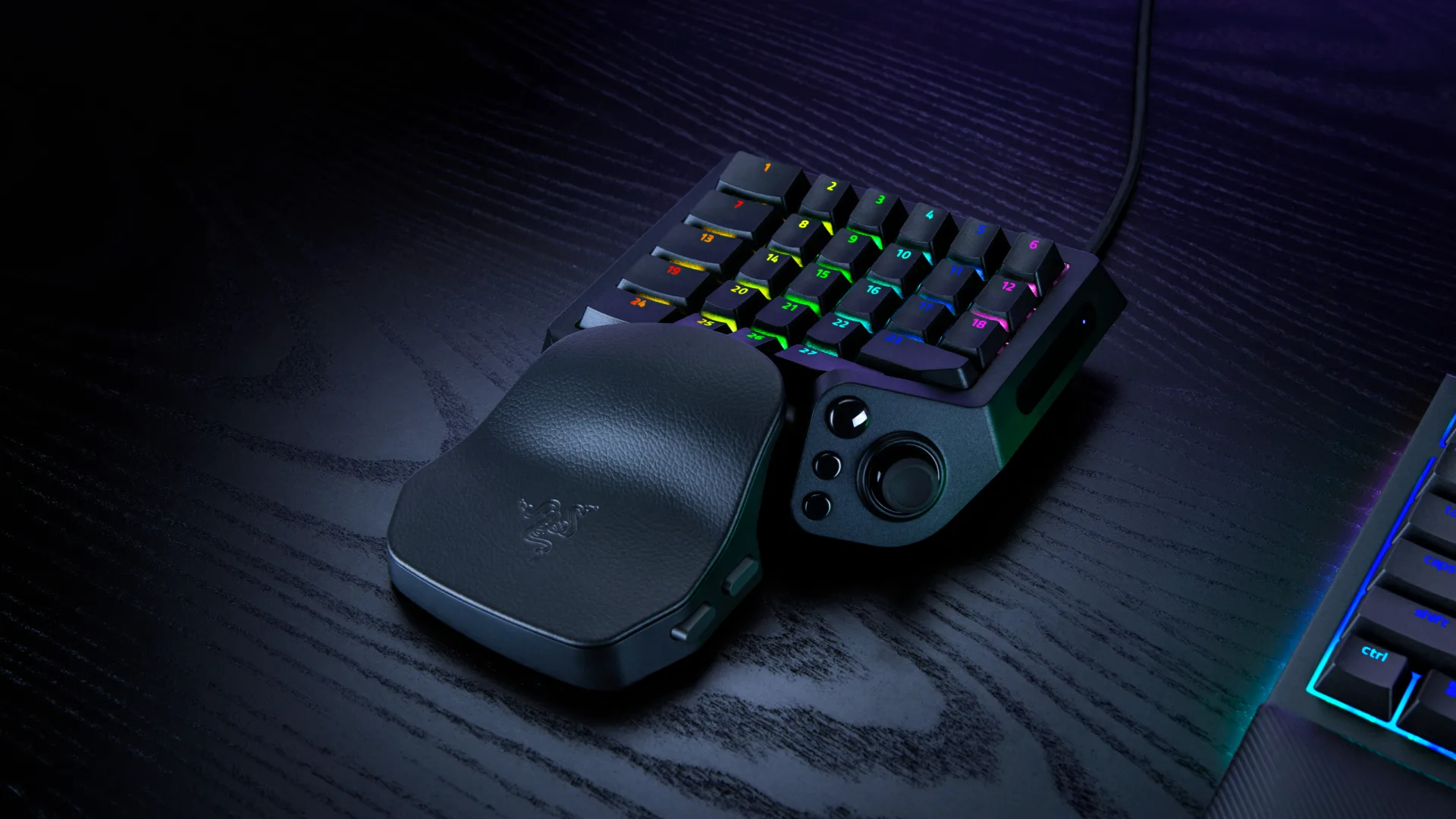
You can push 24 keymaps across three onboard profiles through Synapse, and adjust actuation or Rapid Trigger on the fly using the onboard LED array with no software open. That last bit is genuinely useful. Synapse has a long-standing reputation as the least loved part of owning Razer gear, so being able to retune a key without launching it is a small mercy.
Is It Worth S$270-ish of Your Money?
Context on that US$199.99: Razer has been selling the membrane Tartarus V2 at US$79.99 and the analog Tartarus Pro at US$129.99. So the V2 Pro asks roughly US$120 more than the entry model and about US$70 more than the analog one it succeeds. In Europe it lands at €219.99.
Early reviews have been warm. GamingTrend scored it 95 out of 100, calling it “one of the most comfortable, responsive, customizable gaming tools on the market” while noting the price stings a little. CGMagazine gave it 9 out of 10. GamingShogun rated it 4 out of 5, praising the switches and the drift-free thumbstick but flagging the cost and a genuinely complex setup.
Here’s the honest read. If you play MMOs seriously, or a game where your left hand is running an ability rotation while your right hand aims, this is the most capable version of that tool anyone currently sells and the thumbstick alone justifies looking at it. If you play FPS and your left hand mostly handles WASD plus four binds, the 8000 Hz line is doing more marketing work than competitive work, and the Tartarus Pro at US$129.99 covers the same ground for less. One caveat before you add to cart: this is a left-hand keypad, full stop. No right-hand or ambidextrous version has been announced, so left-handed mousers are out of luck.
“The Tartarus V2 Pro is unapologetically maximalist,” said Barrie Ooi, Head of PC Gaming Division at Razer, who has been the quoted product lead on Razer’s recent keyboard launches including the Huntsman Signature Edition and the Huntsman V3 Pro 8KHz. Maximalist is the right word! This is a company that also just put rear surround sound into a S$149 soundbar, and the throughline is the same: more inputs, more channels, more dials, and a bet that someone out there wants all of them.
Whether 31 buttons makes you better at the game is a question only your raid log can answer. What’s clear is that the ceiling for a left-hand keypad just moved, and it moved in the direction of people who genuinely enjoy tuning a key’s actuation point to the tenth of a millimetre. Go look at the Razer Tartarus V2 Pro product page for the full spec sheet and local availability, and keep an eye on Razer Insider if you want to catch the next Tartarus before it lands.
Visuals courtesy of Razer.
Read us first on Google: add DANAMIC as a preferred source and our stories show up more in your Top Stories and AI results.






One Comment