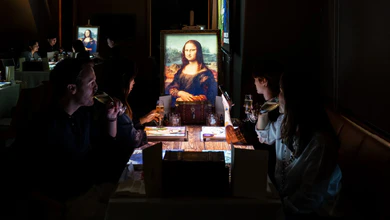
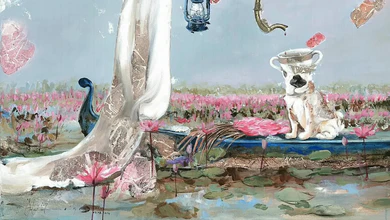
Ahh, Impressionism, the art movement with those timeless works of Monet, Renoir, Degas, and more. There’s no better collection of paintings that’s as Instagrammable as this one, but beyond the beauty of it all, is there anything else we can discuss about them, and more importantly, is there a way to make Impressionism seem new?
That must’ve been what the National Gallery Singapore (NGS) were asking themselves as well, because from 14 November 2025 till 1 March 2026, it’s hosting Into the Modern: Impressionism from the Museum of Fine Arts, Boston — a reframing of over 100 artworks by 25 of the movement’s most influential artists that grapples with not only what’s on their canvases, but also how that reflected the turbulent times they lived through.
Preface

Take, for instance, Claude Monet’s Meadow at Giverny, which opens the exhibition as one of 17 works by him that the Museum of Fine Arts (MFA) Boston has loaned to the gallery.
Despite its lack of obvious focal point or subject matter, as NGS Senior Curator Dr Phoebe Scott points out, the field itself is a riotous, well, field of colours and patterns that Impressionists like him would eventually be renowned for, therefore providing a focused view of the dynamism that, as you’ll see, the modern continuously delivers.
Seeking the Open Air
Before that, however, we must first understand how Monet and his contemporaries reached this point, and wouldn’t you know it, part of that answer lies within the exhibit’s first section and its premoderness.
Precursors to the Impressionists and skilled painters in their own right, the Barbizon school was known for Seeking the Open Air around the edges of the Forest of Fontainebleau, where they painted landscapes like those seen in Edge of the Woods (Plain of Barbizon near Fontainebleau) by Théodore Rousseau.

Once again, there are no classic characters here to elevate this otherwise busy and even banal scene, though that doesn’t mean there aren’t any at all. Hard-to-discern figures of two women nonetheless exist between the lush bushes of this piece, and upon closer inspection of their attire and loads, one might even recognise them as (excuse my French) faggot gatherers, revealing, as Prof. Griselda Pollock claimed in a lecture concerning the exhibit, a glimpse of poverty amongst a wealth of nature.
Compare this now to another one of Monet’s works, The Woodgathers at the Edge of the Forest, whose subjects are front but not quite centre against a much emptier yet still elegant backdrop. His painting doesn’t shy away as much as Rousseau’s from depicting the harsh realities of labour, but at the same time, the vibrant surroundings of nature continue to distract us from this truth, perhaps even more so with Monet’s rejection of tones.

As such, juxtapositions like these in Seeking the Open Air go beyond linking the Barbizon School to the Impressionists through their loose strokes and practice of painting outdoors — they also showcase a desire to capture the fleeting forests, and within it, the destitution that is often overlooked, quite literally for the trees.
Plein Air Impressionism
The next section, aptly titled Plein Air Impressionism, tracks the group as they build upon the Barbizon School’s methods while establishing their artistic identities by submitting to the Salon. This famously does not go well since the Salon’s juries disliked their style and frequently rejected or poorly placed their paintings, but guess what? In 1874, the Impressionists went ahead to hold their first joint exhibition, thus launching their movement and eventual rise to fame.

But as for what the big fuss about them was? Referencing Edgar Degas’s At the Races in the Countryside as one of the pieces featured at this exhibit, the Impressionists—for one— had an unusual sense of composition. For example, in spite of it looking like a natural snapshot to most today, according to MFA Boston Assistant Curator of Paintings Julia Welch, the cropping of the carriage’s wheels was a strange choice to the Parisian art scene at the time.
Moreover, the entire painting contradicts what its title might suggest, since the races (then a novel concept) are happening far in the background as a breastfeeding scene takes up our attention, which is the point.
Everyone, from the carriage driver to his presumed wife and even their dog, is staring at the poor wet nurse as well, and though it might not be as tense as horse racing, it’s certainly more relatable of a moment to countless mothers even now.

Similarly, the composition of Pierre-Auguste Renoir’s Woman with a Parasol and Small Child on a Sunlit Hillside is also something one might still find trending on Instagram now, but where Degas maintains a more realist and precise style with his painting, Renoir comes and paints with the fluid palette and brushwork that he soon became renowned for, turning what is otherwise a straightforward scene that could’ve comprised only of plain greens and whites into a flowing one full of emeralds, silvers, and even tufts of amethyst purple.
ARTelier 1
This stark difference between the pieces of Degas and Renoir is just one example of how reductive it is to group them and their peers, especially during this period, by a singular defining style. And hence, when the curators were thinking about how to link these Western artists back to those of Southeast Asia (this is the NGS, after all), it was ultimately a priority to concentrate on the Impressionists’ practices over their technique while doing so.

Specifically, this priority manifested into the forms of the ARTeliers — three learning spaces demarcated in dark blue that invite visitors to explore Impressionism and its legacies in our region.
The first, positioned right after Plein Air Impressionism, presents an animation about how the practice of painting outdoors travelled to Vietnam during the French colonial period, where it took on a life of its own after the First Indochina War began, and art turned into a weapon for the state.
ARTelier 2
The second ARTelier, meanwhile, reveals how gallery poster girl Georgette Chen painted en plein air through two displays of reproduced paintings, archival photographs, and a multitude of art materials. Here, it’s interesting to note that a collection of paint tubes is showcased, since they were relatively recent inventions during the Impressionist movement, which made the practice of painting outdoors so much more convenient, thereby showing how modernity enabled its proponents to flourish.

Though, with these artefacts, you’ll also be able to practice plein air and capture the beauty of Singapore as Georgette once did through an assortment of colour pencils and a gorgeous view of the Esplanade, Marina Bay Sands, and more. There are even places for you to hang up your masterpieces to replicate how the Impressionists exhibited their own, so don’t be afraid to channel your inner Monet, Degas, or Renoir.
Labour and Leisure on the Water
Then, once you’re done with that, it’s time to dive into Labour and Leisure on the Water, where the focus is on the rivers and seas and how important they were to the Impressionists when the modern idea of a holiday and other industrial improvements were developing in the 19th century. Inside, this section is introduced by a wealth of Fashionable Figures on the Beach by a certain Eugène Louis Boudin, who is otherwise referred to as both a master of marine painting and king of the skies.

Impressive titles indeed, and fortunately, he does them justice through this mesmerising piece by detailing not only the difference in atmosphere above and below the horizon, but also the fashionable crowds that they drew.
Unfortunately, much like how one might crop out tourists in their selfies, Impressionists like Boudin soon grew tired of the ever-encroaching bourgeois and eventually started painting only seascapes with little emphasis on the human subjects — numerous instances of which can be found in this section too.
Not everyone in the group chose to do this, however, and in fact, some, like Alfred Sisily, even continued capturing said industrial improvements (albeit discreetly) in pieces like The Loing at Saint-Mammès. At first glance, there seems to be nothing out of the ordinary here, save for his extraordinary technique in the clouds of the sky and in the ripples of the river.

But upon closer inspection with the right context in mind, one might begin to notice that Sisily has skillfully nestled in the modern with the rural through elements like the river that is really a canal, or the arched bridge that is actually part of the Paris-Lyon rail line. So, it sort of harkens back to us in Singapore, where our land is constantly made and unmade, thus providing a nice comparative link across continents.
Shared Ambitions
Speaking of links, the fourth section, Shared Ambitions, investigates the collective ideal that the Impressionists shared as independent artists who helped each other find their voice without the help of the Salon, regardless of whatever stylistic or technical differences they may have had. Hence, it’s why this part of Into the Modern mainly centres itself on Camille Pissaro, as he was the only one to have participated in all eight Impressionist exhibitions, alongside the fact that he was close to many in the group.

These two tidbits of information probably aren’t coincidences, by the way — one of the beliefs that fuelled both Pissarro’s prolific output and reputation was his rejection of the typical student-teacher relationship, that is to say, he allowed himself to be mentored by younger artists. This was likely influenced by his upbringing on the slave-dependent island of St. Thomas, which, as such, could’ve motivated him to frequently feature labourers inside his pieces as well, such as in Morning Sunlight on the Snow, Éragny-sur-Epte.
Though, this compassion towards the plight of workers could also be attributed to the poor situation Pissarro faced as a struggling artist who had to father eight children. It’s no wonder then that he was rather influenced by the currents of leftist thought that were rising in the modern period, and in drawing light to these views, this section also showcases some of his more explicit and socially-charged pieces.

Finally, Pissarro’s trust in non-hierarchical learning, sympathy for rural life, and overall oeuvre weren’t just limited to paint only, since in association with a number of Impressionists, he experimented with print quite a lot too. In particular, the artist’s perspective on his Woman Emptying a Wheelbarrow series embodies all three aspects effectively, since he saw none of them as more finished than the others based upon their detail, but rather as all equal iterations that each captured a unique season.
ARTelier 3
Thus, when viewed like that, the parallels between painting and print become ever more clear as mediums that can show the subject at different moments through its tonalities, evoking the idea we are now very familiar with in the postmodern that printmaking is a medium that could reproduce more than objective images.

This then brings us to the third ARTelier and its subject, Lim Yew Kuan, who is renowned as one of the most prominent local printmakers of his time. Just like Pissarro, Lim also had an empathetic gaze on the lives of working people in addition to an innovative approach to the medium that intertwined to show a deep humility and humanity in his prints, which is why they’re juxtaposed with the tools used to craft them.
Modern Encounters
With so much focus on the rural landscapes of France, Modern Encounters brings us back into its capital just in time to witness its rebirth. As swathes of streets and squares across the city underwent mass transformations that made them more open, the communities that occupied them were then presented with fresh possibilities of using this extra space.
This, therefore, brought about an enlivened social scene with the new Paris, and consequently, for paintings like Pierre-Auguste Renoir’s Dance at Bougival to encapsulate it all.

Immediately, the painting is arresting — it’s probably the first thing your eyes draw to while heading out of the gallery’s narrow corridor and into its expanse, itself an impression of what it was like during the city’s renovation. Yet, despite its romantic and innocent subjects, even more vices remain hidden in plain sight, from the litter on the floor and the beers in the back, to even the lady’s improper posture and the dizzying, dappled sky.
In contrast, while Eduard Manet’s The Street Singer (positioned directly opposite Renoir’s painting) shifts the spotlight from the audiences of these social events to one of its artists, the same eagerness to capture the city is evoked through the ambiguous composition of the subject, especially since it isn’t the real deal he was inspired by but instead Manet’s favourite model, Victorine Mereunt, who agreed to pose after the former denied.

On that note, it’s also important to point out that Meurent was also a painter in her own right, and though this section only has one recently discovered self-portrait to back this up, the gallery hoped that its position in-between two other Manet works featuring her, including a print of the then-outrageous Olympia, could nonetheless reinforce how influential of a figure she was to him and the greater Impressionist movement.
Reimagining the Commonplace
But the representation doesn’t stop there, because in Reimagining the Commonplace, one of the section’s highlights is a still life of White Flowers in a Bowl by Berthe Morisot, the only work by her in the MFA Boston’s collection. Here, she demonstrates how skilled the Impressionists were outside (pun intended) of plein air painting by experimenting with loose brushstrokes that match the lively blossoms of her work, giving a real sense of freedom that matches her carefree attitude to painting as a career due to her well-off background.

Nonetheless, despite critics lambasting her avant-garde approach and misinterpreting it as an attribute of her gender rather than a deliberate technique, she became and remained a key part of the group and its activities anyway, participating in all but one of the eight exhibits the Impressionists held.
In a way, she thus somewhat proves to be a nice complement to Henri Fantin-Latour, as he was never an official member of the Impressionists, but was active in the same scenes as the group too. Specifically, he exhibited with close friends like Manet, Renoir, and Monet with his renowned still-lifes of flowers, and while much of that is featured here, his Flowers and Fruits on the Table painting shows he was no stranger to their products either.

In fact, while the composition of this painting may seem quite casual, Latour actually claimed that he “put a great deal of thought into the arrangement” with “the idea of making it look like a natural arrangement of random objects” so that the final result can ironically give a “total lack of artistry” — an aspiration that feels too modern in our era of nonchalance.
Monet — Moment and Memory
At last, in Monet — Moment and Memory, the last section of Into the Modern dedicates its entirety to the leading figure of Impressionism, its founder, even, Oscar-Claude Monet. The artist needs no introduction, but in case you were wondering, nine out of the 35 paintings the MFA Boston currently owns by him in total are shown right in this section.

This includes Meadow with Haystacks near Giverny, which, if you can remember, is really the same field depicted right in the first painting of the exhibit, just from a different direction, showcasing how skilled he was at translating such a nondescript venue such as this into two wholly unique visions, each imbued with their own variations in light, colour, and texture.
Additionally, it also includes one of the approximately 250 paintings in his iconic Water Lilies series, specifically the 1900 variant of The Water Lily Pond, depicting the enormous water garden that he claimed all his money went to. One of a series of this particular view that has been spread all over museums in Paris, London, and New York, this all-encompassing view of the land, water, and a Japanese-style bridge succinctly reflects his legacy of who he was as an Impressionist and what he painted.

Finally, Into the Modern ends on the only known footage of Monet, which, among countless scenes of his beloved water lily pond, shows the set-up which he painted en plein air in and how long he could smoke a cigarette for without the ash falling down. As reasoned by Dr Phoebe Scott, it’s a remarkable film to consider since the age of Impressionism overlapped with the age of the moving image, and so for the sort of sense that this exhibit intends to evoke, it’s the perfect ending statement to take you both out and Into the Modern.
Impressionism from the Museum of Fine Arts, Boston
With that, these are some of the best stories about the Impressionists and their art inside the exhibit — but don’t let that stop you from discovering your own. Plus, there’s just something about Impressionist artworks that makes them look infinitely better in person than through the lenses of a camera, so don’t miss out on this once-in-a-lifetime exhibition by the National Gallery Singapore and the Museum of Fine Arts, Boston.

Into the Modern: Impressionism from the Museum of Fine Arts, Boston
Tickets to Into the Modern: Impressionism from the Museum of Fine Arts, Boston cost S$15 for Singaporeans and PRs and S$25 for foreigners, though local students, NSFs and those with Insider membership can view these beauties for free.
More in-depth and updated information about the Into the Modern exhibit can be found on the National Gallery Singapore’s website, and as a secret between you and me, the galleries are much, much emptier on weekdays, so use that information wisely.
🗓️Date: 14 November 2025 to 1 March 2026
📍Location: Singtel Special Exhibition Galleries 1, 2 & 3, Level 3, City Hall Wing, National Gallery, Singapore 178957
💲Price: S$15 for Singaporeans and PRs
⏰Time: 10 am to 7 pm
Finally, do use the hashtag #IntoTheModernNGS when you post about your experience for a chance at being reposted on the gallery’s Instagram and TikTok. See you there, and let’s hope the exhibition leaves an impression on you!
Photos by Russell Loh of the DANAMIC Team. Additional visuals courtesy of National Gallery Singapore.
Read us first on Google: add DANAMIC as a preferred source and our stories show up more in your Top Stories and AI results.