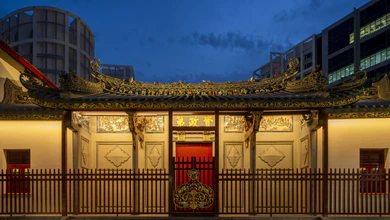
Ladies and gentlemen, welcome back to your favourite highlights series here on DANAMIC. In case you’re wondering why I sound like a certain chess YouTuber, it’s because we’re diving into the Asian Civilisations Museum’s (ACM) first-ever playable exhibition, where — you guessed it — the iconic board game makes an appearance.
That’s not all, though. Since Let’s Play! The Art & Design of Asian Games illuminates visitors over the various games played in Asian from the past all the way to the present, featuring over 150 artworks and artefacts from across the continent (way too much to cover in one article). I’ve picked out ten of the most stunning game sets for you to marvel at instead. So, if you’re ready to make your move, let’s press start and get right into this list!
Tiger and Goats
Our first highlight for Let’s Play! The Art & Design of Asian Games is the aptly named tiger and goats, which originated in Nepal as bagh-chal (“tiger-game”) before spreading to regions like southern India and Indonesia, where it took on different names and boards. Despite these variations, however, the game’s rules have largely stayed the same across Asia, meaning anyone can play so long as they know the basics.

But as to what those basics are? In short, one side controls several tigers while the other herds a larger group of goats, and both take turns moving their animals along a grid of points. This continues until one can no longer move, either because all their tigers have been trapped or all their goats have been gobbled, resulting in victory for the other.
Just don’t be fooled into thinking the sheer number of goats will guarantee a win, since if you’re not careful, that strength in numbers can vanish fast! By the way, don’t miss the other tigers and goats board behind, since it begs the question — is this the first game with custom maps?
Liubo
Now, compared to what we know about Tiger and Goats, the rules of liubo (“six sticks”) are practically a mystery. Historians believe the game involved throwing six double-sided sticks to move another six game pieces on a board. But beyond depictions in art and literature that show all social classes enjoyed it, the exact play of liubo has been lost to time.

That hasn’t stopped experts from speculating about the game, though. One of the most fascinating theories comes from the distinctive design atop its board. Since liubo was largely based on chance, this pattern is thought to be drawn from divination diagrams, thus tying it to fate and the spirit world.
However, while I can’t truly verify whether this game is fun, judging by the laughs on these early 3rd-century figures, it seems to have been a hit in Han dynasty China!
Chaupar
But since we’re talking about popularity, it’s the perfect time to bring up chaupar — a game that captivated the Mughal Empire and one of its greatest rulers, Akbar. This craze across the subcontinent was so huge that it caught the attention of European writers, who eventually caused chaupar to make its way West into serving as the basis of ludo.

And honestly, it’s easy to see why it got so far. For one, its objective is rather straightforward: each player just has to get all four of their pieces into the central square by rolling several dice. Plus, since chaupar boards are usually crafted from fabrics and sometimes even include pockets for pieces and dice, they’re super portable.
Finally, the game set is just gorgeous to look at. Keep your eyes peeled at Let’s Play not only for the vibrant cowrie shells used as pieces, but also for the exquisite set made out of Venetian glass beads!
Snakes and Ladders
Did I mention that chaupar is the ancestor of snakes and ladders, too? In India, the iconic board game known originally as gyau chaupar started as a metaphor for the universe, where players aimed to climb ladders representing virtues while avoiding being swallowed by snakes representing vices, all to reach heaven.

Also, while your typical snakes and ladders set is probably no bigger than a coffee table, this particular board in this exhibit stands out for being almost as big as a rug. Naturally, its pieces — carved as pavilions with people inside — followed suit, weighing so much that players had to move them not with their hands, but rather with sticks tied on their tops.
Though, don’t start thinking this is the last big board game you’ll see! We’re still barely halfway through the list, so unlike the unpredictable nature of snakes and ladders, let’s not get ahead of ourselves.
Weiqi
Instead, let’s move back to East Asia, where the humble game of weiqi awaits us. Often referred to as go in Japan and the wider Western world, this abstract game can trace its roots back to ancient China as one of the four arts every scholar working in the government should’ve mastered.

The core gameplay of weiqi involves placing black or white stones to surround as much empty territory as possible on a typically 19-by-19 grid, all while attempting to capture and not be captured by the other’s pieces. In essence, it sounds simple, but with centuries of strategies built into its play, this traditional game has not only survived but thrived into modern times.
For instance, beyond the various weiqi artefacts of dynasties past, check out the board used for the 1st Ing Cup here as well. The last two games were held right in Singapore, and from our tiny island, Cho Hun-hyun’s win led to a go resurgence in Korea!
Xiangqi
On that note, I can’t talk about Chinese games without mentioning Chinese chess, aka xiangqi. Similar to its Western sibling, this two-player game simulates ancient warfare through different piece types. Of course, there are plenty of differences between the two games’ pieces and how they move, but overall, the xiangqi pieces are usually considered more dynamic than chess.

The xiangqi board also set itself apart from other chess variants with its signature river, which prevents elephants from crossing while allowing soldiers to move sideways once they do. Each side also has two palaces that restrict the kings and advisors, but unlike the river, this addition is also shared with Korean chess.
Personally, I can’t recommend the case showing off two figural xiangqi sets from the 21st and 18th centuries enough. It’s super fascinating to see how our aesthetic tastes have evolved so drastically from realism to abstraction, even though the game has stayed virtually the same!
Congkak
Now, that’s a lot of games from India and China, but fret not: the exhibit also features something closer to home. Enter congkak, a Southeast Asian classic that traces its roots back to the mancala games of the Arab world and East Africa. Historians believe its concept arrived via the trade of the Indian Ocean, and since then, it’s become a staple across countless Asian cultures.

That includes a large portion of the Malay Archipelago, which has given a myriad of names to the board game. Though much like tigers and goats, the rules of congkak have remained rather consistent across the region, with the main goal simply boiling down to scooping more seeds into your store than your opponent by carefully choosing how to drop them.
As such, be sure not to miss all of the different congkak boards from Asia! My fave has to be the bird-shaped ones resembling the guardians that accompanied the Kelantan princes during their circumcision ceremonies — talk about a board that’s cut above the rest!
Carrom
Anyway, if there’s one thing that everyone knows about carrom, it’s the trick shots. The tabletop game requires serious amounts of control, coordination, and calculation to score the perfect hit that’ll knock a disc or two down. But even then, there’s no guarantee that your opponents won’t score a hot streak right after your turn.

Indeed, the fast-paced action of carrom does resemble that of cue sports, and guess what: you wouldn’t be wrong in making that connection! In fact, its very name shares roots with the term “carom” used in billiards, and a photo here at Let’s Play! even proves an Americanised take on the Indian game exists, complete with mini snooker cues.
However, though this adorable variant has fallen out of favour here, the original game certainly hasn’t. Just look at the well-worn boards on display and you’ll see that, in the schools they’re from, carrom was — and perhaps still is — a beloved pastime for generations of students.
Mahjong
It’s heartwarming to see that there are youths today who keep the act of playing physical board games alive. Yet, if there’s one game that’s undoubtedly the bridge between young and old, it has to be mahjong. The game is practically built for gatherings, and contrary to popular belief, you don’t need to understand Chinese to start playing it!

Instead, all you really need to know is that by forming certain sets through drawing, discarding, and claiming, you can win and become public enemy number one at your next Chinese New Year house visit. Sure, there’s also plenty to learn depending on which of the countless variants you’re playing (I’ve heard every family has its own rules) — but when in doubt, just ask!
After all, the true magic of mahjong lies in community, and at this exhibition, you can see the artefacts of families that loved the game, including a collection of tiles, a furniture set, and a printing block used for producing madiao, the predecessor of mahjong.
Chess
Last but not least, our final entry on this list is chess, a game I’m sure almost everyone is well aware of, including the folks behind Let’s Play! From three rows of chess pieces spanning countries and eras, to a multitude of artefacts from the 2024 FIDE World Chess Championship hosted in Singapore, there’s so much for budding grandmasters like you and me to see.

Personally, my chess-related highlight would be the SenseRobot, since the rise of artificial intelligence has been both a bane and boon for countless chess players through its invaluable insight for studying or cheating. Additionally, you can play against the robot across a wide range of difficulties, so no worries if you’re a curious newcomer or a pro looking for a challenge.
At the end of the day, this exhibit is all about the spirit of play — so what are you waiting for? Go get your tickets to Let’s Play! today! Or better yet, come and make the most out of your SG Culture Pass by redeeming this experience for free!
Let’s Play! The Art & Design of Asian Games
🗓️Date: Now – 7 June 2026
📍Location: Asian Civilisations Museum, 1 Empress Pl, Singapore 179555
💲Price: S$12 for Singaporeans and PRs
⏰Time: 10 am – 7 pm (Sundays to Thursdays) and 10 am – 9 pm (Fridays)
And as always, no matter how you’ll be booking your experience, you can always check out the Asian Civilisations Museum’s official website and Instagram for more info about the Let’s Play! exhibit and others. With that said, GLHF (good luck, have fun)!
Photos by Russell Loh of the DANAMIC Team. Additional Visuals Courtesy of Asian Civilisations Museum.
Read us first on Google: add DANAMIC as a preferred source and our stories show up more in your Top Stories and AI results.